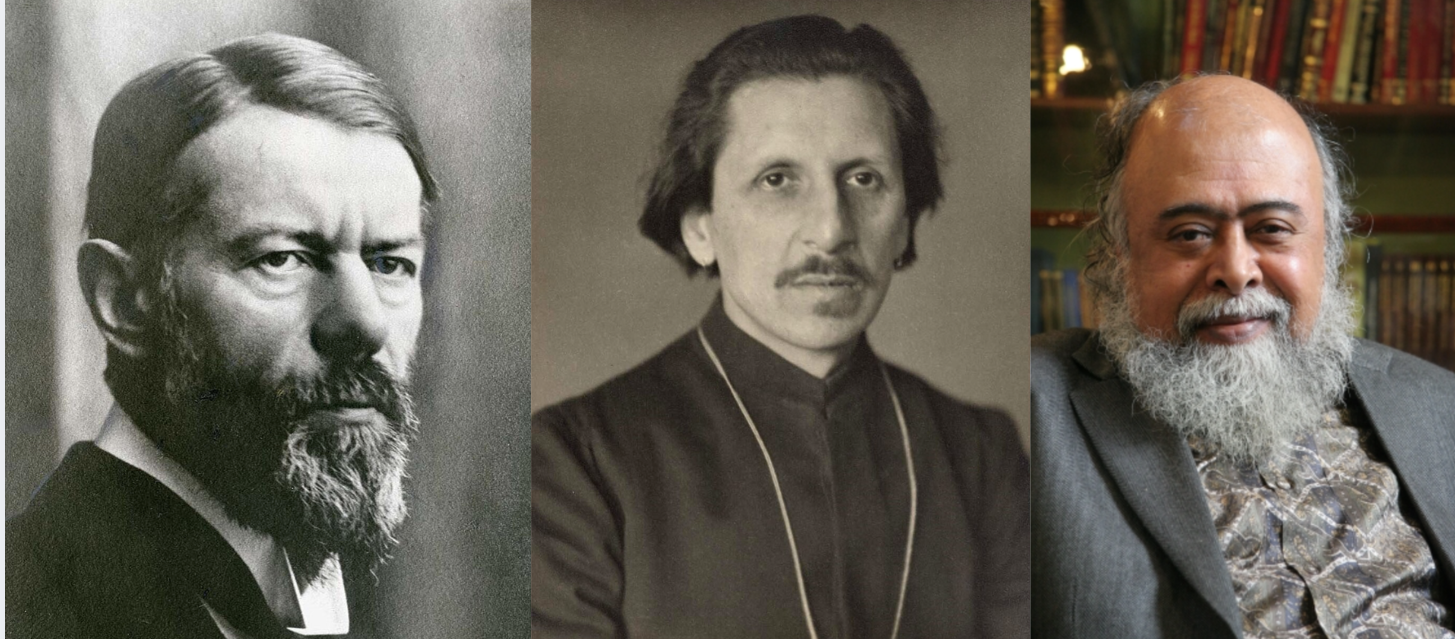
Rethinking the Sociology of Religion: Max Weber, Ananda K. Coomaraswamy, and S. N. Balagangadhara in Civilizational Perspective
The comparison between India and Europe in the sociology of religion cannot be reduced to a simple contrast between two geographical regions or cultural formations. It is, rather, a comparison between two distinct civilizational grammars of life, two ways of organizing knowledge, experience, and social order. The European trajectory, culminating in the works of Max Weber, represents a movement toward differentiation, rationalization, and the eventual separation of religion from other domains of life. The Indian trajectory, articulated in different ways by Ananda K. Coomaraswamy and S. N. Balagangadhara, reflects a persistent integration of the sacred with the social, the economic, and the ecological. To juxtapose these trajectories is not merely to compare different societies but to interrogate the foundations of sociological knowledge itself.
The European understanding of religion, as it emerges in the sociology of Weber, is inseparable from the historical experience of Christianity and the transformations of early modern Europe. In The Protestant Ethic and the Spirit of Capitalism (1904–1905), Weber argues that certain forms of Protestantism, particularly Calvinism, generated an ethic of disciplined labor and rational organization that contributed to the rise of modern capitalism (Weber 1905: 102–105). The concept of “inner-worldly asceticism” captures this transformation: religious devotion is no longer expressed through withdrawal from the world but through systematic engagement with it.
This formulation rests on a series of assumptions that are rarely made explicit. First, it presupposes that religion is a distinct domain, separable from economic and political life. Second, it assumes that religious ideas can be isolated and analyzed as causal factors influencing social behavior. Third, it situates religion within a broader narrative of rationalization, where traditional forms of life are progressively replaced by calculative and instrumental modes of action.
These assumptions are not merely analytical; they reflect a specific historical trajectory. The Reformation, the rise of nation-states, and the development of capitalist economies all contributed to the differentiation of social spheres in Europe. Religion, once integrated into the fabric of everyday life, became increasingly confined to the private domain, its authority challenged by science and secular institutions. Weber’s sociology, in this sense, is both a description and a theorization of this process.
Yet when this framework is applied to the Indian context, it encounters significant difficulties. The assumption that religion is a distinct domain does not hold, for what is described as religion in India permeates all aspects of life. Economic activity, for instance, is not governed solely by rational calculation but is embedded in a network of ritual practices, kinship obligations, and notions of auspiciousness. The pursuit of wealth (Lakshmi) is simultaneously a material and a spiritual endeavor, resisting the separation between sacred and secular that underlies Weber’s analysis.
Similarly, the idea that religious ideas can be isolated as causal factors becomes problematic in a context where practices, narratives, and values are deeply intertwined. The concept of dharma, for example, cannot be reduced to a set of beliefs; it encompasses a normative order that integrates ethics, law, and social responsibility. To analyze such a concept within the Weberian framework is to risk fragmenting it into components that lose their meaning outside the whole.
It is precisely this fragmentation that Ananda K. Coomaraswamy sought to resist. Writing in the early twentieth century, Coomaraswamy argued that traditional societies do not recognize the divisions that structure modern knowledge. Religion, art, and science are not separate domains but aspects of a unified cosmological vision, oriented toward the realization of truth (Coomaraswamy 1943: 18–20). The craftsman, the philosopher, and the priest all participate in this vision, their activities guided by principles that transcend individual interests.
Coomaraswamy’s critique of modernity is not merely nostalgic; it is analytical. He identifies the fragmentation of knowledge as a central feature of modern civilization, one that has led to the loss of meaning and coherence. The separation of religion from other domains is not a natural development but a historical anomaly, reflecting the specific conditions of European history. To universalize this anomaly, as Weber’s sociology implicitly does, is to impose a particular experience on a global scale.
At the same time, Coomaraswamy does not deny the reality of change. He recognizes that Indian society, like all societies, undergoes transformation. However, he insists that such transformation must be understood in relation to the underlying principles that give it coherence. Modernization, in this perspective, is not a linear process of rationalization but a reconfiguration of tradition, one that can either preserve or disrupt its integrative structure.
The critique of Weberian sociology is taken to a more radical level in the work of S. N. Balagangadhara. While Coomaraswamy challenges the fragmentation of knowledge, Balagangadhara questions the very category of religion that underlies Weber’s analysis. In The Heathen in His Blindness… (1994), he argues that religion, as a conceptual category, is rooted in the theological history of Christianity and cannot be applied to Indian traditions without distortion (Balagangadhara 1994: 8–10).
This argument has far-reaching implications for the comparison between India and Europe. It suggests that the Weberian framework is not merely limited but inapplicable to the Indian context, for it presupposes a form of religion that does not exist there. Indian traditions, according to Balagangadhara, do not revolve around belief in a revealed truth but around a set of practices and narratives that do not require doctrinal coherence. The search for a “Hindu ethic” analogous to the Protestant ethic is therefore misguided, based on a misunderstanding of the nature of Indian traditions.
Balagangadhara’s critique also extends to the broader project of comparative sociology. The attempt to compare India and Europe using the same categories presupposes a common framework that may not exist. Instead, he calls for a reconceptualization of the categories themselves, one that takes into account the diversity of cultural and historical experiences.
The contrast between Weber, Coomaraswamy, and Balagangadhara thus reveals three distinct approaches to the study of religion. Weber represents the classical sociological approach, grounded in the differentiation of social spheres and the analysis of causal relationships. Coomaraswamy offers a civilizational critique, emphasizing the integration of knowledge and the centrality of the sacred. Balagangadhara advances a more radical position, questioning the universality of the very categories used in sociological analysis.
These approaches are not mutually exclusive but represent different levels of analysis. Weber’s framework provides valuable insights into the European experience, particularly the relationship between religion and economic development. Coomaraswamy’s perspective highlights the limitations of this framework when applied to other contexts, emphasizing the need for a more integrated understanding of social life. Balagangadhara’s critique goes further, suggesting that the categories themselves must be rethought.
The comparison between India and Europe, therefore, cannot be conducted within a single theoretical framework. It requires a plurality of perspectives, each addressing different dimensions of the problem. At the same time, it calls for a synthesis that can integrate these perspectives into a coherent whole.
Such a synthesis may be found in the emerging framework of Noumenal Autology, which seeks to move beyond the limitations of both classical sociology and traditional metaphysics. By reintroducing the question of being into the study of religion, Noumenal Autology provides a basis for understanding both the differentiated structures of European society and the integrated forms of Indian civilization.
In this framework, Weber’s analysis of rationalization is not rejected but reinterpreted as a particular manifestation of a broader process, one that involves the reconfiguration of the relationship between knowledge and being. Coomaraswamy’s emphasis on integration is seen not as a static ideal but as a dynamic principle, capable of accommodating change without losing coherence. Balagangadhara’s critique of categories becomes a methodological guide, reminding us of the need to remain attentive to the specificity of cultural contexts.
The implications of this synthesis extend beyond the comparison of India and Europe. They point toward a transformation of the sociology of religion itself, one that recognizes the limits of its traditional frameworks and seeks to develop new approaches that are both empirically grounded and philosophically informed.
In the context of the contemporary world, where the boundaries between cultures are increasingly blurred and the challenges of modernity are shared across societies, such a transformation becomes essential. The study of religion can no longer be confined to the analysis of isolated traditions; it must engage with the global interplay of civilizational forms, drawing on the insights of different traditions to develop a more comprehensive understanding of human existence.
Concluding Reflection
The comparison between India and Europe, when conducted at this level of depth, reveals not a simple opposition but a complementarity of perspectives. Europe, through its trajectory of rationalization and differentiation, has developed powerful analytical tools for understanding social processes. India, through its integration of the sacred and the social, offers a vision of coherence and continuity that challenges the fragmentation of modern life.
To bring these perspectives into dialogue is not merely an academic exercise but a civilizational task, one that requires both critical reflection and creative synthesis. The sociology of religion, reconstituted through this dialogue, has the potential to become a truly global discipline, capable of engaging with the diversity of human experience while addressing the fundamental questions of meaning, value, and existence.