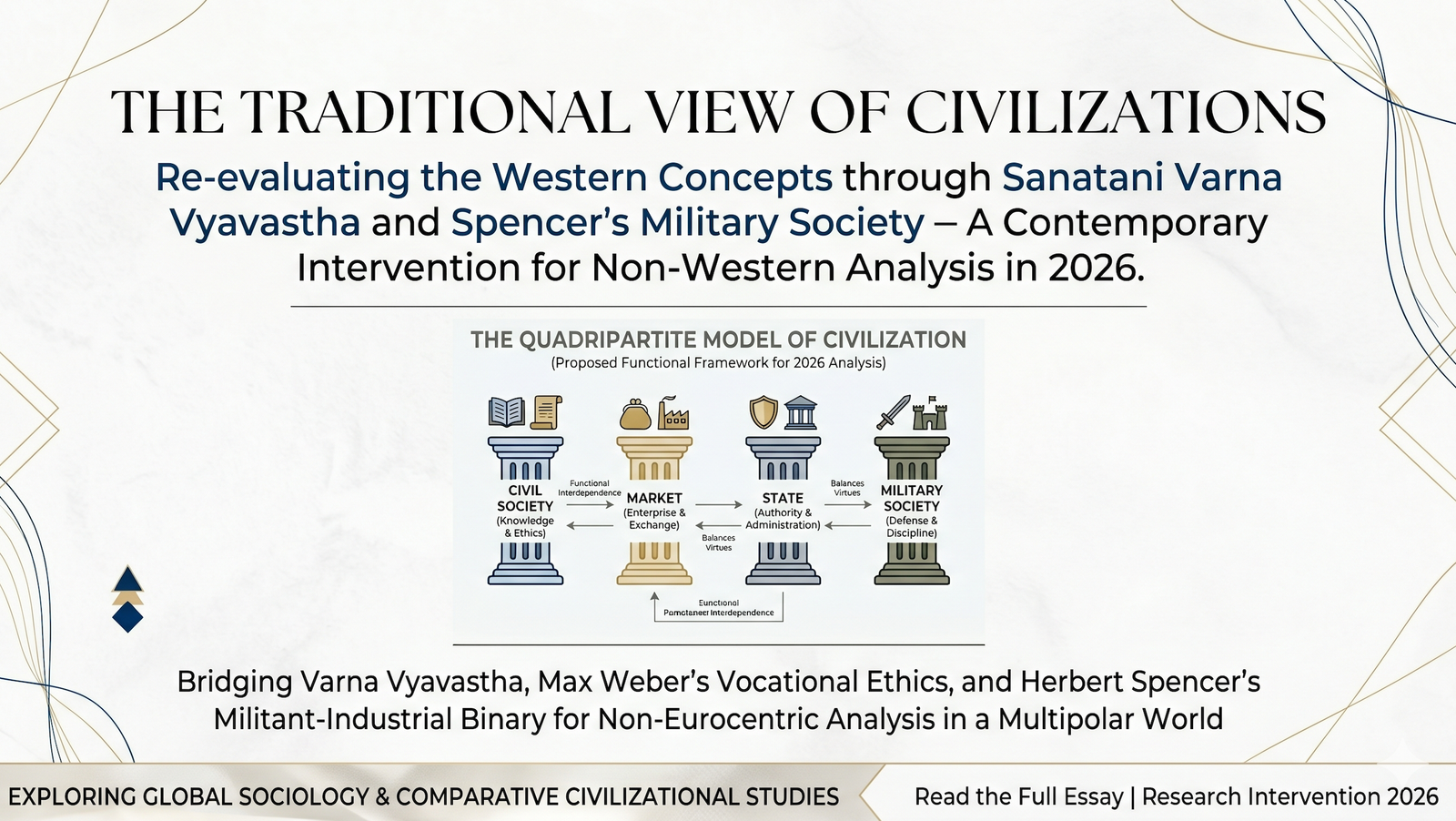
The traditional view of Civilizations : Re-evaluating the Western Concepts through Sanatani Varna Vyavastha and Spencer’s Military Society – A Contemporary Intervention for Non-Western Analysis in 2026
Civilization as a Contested Category in Global Sociology
The concept of “civilization” remains one of the most contested yet indispensable categories in contemporary social science. In Western sociological and historical traditions, it has often been framed through evolutionary lenses—from Auguste Comte’s positivist stages to Herbert Spencer’s distinction between militant and industrial societies—or through civilizational “clashes” as proposed by Samuel Huntington. These approaches, while analytically powerful, frequently embed Eurocentric assumptions: progress measured by market individualism, state rationalization, and secular civil society, with non-Western formations cast as “traditional,” “militant,” or pre-modern.
This intervention proposes a “quadripartite model” of civilization comprising four interdependent pillars: “civil society” (normative cohesion and voluntary association), the “market” (production and voluntary exchange), the “state” (legitimate authority and administration), and the “military society” (organized defense, discipline, and protection). Rooted in the ancient Sanatani varna vyavastha—reinterpreted as a system of vocational ethics—this model offers a balanced, functionalist framework that enriches rather than supplants Spencer’s binary while providing a more universal comparative lens for analyzing both Western and non-Western civilizations in the multipolar world of 2026.
Contemporary global scholarship (2020–2026) increasingly critiques Western civilizational concepts for their universalist pretensions and historical amnesia regarding non-Western contributions. Post-Western sociologies, decolonial approaches, and comparative civilizational studies emphasize hybridity, inter-civilizational dialogue, and the limitations of tripartite models. The quadripartite model addresses this gap by integrating the military society as a specialized yet essential pillar, homologous to the Kshatriya varna, thereby avoiding the reduction of non-Western societies to “militant” relics or threats.
The Manusmriti articulates that all individuals begin as shudra from the mother’s womb, with differentiation arising through training and vocation under the cosmic order established by Prajapati Brahma (Manusmriti 1.87–91). The four varnas—Brahmin (intellectual), Kshatriya (military/governing), Vaishya (entrepreneurial), and Shudra (professional)—function as training modules for elite segments, each with distinct dharma and compensation logics: daan/dakshina, taxes, profits, and salaries respectively. This vocational ethic parallels Max Weber’s Berufsethik and ideal types, yet transcends his pessimistic reading of Indian traditionalism by highlighting functional interdependence rather than barriers to modernity.
In 2026, amid rising multipolarity, great-power competition, and civilizational resurgence (e.g., Confucian China, Islamic revival, Indic assertiveness), this Sanatani-derived model enables a non-Eurocentric evaluation. It treats Western civilization not as the telos but as one historical approximation—often market- and state-dominant with civil society secularized and military professionalized—while illuminating homologous structures in non-Western contexts without essentializing them as “backward.”
The Quadripartite Model – Conceptual Foundations and Interdependence
Civilization is not a unilinear evolutionary stage but a dynamic system balancing four functional domains. Civil society provides diffuse normative integration (echoing Gramsci and Cohen/Arato but broader than secular NGOs). The market enables voluntary resource allocation and innovation (Smithian and neoliberal traditions). The state supplies centralized legitimate coercion and administration (Weberian monopoly of violence). The military society specializes in organized force, hierarchy, and collective defense—drawing militant virtues without colonizing the whole social order.
This quadripartite structure addresses limitations in dominant Western models. Tripartite frameworks (state-market-civil society) often under-theorize security in non-Western or hybrid contexts, where military institutions play integrative or developmental roles (e.g., in post-colonial states or contemporary China). Contemporary literature on civil-military relations and “civilizations as living systems” supports embedding defense as a distinct yet interdependent pillar.
Each pillar maps to varna functions: Brahmin ~ civil society (knowledge/ethics), Vaishya ~ market (enterprise), state elements shared with Kshatriya functions, military society ~ core Kshatriya specialization. Shudra professional elites execute across domains as salaried experts. Compensation modes reflect relational logics, preventing full marketization or statism.
Empirical interdependence is evident in crises: military over-dominance produces Spencerian “militant” pathologies (centralization, compulsion); market hegemony erodes social cohesion and defense capacity. In 2026, hybrid regimes illustrate this—e.g., state-market alliances with strong military pillars in Eurasian contexts versus civil society/market emphasis in liberal democracies.
Varna Vyavastha as Vocational Ethic – Sanatani Paradigm and Weberian Homologies
The varna system, per Manusmriti and Rig Veda’s Purushasukta, originates in functional differentiation for cosmic and social order, not rigid birth (ideal form emphasizes guna and karma). Brahmins sustain normative/civilizational wisdom; Kshatriyas provide protection and rule; Vaishyas generate wealth; Shudras deliver professional services. Panchama denotes the general populace.
This constitutes vocational ethics homologous to Weber’s ideal types: distinct Berufsethik shaping conduct without universal ascetic rationalism. Weber’s The Religion of India critiqued varna traditionalism as hindering capitalism, yet contemporary reassessments affirm its status-group dynamics while noting adaptive potential and cross-civilizational parallels (priestly, warrior, merchant, artisan classes in Egypt, China, Europe, Islamicate societies).
Homologies appear in compensation (gifts/taxes/profits/salaries) and training modules. In 2026 decolonial and comparative literature, this framework counters Orientalist reductions, enabling analysis of non-Western elite formations without imposing Western binaries.
Re-reading Herbert Spencer – From Binary to Quadripartite Integration
Spencer’s Principles of Sociology contrasts militant societies (compulsory cooperation, hierarchy, defense-oriented, army-like structure) with industrial ones (voluntary cooperation, individualism, exchange). Militant traits include centralization and extraction for collective security; industrial emphasises contract over status.
The quadripartite model embeds Spencer’s military society as the Kshatriya pillar—incorporating discipline and order without total societal militarization. It balances militant virtues with industrial/market voluntarism, civil society norms, and state administration. Over-dominance risks pathologies Spencer identified; equilibrium fosters resilience.
Contemporary evaluations show militant traits persisting in great-power competition, while industrial logics dominate globalization. The varna lens enriches this by adding vocational-ethical depth, avoiding Spencer’s evolutionism’s teleological bias toward Western industrialism.
Comparative Application to Non-Western Civilizations – Empirical Cases in 2026
Applying the model to Indic, Sinic, Islamic, and other traditions reveals homologies and variations. In historical India, varna provided explicit quadripartite logic; modern India balances democratic civil society/state with market reforms and professional military. Sinic civilization emphasizes state-market synergy with Confucian intellectual elite and strong military pillar. Islamic cases integrate ummah (civil society analogue), bazaar (market), caliphal/state authority, and jihad/military ethics.
2026 literature on multipolarity (Huntington reassessed, inter-civilizational studies) highlights how pillar imbalances fuel tensions or resilience. Non-Western resurgence often strengthens military or state pillars against perceived Western market/civil society hegemony.
Implications for Sociology of Civilizations in 2026 and Beyond – Towards Ethical Pluralism and Comparative Rigor
This quadripartite framework, grounded in Sanatani vocational ethics, intervenes in Western-dominated civilizational sociology by offering a non-reductionist, functionally balanced alternative. It explains stability via elite specialization and interdependence, diagnoses crises from imbalance or vocational degeneration, and clarifies modern tensions (liberties vs. security, economy vs. defense).
For non-Western analysis, it avoids casting societies as deficient Western approximations, instead revealing homologous structures adaptable to contemporary challenges. In an era of deglobalization/reglobalization and civilizational assertiveness, it promotes dialogue through shared functional needs while respecting ethical pluralism.
Future research should empirically test pillar configurations across cases, integrating complexity science and living-systems approaches. Ultimately, civilization appears as an ethical achievement of differentiated elites, where the military society protects without subsuming—enriching Spencer while universalizing insights from Varna Vyavastha.