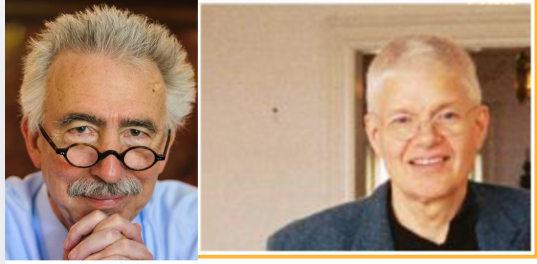
Nicholas Dirks and Ronald Inden:Toward a New Sociology of India
The new sociology of India did not begin simply as a correction of colonial Indology, nor merely as an extension of postcolonial theory. It emerged from a deeper crisis in the Western sciences of society: the crisis of representation, the crisis of civilizational categories, and the crisis of the modern claim that Europe possessed the universal grammar through which all societies could be classified. Ronald Inden and Nicholas Dirks must therefore be read not as isolated South Asianists, but as two complementary theorists who participated in the making of a new historical sociology of India. Their work arose from the older Chicago tradition of civilizational anthropology, from the semiological and semiotic turn in the human sciences, from Bernard Cohn’s anthropology of colonial knowledge, and from the wider critique of European modernity developed by Indian thinkers such as J. P. S. Uberoi, Ashis Nandy, Dharampal, Tapan Raychaudhuri, and later Dipesh Chakrabarty.
This is why Inden and Dirks cannot be reduced to the formula that “India was imagined” or “caste was colonial.” Their contribution was more serious. They challenged the epistemological foundations of the modern knowledge-system that had converted India into an object of rule, classification, ethnography, census, philology, anthropology, and civilizational theory. Inden’s Marriage and Rank in Bengali Culture appeared in 1976, long before Imagining India; it studied caste, clan, marriage, and rank in middle-period Bengal historically rather than as frozen ritual hierarchy. Dirks’ The Hollow Crown, first published in 1987, was likewise not a late postcolonial slogan but a major ethnohistorical reconstruction of kingship, ritual sovereignty, and political culture in South India. Their mature works grew from these earlier historical-anthropological foundations.
The intellectual soil beneath them was the rise of semiology and semiotics. After Saussure, Peirce, Barthes, Lévi-Strauss, Geertz, and Sahlins, culture could no longer be treated merely as custom, institution, or belief. It became a system of signs, codes, symbols, performances, classifications, and meanings. This turn deeply affected the anthropology of India. Milton Singer’s When a Great Tradition Modernizes was decisive because it refused to see Indian civilization as a dead survival. It studied Madras as a modern city in which Sanskritic, ritual, urban, commercial, artistic, and civic forms interacted dynamically. Singer’s long research over several visits to India produced a theory of cultural change in which “great tradition” and modernity were not enemies but mutually transforming civilizational fields.
McKim Marriott carried this further by attempting an ethnosociology of India through Indian categories. His edited volume India through Hindu Categories sought to understand Indian social thought through indigenous concepts rather than only through Western sociological abstractions. Bernard Cohn then made the decisive move from culture as meaning to colonialism as knowledge-power. His work showed that British rule in India depended not merely on armies and revenue, but on surveys, censuses, legal codes, ethnographies, maps, archives, and classificatory sciences. Colonialism and Its Forms of Knowledge became foundational because it showed that colonialism transformed Indian society by converting knowledge into an instrument of rule.
Inden’s sociology must be placed precisely here. His 1986 essay “Orientalist Constructions of India” had already criticized the long tradition by which India was represented as passive, irrational, mystical, caste-bound, despotic, and incapable of self-generated historical agency. Imagining India then became a systematic critique of the Western imagination of India. But Inden’s critique was not merely negative. He wanted Indians to be restored as rational, historical, world-making agents. His argument was not that India had no structure, nor that caste, kingship, religion, and hierarchy were invented illusions. His argument was that Western scholarship had repeatedly denied Indians the status of intentional historical subjects.
Dirks complemented this intervention from the side of colonial state formation. In The Hollow Crown, he studied the old kingdom of Pudukkottai and showed that precolonial South Indian kingship was not reducible to either ritual spectacle or political administration. It was a complex civilizational form in which sovereignty, temple, caste, land, honor, genealogy, gift, and ritual were woven together. Colonial rule broke this world by separating politics from culture and then reclassifying Indian authority as custom, religion, or tradition. Dirks later explained that The Hollow Crown became the intellectual source for his later writings, including Castes of Mind and The Scandal of Empire.
Castes of Mind was therefore not a casual claim that caste did not exist before colonialism. Its deeper thesis was that colonialism reorganized caste into the privileged administrative category through which India was known and governed. The census, ethnographic survey, legal schedule, district manual, and anthropological report transformed fluid, regional, political, sectarian, occupational, and ritual identities into a rigidly legible structure of rule. The point was not invention ex nihilo, but epistemic reconstitution. Colonialism did not create social difference from nothing; it made certain differences official, frozen, comparable, enumerated, and politically consequential.
This is where Inden and Dirks become complementary. Inden attacked the metaphysical image of India produced by Orientalist thought. Dirks examined the institutional machinery through which colonial rule materialized such images in archives, censuses, ethnographies, law, and governance. Inden’s India was wrongly imagined as lacking agency; Dirks’ India was administratively remade through colonial knowledge. Together they produced a new sociology of India in which society, culture, state, archive, ritual, sign, and power had to be studied together.
This new sociology also resonated with Indian critiques of European modernity. J. P. S. Uberoi’s Science and Culture and The Other Mind of Europe challenged the idea that modern science was a single, homogeneous European achievement; he recovered Goethe as a scientist and showed that Europe itself contained alternative minds suppressed by dominant modernity. Dharampal’s archival work on indigenous Indian science, technology, education, and polity challenged the colonial myth that India was civilizationally stagnant before British rule. Ashis Nandy’s Alternative Sciences and the edited volume Science, Hegemony and Violence exposed the violence hidden inside the modern state’s alliance with science and development. Tapan Raychaudhuri gave a historically sensitive account of colonialism, economy, mentality, and the encounter between Europe and India. Dipesh Chakrabarty’s later project of “provincializing Europe” made explicit what Inden, Dirks, Cohn, Nandy, Uberoi, and Dharampal had already implied: Europe could no longer remain the silent universal subject of history.
The importance of this whole formation becomes clearer when read alongside Andre Gunder Frank and Bruno Latour. Frank’s ReOrient attacked Eurocentric world history by showing that Asia was not peripheral but central to the early modern world economy. Latour attacked the modern constitution itself by arguing that modernity falsely separated nature, society, science, politics, and religion. Inden and Dirks did for India what Frank did for world history and Latour did for modern epistemology. Frank displaced Europe from the centre of world-historical development. Latour dissolved the purified categories of modern social theory. Inden restored Indian agency against Orientalist passivity. Dirks showed how colonial knowledge converted culture into governable social fact. Read together, they form a powerful quartet for the sociology of civilizations after Eurocentrism.
The contemporary relevance of Inden and Dirks is therefore immense. In the post-Corona world, when algorithmic governance, biometric citizenship, digital surveillance, platform capitalism, data colonialism, and civilizational nationalism have become central to global society, Dirks’ “ethnographic state” must be extended into the digital state. The census has become the database. The ethnographic report has become the algorithmic profile. The colonial archive has become the cloud. The classificatory state has become the surveillance platform. Similarly, Inden’s critique of imagined India remains crucial because India is still represented through simplified civilizational images: spiritual India, caste India, Hindu India, chaotic India, democratic India, market India, authoritarian India, digital India. Each image contains partial truth, but each becomes dangerous when it denies India’s internal plurality, historical agency, and civilizational self-reflection.
Yet a full evaluation must also recognize their limits. Inden and Dirks were powerful critics of colonial knowledge, but they did not fully reconstruct Indian sociology from within Indian categories. Marriott attempted this more directly; Uberoi and Dharampal approached it through science and swaraj; Nandy through civilizational psychology and critique of modernity; Balagangadhara through religion and colonial consciousness; and your own Westology/Noumenal Autology project attempts to move beyond both colonial Indology and postcolonial deconstruction. Inden and Dirks opened the door, but the deeper task remains: to build a sociology of India that is not merely anti-Orientalist but positively civilizational, semiotic, historical, ecological, cosmological, and grounded in Indian categories of life.
In that sense, Nicholas Dirks and Ronald Inden should be read as founders of a transitional but indispensable new sociology of India. They did not merely add new facts to Indian sociology. They changed the grammar of the discipline. After them, caste could not be studied without colonial classification; kingship could not be studied without ritual sovereignty; Indian civilization could not be studied as passive tradition; modernity could not be studied as European destiny; and sociology could not pretend innocence about its own categories. Their work remains essential for any contemporary sociology of India, sociology of civilizations, or post-Western social theory.