By Amit Kumar Sharma, Professor of Sociology, Jawaharlal Nehru University, New Delhi
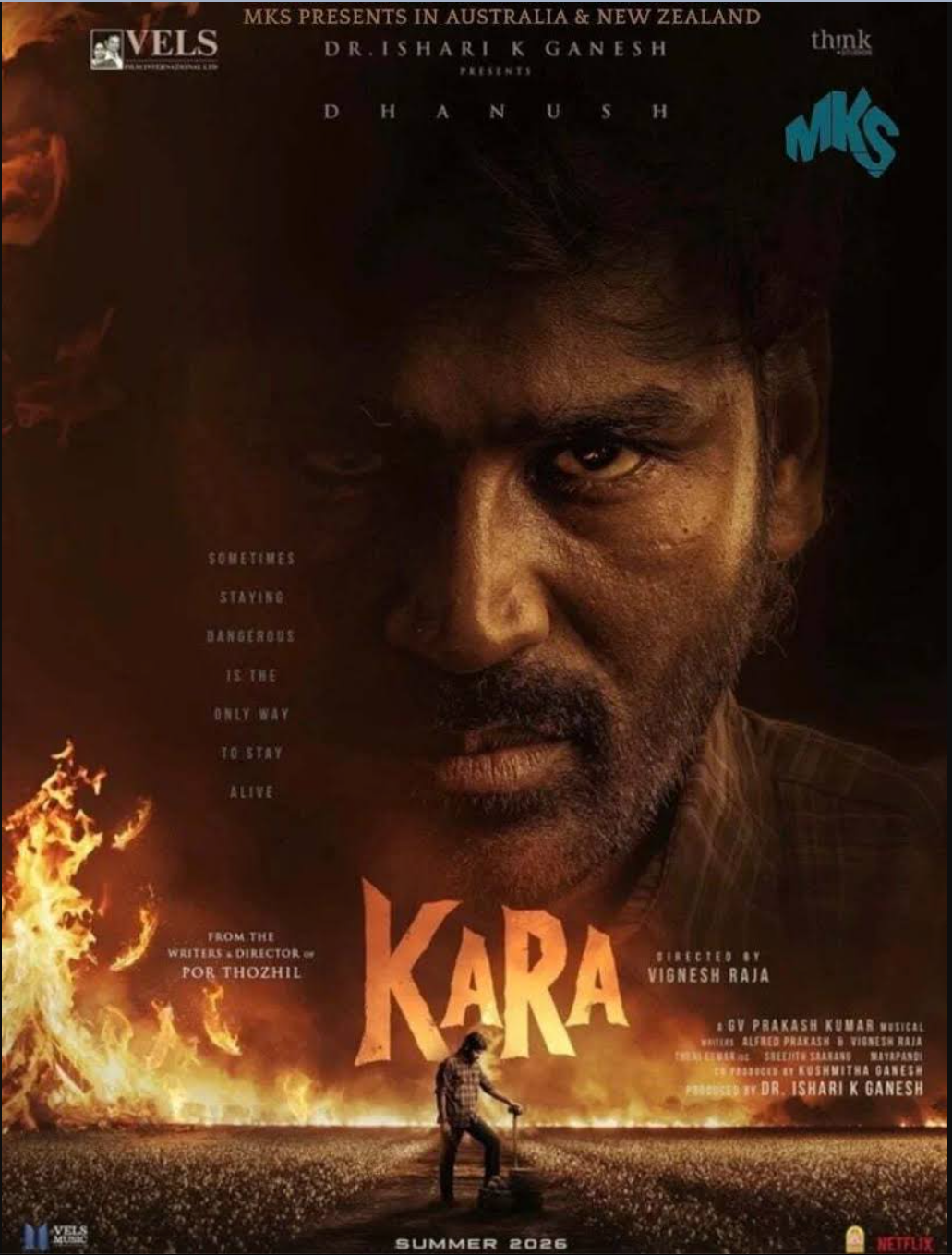
Kara, released on the 30th of April 2026, is Vignesh Raja’s follow-up to his widely celebrated Por Thozhil (2023), and it arrives carrying the full weight of that reputation. Written by Raja alongside Alfred Prakash, the film stars Dhanush as Karasaami — a man the world simply calls Kara — a reformed thief living in the coastal district of Ramanathapuram in 1991, at the precise moment when the Gulf War is sending economic shockwaves across the Indian subcontinent. Petrol prices are climbing. Remittances from the Gulf are drying up. Banks, sensing vulnerability in rural communities, are tightening their grip on ancestral land through predatory loan structures. Into this pressure cooker, Vignesh Raja drops a man who had once made peace with his criminal past, only to find that peace is a luxury the poor cannot afford for long.
Vignesh Raja loves a good cat-and-mouse hunt, and he is good at it too. While Por Thozhil placed its protagonists on the right side of the law as they hunted a serial killer, Kara puts its lead on the wrong side, deriving suspense from a deceptively simple question: will he be able to get away? But terms like “good” and “bad” don’t apply cleanly to a Vignesh Raja film. The good here is more grey, in varying shades. The bad is truly black. Everyone has an agenda, and everyone wants to accomplish something. It is a moral universe without absolutes, and that ambiguity is both the film’s great strength and, eventually, its most significant missed opportunity.
The drama builds steadily and then explodes into an intensity-peaked interval block that absolutely blasts. The triangular cat-and-mouse narrative holds up well in the second half, thanks to its tense atmospheric mood, top-notch craftsmanship, and an exceptional Dhanush. The grounded storytelling, strong supporting cast performances, and perfectly in-sync music only elevate the experience further. G.V. Prakash Kumar’s score deserves particular mention — it is restrained where it needs to be restrained, and overwhelming when the film demands that the audience feel cornered alongside its protagonist. Theni Eswar’s cinematography is equally assured, finding visual language for both the dust of Ramanathapuram’s interiors and the cold arithmetic of a bank vault. The interval sequence goes a step further than anything in Por Thozhil, creating a moment with even more at stake. The detailing is specific, and a reaction shot of Dhanush’s face is framed through the holster of a police officer’s pistol. The sequence is written like a visual demonstration of Murphy’s Law — everything goes wrong, all at once.
Dhanush is exceptionally good in the lead role, delivering a physically demanding and gritty performance that anchors the film through its most routine stretches. He brings a visceral intensity to the explosive action sequences, while Mamitha Baiju provides a brilliant performance that gives the family dynamic its necessary emotional weight. Suraj Venjaramoodu, in a supporting role of considerable moral complexity, is the film’s dark mirror — a man who also has reasons, also has desperation, but has made entirely different choices with it. Their scenes together crackle with the tension of two men who understand each other too well.
Where Kara stumbles is in its final act. With so much going for it through most of its runtime, one wonders why the film then settles for so little as it progresses into its last act. It is as though the film decides to forego its sophisticated writing choices to settle for safety. Clever symbols that represented Kara’s complex moral layer step aside, and the film begins to shout out its virtues rather than whisper them. The whitewashing of the protagonist’s character becomes too obvious, especially when the film takes a giant pause to underline the suffering of an older farmer. The writing starts out smart, utilizing a unique 1991 backdrop to build genuine tension early on. However, the pacing drags heavily after the interval, settling into a well-worn storyline that tests patience. It is the familiar tragedy of Tamil commercial cinema — a filmmaker who trusts his audience enough to build something complex, then distrusts them at the last moment when it counts most. Kara is, ultimately, a very good film that contains the bones of a great one.
Violence as a Noumenal Metaphor: The Philosophical Framework
To understand Kara only as a heist film, or even as a period drama about agrarian distress, is to read it at its shallowest level. The film’s violence — and there is considerable violence in it, both physical and structural — operates on a register that demands a different kind of critical language. The most useful framework here is Kantian. Immanuel Kant distinguished between the phenomenal world, the world of appearances that we can observe and measure, and the noumenal world, the realm of the “thing-in-itself,” the underlying reality that generates those appearances but can never be directly seen or known. In Kara, every act of violence is phenomenal: we see the punch land, the shot fired, the confrontation reach its terrible conclusion. But these visible eruptions are not the real subject of the film. They are the surface through which something deeper — something about land, about debt, about inherited guilt and the rage that poverty manufactures — briefly becomes legible. Violence, in this sense, is not the story. It is the language in which the real story is being told.
This distinction matters because it separates Kara from the vast archive of Indian action films in which violence is merely spectacle, a kinetic reward for the audience’s patience during slower scenes. Vignesh Raja is not interested in that transaction. When Kara beats a man, the camera does not celebrate the choreography. It holds on his face afterward — on the cost registered there, the slight trembling of a man who hoped he had left this world behind and now understands he never will. This is the phenomenal moment pointing toward the noumenal truth: that the violence was always latent, always waiting, not because Kara is by nature a violent man, but because the systems surrounding him — the bank, the moneylender, the complicit state apparatus — had been conducting their own quiet violence for years before he threw a single punch. Physical violence in the film is merely the moment when the invisible becomes visible, when the slow violence of debt and dispossession finally acquires a body, a name, and a face.
The Mundane Astrology of Independent India
To layer this philosophical reading with the framework of Jyotish — Vedic astrology applied to the fate of nations rather than individuals — is not to abandon rigour but to enter a different epistemological tradition, one that India’s own intellectual history takes seriously. Mundane astrology reads collective destiny through the horoscope of a nation’s birth, and Independent India’s chart, cast for the midnight of the 15th of August 1947 in New Delhi, reveals a deeply particular national character. The Cancer Ascendant and the strong Cancer stellium — Sun, Moon, Mercury, Venus, and Saturn crowding the same sign — describes a nation whose identity is inseparable from its emotional life, its family structures, its agricultural roots, and its relationship to home and the memory of home. India does not simply think; it feels, and it feels collectively, in great tidal movements of public sentiment that can shift with a film or a flood or a speech delivered at the right moment.
The position of Rahu in Taurus in this chart is of particular significance for reading Kara. Taurus governs material security, land, accumulated wealth, and the deep human attachment to what one owns and what one’s ancestors owned before them. Rahu, the north node of the moon, is a shadow planet in Jyotish — it amplifies, distorts, and obsesses. Rahu in Taurus in India’s chart points toward a national karma organised around land: the landlord and the landless, the zamindari system, the promises of land reform that arrived and then quietly dissolved, the farmer suicides that have been statistically documented across decades. The ancestral land at the center of Kara’s plot is not incidental to this reading. It is the film’s deepest subject, and it is precisely the Taurus-Rahu subject in the national chart made cinematic. Kara does not rob banks because he is reckless. He robs banks because his land — the material foundation of everything his family is — is about to be swallowed by a system that manufactures debt the way it manufactures consent: quietly, systematically, and without the appearance of violence.
The Mars-Rahu Dasha: A Nation Under Shadowed Fire
The dashas of Vedic astrology are planetary periods, windows of time in which a particular planet’s energy colours the collective experience of a nation. The Mars-Rahu dasha for Independent India runs from approximately early February 2026 through to late February 2027, and its arrival as a period of interpretation for Kara is not merely coincidental — it is architecturally meaningful. Mars is the planet of action, aggression, courage, war, and land disputes. It is the force that acts rather than reflects, that cuts rather than deliberates. Rahu is the shadow that surrounds Mars during this period, transforming its fire into something unstable and distorted — a flame fed by illusion, by foreign interference, by obsessions that feel righteous in the moment and hollow in retrospect.
The dasha’s signature is the amplification of Mars energy through a lens that removes clarity. Aggression becomes unpredictable. Conflicts arise from grievances that were always present but suddenly acquire urgency. Economic pressures bear down on ordinary people while larger, structural beneficiaries of those same systems appear insulated from consequence. This is precisely the atmosphere of 1991 that Vignesh Raja reconstructs in Kara — the Gulf War’s disruption of oil prices feeding into a domestic economic crisis that fell hardest on rural communities and migrant workers, while the banking system, ostensibly a mechanism of stability, functioned as an instrument of dispossession. The film is set in 1991, but it is written for 2026. The historical distance is a directorial strategy, allowing the audience to see their present anxieties from the slightly safer vantage point of the past, close enough to recognise, far enough to examine.
Agrarian Distress and the Land as the Film’s True Protagonist
If one were to ask what Kara is fundamentally about, the honest answer is not Dhanush’s character or even the heist sequences, magnificent as they are. The film is about land. More precisely, it is about the severing of a family from its land, and the particular quality of desperation that this severing produces — a desperation that is not melodramatic but quiet, dignified, and finally explosive. In the film’s moral logic, the bank that holds the loan is a greater criminal than the thief who robs it, because the bank’s crime is legal, systemic, and invisible, while the thief’s crime is visible and punishable. This is the film’s most important insight, and it is also the insight of the Mars-Rahu dasha as applied to the national chart: the structural violence of financial systems is the noumenal reality beneath the phenomenal violence of the man who finally refuses to be processed through that system without resistance.
The 1991 backdrop deepens this argument considerably. The liberalisation of the Indian economy in that year was experienced very differently depending on one’s position within it. For urban professionals and the emerging middle class, it was the beginning of an era of possibility. For rural communities in districts like Ramanathapuram — already economically marginalised, already dependent on Gulf remittances that were now disrupted by a war in which India had no direct stake — it was an intensification of vulnerability. Kara’s family exists in this latter world, and the Gulf War is not background scenery in the film. It is an active force, an instance of the Rahu principle in action: a foreign disruption, vast and geopolitical and utterly indifferent to the fates of particular families in southern Tamil Nadu, that nevertheless determines everything about what happens to those families. The noumenal forces are planetary in their scale; the phenomenal suffering is intensely, specifically human.
Dhanush, Masculinity, and the Ethics of the Outlaw
Dhanush has spent much of his career exploring a particular kind of Tamil masculinity — not the invincible hero of mass-market cinema, but the man who is beaten by the world before he beats it back, if he beats it back at all. In Kara, this sensibility is fully deployed in service of the film’s moral argument. Kara is introduced as a man who has already absorbed his violence, who has tried to metabolise it into something domesticated and responsible. He is a father, a husband, a man who runs a small business and keeps his head down. The film’s tragedy is that this very ordinariness, this aspiration to a quiet life, is precisely what the system makes impossible for someone of his class and background. His past catches up with him not because of any flaw in his character but because the economic structure demands a sacrifice, and men like him are always the ones nominated for that role.
This is the “shadowed masculinity” that the Mars-Rahu dasha illuminates in the national chart. Mars in its pure form is heroic agency — the capacity to act, to defend, to build. Rahu’s shadow over Mars distorts this into something more ambiguous: the outlaw who is right, the theft that is justice, the violence that is the only remaining avenue for a dignity that has been systematically stripped away. Kara’s arc from reformed thief to reluctant robber to something approaching a Robin Hood figure is compelling precisely because the film, in its better moments, refuses to celebrate this arc. It presents it as a tragedy within a tragedy — a man who had genuinely changed being forced to un-change himself because the world did not change to meet him.
The 1991-2026 Temporal Bridge: Cinema as Collective Processing
There is a meaningful conversation to be had about why Indian cinema repeatedly returns to the past — to the 1970s, to 1991, to the Emergency years — at moments of present anxiety. One answer is purely commercial: nostalgia is a reliable emotional currency. But a deeper answer, and one that the astrological framework supports, is that cinema functions as a form of collective ritual during periods of planetary intensity. The Mars-Rahu dasha creates conditions of heightened social friction — economic pressure, agrarian stress, sudden escalations of conflict, a pervasive sense that the ground beneath ordinary life is less solid than it appeared. In such conditions, the audience does not simply want entertainment. It wants recognition. It wants its experience of the world named and held up so that it can be seen clearly.
Kara provides this recognition by setting the present’s anxieties in the past’s body. The Gulf War’s oil shocks and the 1991 economic crisis are precise historical analogues for the geopolitical disruptions and economic pressures that the Mars-Rahu dasha surfaces in the present. Audiences watching Kara’s family lose their land to a predatory bank in 1991 are not watching a history lesson. They are watching a mythological enactment of their own fears, given the emotional safety of historical distance. This is cinema functioning not merely as art or entertainment but as what it has always been in its deepest cultural register: a mirror, a dream, a communal space in which things too large or too threatening to process individually are brought into shared experience and thereby made, if not bearable, at least legible.
Conclusion: The Film India Needed
In Kara (2026), violence operates as a noumenal metaphor: the visible eruption of invisible planetary and societal forces. Contextualized in Independent India’s mundane chart and the Mars-Rahu dasha, the film becomes a cinematic ritual—processing collective karma around land, debt, redemption, and shadowed agency. As India navigates this period of amplified aggression and illusion (Feb 2026–Feb 2027), Kara holds up a mirror: violence is not mere action but the raw language through which a nation confronts its deeper realities, seeking transformation amid chaos. Dhanush’s grounded performance and Vignesh Raja’s execution make it a timely artifact, blending entertainment with profound astrological-cultural resonance.
Viewed through the lens of mundane astrology and the Mars-Rahu dasha, Kara becomes more than a strong Tamil commercial film. It becomes a cultural document of a nation processing its shadow — its rage, its grief over lost land and broken promises, its ambivalence about the violence that the dispossessed eventually reach for when all other instruments of justice have been taken away. Dhanush embodies this with the physical and emotional precision that makes him one of the most compelling actors working in Indian cinema today. The film does not resolve the questions it raises, because the dasha does not resolve them either. What it does is name them, frame them, and hold them up against the light long enough for an audience to recognise what they are looking at. In a period of shadowed fire, that is no small thing.