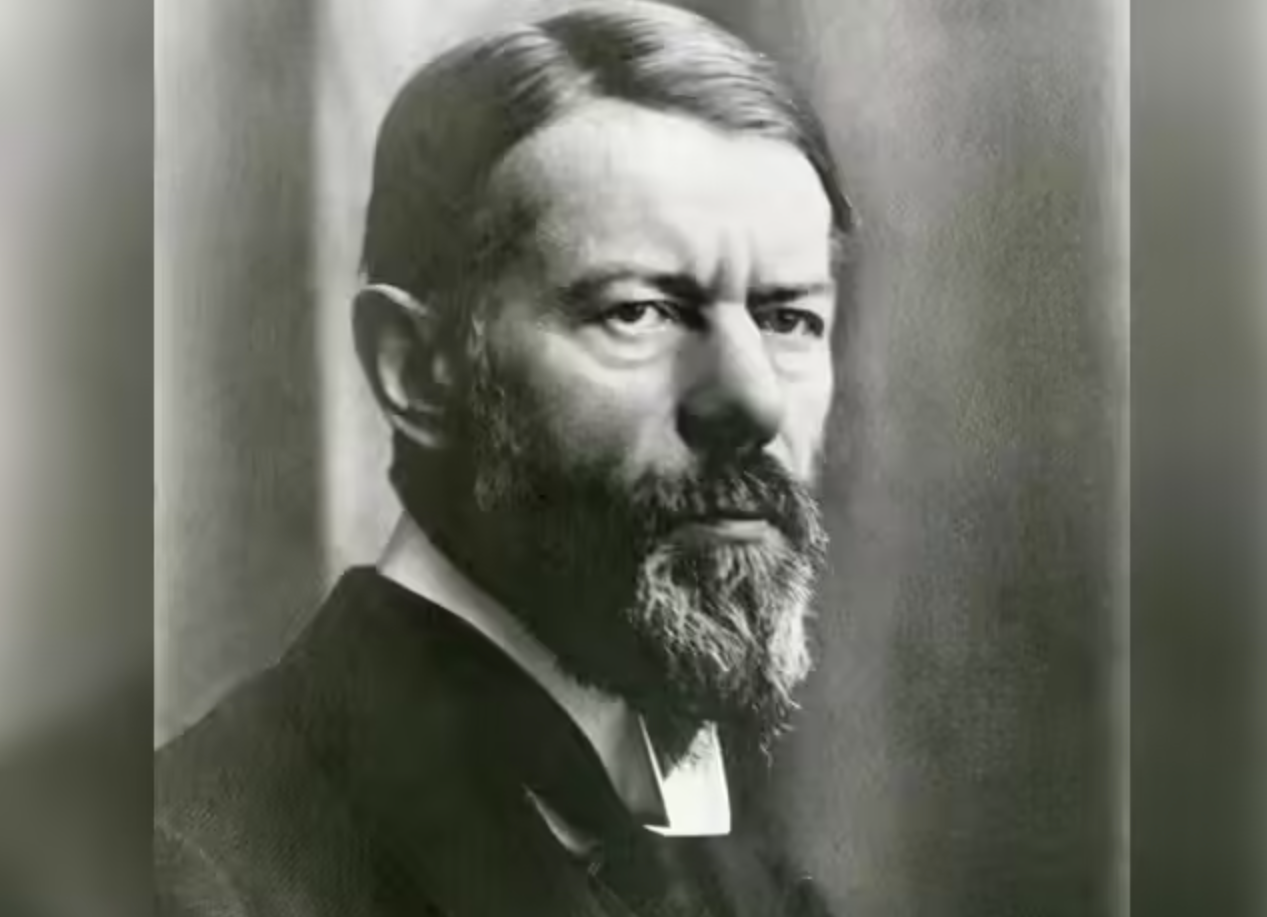
Rethinking Max Weber : From Protestant Ethic to Juridical Civilization
The tragedy of Max Weber in the twentieth century was not merely the selective reading of his works, but the conversion of a deeply wounded, historically burdened, intellectually restless German jurist into a frozen icon of “scientific sociology” and “capitalist modernity.” The Weber who emerged after the Second World War, especially through the institutional mediation of Talcott Parsons and the American academy, was not the living Weber of crisis-ridden Wilhelmine Germany, nor the exhausted intellectual struggling through nervous collapse, political anxieties, unfinished manuscripts, and the disintegration of European civilization after the First World War. The postwar Anglo-American canon transformed Weber into an ideological counterweight to Karl Marx. In the Cold War university system, Marx became the dangerous prophet of collectivism while Weber was elevated as the prophet of liberal rationality, methodological individualism, and the ethical origins of capitalism. This binary itself was historically artificial. Both Marx and Weber were products of nineteenth-century European civilizational crisis, and both were responding to the collapse of older theological and political orders under industrial capitalism. Yet the Cold War university converted them into ideological mascots rather than historically situated thinkers.
The most important fact neglected by Weber’s admirers is that Weber was not primarily a professional sociologist in the manner of Émile Durkheim, Georg Simmel, or even his own brother Alfred Weber. Weber was trained as a jurist and political economist. His deepest intellectual instincts emerged from jurisprudence, comparative legal history, constitutional questions, political leadership, bureaucracy, and the sociology of domination. His early work on Roman agrarian history and medieval trading companies already demonstrated that his true genius lay not in abstract social theory but in historically grounded institutional analysis. Stephen P. Turner and Regis A. Factor’s important monograph, Max Weber: The Lawyer as Social Thinker, correctly relocates Weber within the world of legal reasoning and juridical rationality rather than within the later myth of “founding father of sociology.” Turner and Factor argue persuasively that Weber’s categories of authority, legitimacy, rationalization, and bureaucracy were deeply shaped by legal training and juridical modes of thought rather than by any autonomous sociological method.[1]
The American reception of Weber after 1945 systematically decontextualized him. Parsons’ translation of The Protestant Ethic and the Spirit of Capitalism in 1930 was historically decisive because it introduced Weber into the Anglo-American world precisely at the moment when capitalist liberal democracies sought an intellectual genealogy for themselves against fascism and communism. Parsons read Weber through neo-Kantian functionalism and reconstructed him as a theorist of normative order.[2] Yet Weber himself was far more tragic, conflicted, and historically fragmented. He was not offering a celebration of capitalism. Rather, he was diagnosing the emergence of an “iron cage” of rationalization in which religious charisma had already begun to die. The tragedy is that Weber’s admirers converted a civilizational lament into a triumphalist theory of modernity.
Even more misleading was the canonization of The Protestant Ethic. Weber himself never treated this text as his magnum opus. The work was initially published as two journal essays in 1904–1905.[3] It was neither conceived nor completed as a definitive theory of capitalism. Recent Weber scholarship has increasingly emphasized that the text was provisional, polemical, and exploratory. Weber was intervening in debates concerning the cultural preconditions of rational economic conduct within the context of German historical economics and comparative religion. He was not presenting a monocausal theory of capitalism. Indeed, Weber repeatedly clarified that capitalism existed long before Protestantism and outside Protestant societies.[4] Yet generations of admirers simplified the work into the absurd slogan that “Protestantism created capitalism.”
The tragedy deepened because Weber’s own historical claims were often empirically fragile. The rise of capitalist institutions in the Italian city-states, Catholic merchant networks, Jewish commercial traditions, Dutch maritime finance, Iberian imperial extraction, and medieval trading guilds all complicated Weber’s thesis. Later historians such as Fernand Braudel, Immanuel Wallerstein, and Andre Gunder Frank demonstrated the enormous role of global trade systems, colonial extraction, Asian commercial networks, and state power in the emergence of capitalism.[5] Weber’s Protestant ethic thesis thus increasingly appeared as one cultural fragment within a much larger historical process. Werner Sombart’s analyses of Jewish commercial networks and Georg Simmel’s reflections on money arguably penetrated deeper into the psychological and structural logic of capitalism than Weber’s moral-cultural thesis.[6]
Weber’s methodological writings suffered a similar fate. His admirers elevated them into universal principles of social science methodology, yet Weber himself rarely followed them consistently in practice. The celebrated distinction between Verstehen, ideal types, value neutrality, and causal adequacy was less a finished methodology than an intellectual toolbox improvised amid the epistemological crises of late nineteenth-century German thought.[7] Weber was deeply influenced by neo-Kantianism, especially Heinrich Rickert and Wilhelm Windelband, who sought to distinguish cultural sciences from natural sciences. But Weber’s own substantive historical works constantly violated the rigid boundaries proposed in his methodological essays. His writings overflowed with evaluative judgments, civilizational anxieties, and political passions.
This contradiction is now increasingly acknowledged by contemporary Weber scholarship. Scholars such as Wilhelm Hennis argued that Weber should not primarily be understood as a sociological methodologist but as a thinker concerned with the formation of personality under modern civilization.[8] Hennis insisted that Weber’s real question was the fate of humanity in conditions of rationalization. Similarly, recent philological work on Weber’s manuscripts has shown that Economy and Society itself was not the coherent finished masterpiece later generations imagined it to be.
The myth of Economy and Society as a completed systematic treatise was largely a construction of editors and translators. Weber died in 1920 before completing the project. Recent manuscript studies have demonstrated that large sections were fragmentary, revised unevenly, or assembled posthumously by editors such as Marianne Weber and later Johannes Winckelmann.[9] Even the influential Roth and Wittich edition cannot be treated as a definitive text. Scholars like Keith Tribe and Wolfgang Schluchter have shown that Weber’s manuscripts existed in multiple layers, drafts, and unfinished conceptual forms.[10] Only a few sections were fully polished. Therefore, the image of Weber as the architect of a complete sociological system is historically untenable.
Yet within these fragments lay Weber’s genuine brilliance. His sociology of domination (Herrschaft) remains one of the great achievements of modern social thought. Weber understood with extraordinary clarity the relationship between legitimacy, law, charisma, and bureaucracy. His typology of traditional, charismatic, and legal-rational authority was not merely a classification scheme but an attempt to understand the historical transformation of civilizations.[11] Here Weber the jurist, not Weber the methodological philosopher, achieved enduring significance. His analyses of bureaucracy, administrative rationality, and political leadership remain foundational because they emerged from direct engagement with the realities of modern state formation.
Nowhere was Weber more profound than in the sociology of law. Contemporary Weber scholarship increasingly recognizes this. The sociology of law was not peripheral to Weber’s project; it was central. Weber grasped that modern capitalism depended not merely on markets or ethics but on calculable legal systems, rational adjudication, bureaucratic administration, and predictable enforcement.[12] His comparative analyses of Roman law, canon law, patrimonial systems, and modern formal rational law revealed the juridical foundations of Western modernity. Contemporary scholars such as David Trubek and Gunther Teubner have expanded Weber’s insights into globalization, transnational governance, and legal pluralism.[13]
Similarly, Weber’s vocation lectures—Science as a Vocation and Politics as a Vocation—represent perhaps his most enduring reflections on modern civilization. These lectures were not technical sociology but existential meditations on responsibility, ethics, leadership, disenchantment, and intellectual integrity in an age where transcendent meaning had fractured.[14] Weber here appears less as social scientist and more as tragic moral philosopher. The distinction between the ethic of conviction and the ethic of responsibility remains relevant precisely because Weber understood politics as a realm of unavoidable moral ambiguity.
By contrast, Weber’s sociology of religion appears far weaker when examined critically. His studies of China, India, and ancient Judaism were often based on limited secondary materials, orientalist assumptions, and insufficient linguistic competence.[15] His comparative civilizational analyses were brilliant in intuition but uneven in scholarship. Later generations often treated these works as authoritative sociologies of world religions, yet contemporary historians of Asia increasingly regard them as historically dated. Weber’s portrayal of Hinduism and Confucianism especially reflected broader European anxieties about rationality, discipline, and modernization rather than balanced civilizational understanding.[16]
The Cold War canonization of Weber thus obscured both his limitations and his true strengths. Parsons and modernization theorists transformed Weber into the prophet of liberal capitalism, rational bureaucracy, and Western exceptionalism. But the twenty-first century requires a different Weber. The new Weber emerging from manuscript studies, legal sociology, intellectual history, and philological scholarship is more fragmented, juridical, political, tragic, and historically situated. He appears less as a universal theorist of modernity and more as a diagnostician of European civilizational crisis.
In this sense, Weber belongs not simply to sociology but to the broader tradition of European reflections on authority, legality, responsibility, and the fate of civilization. His enduring importance lies not in the simplifications of “Protestant ethic” textbooks but in his recognition that modernity produces immense organizational power while simultaneously hollowing out metaphysical meaning. Weber understood earlier than most that rationalization could create technically efficient yet spiritually exhausted societies.
Therefore, rethinking Weber today requires liberation from both Cold War hagiography and simplistic textbook sociology. Weber should neither be worshipped nor dismissed. He should be relocated historically: as a brilliant but incomplete German jurist-intellectual struggling to understand the transformations of law, authority, economy, and civilization in an age of European upheaval. His true legacy lies less in abstract methodology or celebratory theories of capitalism than in his profound reflections on legality, domination, bureaucracy, vocation, and the tragic condition of modern humanity.
Footnotes
[1] Stephen P. Turner and Regis A. Factor, Max Weber: The Lawyer as Social Thinker (London: Routledge, 1994), pp. 12–35.
[2] Talcott Parsons, The Structure of Social Action (New York: McGraw-Hill, 1937), pp. 500–685.
[3] Max Weber, The Protestant Ethic and the Spirit of Capitalism, trans. Talcott Parsons (London: Allen & Unwin, 1930), pp. 13–31.
[4] Weber, Protestant Ethic, pp. 48–53.
[5] Fernand Braudel, Civilization and Capitalism, Vol. II (New York: Harper & Row, 1982), pp. 227–310; Andre Gunder Frank, ReOrient (Berkeley: University of California Press, 1998), pp. 15–76.
[6] Werner Sombart, The Jews and Modern Capitalism (Glencoe: Free Press, 1951), pp. 38–97; Georg Simmel, The Philosophy of Money (London: Routledge, 1990), pp. 113–201.
[7] Max Weber, The Methodology of the Social Sciences (New York: Free Press, 1949), pp. 49–112.
[8] Wilhelm Hennis, Max Weber’s Central Question (Newbury: Threshold Press, 1988), pp. 3–41.
[9] Marianne Weber, Max Weber: A Biography (New York: Wiley, 1975), pp. 611–689.
[10] Keith Tribe, Economy and Society: A New Translation introduction (Harvard University Press, 2019), pp. xiii–xxxvii.
[11] Max Weber, Economy and Society, Vol. I (Berkeley: University of California Press, 1978), pp. 212–301.
[12] Weber, Economy and Society, Vol. II, pp. 641–900.
[13] David Trubek, “Max Weber on Law and the Rise of Capitalism,” Wisconsin Law Review (1972), pp. 720–753.
[14] Max Weber, From Max Weber: Essays in Sociology (New York: Oxford University Press, 1946), pp. 77–156.
[15] Max Weber, The Religion of India (New York: Free Press, 1958), pp. 1–34.
[16] Jack Goody, The Theft of History (Cambridge: Cambridge University Press, 2006), pp. 201–248.
Bibliography
- Fernand Braudel. Civilization and Capitalism. New York: Harper & Row, 1982.
- Andre Gunder Frank. ReOrient: Global Economy in the Asian Age. Berkeley: University of California Press, 1998.
- Jack Goody. The Theft of History. Cambridge: Cambridge University Press, 2006.
- Wilhelm Hennis. Max Weber’s Central Question. Newbury: Threshold Press, 1988.
- Max Weber. Economy and Society. Berkeley: University of California Press, 1978.
- Max Weber. The Methodology of the Social Sciences. New York: Free Press, 1949.
- Max Weber. The Protestant Ethic and the Spirit of Capitalism. London: Allen & Unwin, 1930.
- Max Weber. The Religion of India. New York: Free Press, 1958.
- Marianne Weber. Max Weber: A Biography. New York: Wiley, 1975.
- Talcott Parsons. The Structure of Social Action. New York: McGraw-Hill, 1937.
- Georg Simmel. The Philosophy of Money. London: Routledge, 1990.
- Werner Sombart. The Jews and Modern Capitalism. Glencoe: Free Press, 1951.
- Keith Tribe. Economy and Society: A New Translation. Harvard University Press, 2019.
- David Trubek. “Max Weber on Law and the Rise of Capitalism.” Wisconsin Law Review (1972).
- Max Weber: The Lawyer as Social Thinker. London: Routledge, 1994.