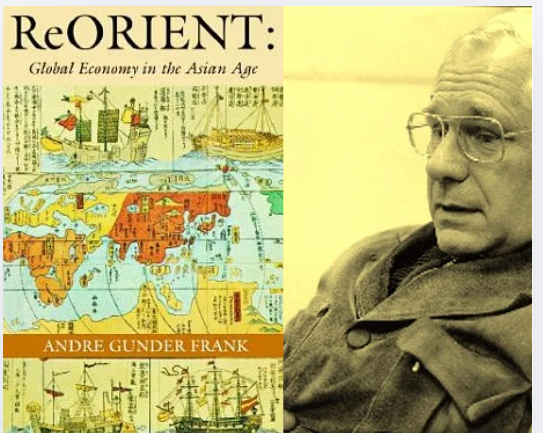
ReORIENTing the World: Andre Gunder Frank and the Return of the Asian Age
The intellectual importance of Andre Gunder Frank in the late twentieth and early twenty-first century lies not merely in his role as a critic of dependency, capitalism, or Eurocentrism, but in his attempt to fundamentally relocate the axis of world history away from the Atlantic imagination and toward Asia as the long-duration center of the world economy. His works ReORIENT: Global Economy in the Asian Age and ReOrienting the 19th Century together constitute one of the most ambitious paradigmatic interventions in the sociology of civilizations after the collapse of the Cold War world. Frank was not simply revising historical sociology; he was attempting to overturn the entire epistemological geography upon which modern Western social theory had been constructed since the Enlightenment.
Frank’s intervention emerged historically from several intertwined crises. The first was the exhaustion of modernization theory after the Vietnam War and the failure of postcolonial developmental states to reproduce the linear trajectory predicted by Western economists and sociologists. The second was the visible rise of East Asian economies—Japan first, then South Korea, Taiwan, Singapore, Hong Kong, and eventually China—which deeply unsettled Weberian assumptions about Protestantism, rationality, and capitalism. The third was the collapse of the Soviet Union in 1991, which produced a temporary triumphalist discourse about “the end of history” in Atlantic intellectual circles even as Asia was already beginning to reorganize global production, trade, finance, and demographic energy. Frank understood earlier than most Western theorists that the so-called “rise of the West” was historically abnormal and perhaps temporary. In this sense, he belongs to the same broad intellectual constellation as Samir Amin, Immanuel Wallerstein, Giovanni Arrighi, and later Kenneth Pomeranz and John M. Hobson. Yet Frank differed from all of them in one decisive respect: he pushed the origins of the world system far deeper into history and insisted that Asia—not Europe—was its organizing center until approximately the nineteenth century.
Born in Berlin in 1929 into a family fleeing Nazism, Frank carried within him the memory of civilizational catastrophe. His intellectual biography is inseparable from exile, migration, and geopolitical upheaval. Educated in the United States but intellectually radicalized in Latin America, especially Chile under Salvador Allende, Frank initially became famous for dependency theory and his critique of development economics. His early work, especially Capitalism and Underdevelopment in Latin America (1967), attacked the belief that “underdevelopment” represented a primitive stage preceding modernity. Instead, he argued that underdevelopment itself was actively produced by the unequal integration of peripheral regions into global capitalism. This formulation transformed development studies, historical sociology, and political economy across Latin America, Africa, and Asia. Yet Frank later became dissatisfied even with dependency theory because he believed it remained excessively Europe-centered in its historical assumptions. He increasingly moved toward macro-civilizational analysis and global historical reconstruction.
The great methodological revolution of ReORIENT lay in its attack upon what Frank called “Eurocentric social theory.” He argued that thinkers such as Karl Marx, Max Weber, Adam Smith, and even Fernand Braudel unconsciously reproduced a narrative in which Europe was treated as the natural origin of modernity, capitalism, rationality, and industrial development. Frank sought to invert this entire historiographical architecture. In his reading, the global economy between 1400 and 1800 was fundamentally Asian-centered, with China functioning as the principal gravitational force of world trade, silver circulation, manufacturing productivity, and demographic vitality. Europe was peripheral, fragmented, and relatively weak until the late eighteenth century.
Frank’s reconstruction of the early modern world economy depended heavily on global trade networks. He emphasized that silver extracted from the Americas did not remain in Europe but flowed overwhelmingly toward China because Chinese markets possessed stronger productive capacities and greater demand for bullion. Europe, therefore, did not “create” the world economy; rather, Europe inserted itself into an already existing Afro-Eurasian commercial network centered upon China, India, Southeast Asia, and the Islamic world. Frank repeatedly insisted that European expansion was parasitic before it became hegemonic. This argument directly challenged classical Weberian assumptions about Protestant rationality and capitalist uniqueness. In Frank’s formulation, the dynamism of Ming and Qing China, Mughal India, Ottoman commerce, and Indian Ocean trading systems far exceeded that of Europe until approximately 1750–1800.
The sociological implications of this argument were enormous. If capitalism, trade rationality, long-distance finance, urban manufacturing, and technological sophistication existed across Asia centuries before Europe’s industrial revolution, then the entire narrative of “Western exceptionalism” became unstable. Frank therefore anticipated many later debates around the “Great Divergence.” Scholars such as Kenneth Pomeranz would later argue that parts of China and Europe remained economically comparable until the late eighteenth century. Frank radicalized this thesis further by arguing that Asia was not merely “comparable” to Europe but actually superior in aggregate productivity, market integration, and demographic weight.
Frank’s later work, especially ReOrienting the 19th Century, written with Robert A. Denemark, extended this argument into contemporary globalization. Here the central claim was that the nineteenth century should not be interpreted solely as the century of European triumph but as a transitional phase in a much longer Asian-centered world historical process. Europe’s industrial dominance emerged not because of inherent civilizational superiority but because of contingent geopolitical, ecological, colonial, and financial factors. Frank saw the contemporary rise of China not as a novelty but as a restoration of historical normalcy.
This is why Frank became profoundly important for the sociology of civilizations. Classical sociology—from Weber to Durkheim to Parsons—developed during the zenith of European imperial power. Consequently, much of classical sociological theory naturalized European categories as universal categories. Frank exposed the provincialism hidden within this supposedly universal social science. In this sense, his work parallels the interventions of Edward Said in Orientalism, but Frank’s focus was economic history and civilizational macro-sociology rather than literary discourse. He attempted to provincialize Europe historically, materially, and demographically. Long before the discourse of “decoloniality” became fashionable in universities, Frank had already opened a large intellectual front against Eurocentric historiography.
Yet Frank’s importance also lies in his methodological ambition. He rejected methodological nationalism and insisted on analyzing civilizations relationally. No civilization, in his view, developed autonomously. China, India, Persia, the Ottoman world, Africa, Europe, and the Americas were interconnected through trade, migration, technology transfer, epidemics, and monetary circulation. This holistic approach resonates strongly with contemporary network theory and global systems analysis. In today’s digitally interconnected world—what may be called the multi-civilizational global network society—Frank appears unexpectedly prophetic. The re-emergence of China, the Belt and Road Initiative, the expansion of BRICS, the weakening of Atlantic monopoly power, and the rise of Asian financial and technological ecosystems all appear as empirical confirmations of his broader intuition that world history was never fundamentally Eurocentric.
However, Frank’s work also generated intense criticism. Conservative historians accused him of “Sinocentrism” replacing Eurocentrism. Critics such as Ricardo Duchesne argued that Frank underestimated Europe’s distinctive scientific, military, and institutional transformations after the Renaissance and Enlightenment. Others claimed that Frank minimized the importance of political pluralism, maritime expansion, scientific revolution, and industrial innovation in Europe. Some Marxists criticized Frank for abandoning class analysis in favor of civilizational macrohistory. Even within world-systems theory, Frank differed sharply from Wallerstein by insisting that the world system predated European capitalism by millennia.
Nevertheless, the significance of Frank today cannot be measured merely by empirical correctness. His deeper contribution was epistemological destabilization. He compelled sociologists, historians, economists, and civilization theorists to reconsider the geography of theory itself. Why should Europe be treated as the universal subject of history and Asia as merely reactive? Why should capitalism be understood only through Protestantism? Why should industrial modernity erase earlier forms of commercial sophistication across Asia? These questions transformed comparative historical sociology after the 1990s.
Frank’s legacy becomes even more relevant in the contemporary planetary condition characterized simultaneously by digital capitalism, ecological crisis, geopolitical fragmentation, artificial intelligence, postcolonial resurgence, and civilizational pluralism. The world today no longer resembles the triumphalist unipolar order imagined after 1991. Instead, it resembles precisely the kind of polycentric civilizational field that Frank anticipated. China’s technological ascent, India’s demographic and digital expansion, Islamic financial networks, Eurasian connectivity projects, and the weakening legitimacy of Atlantic universalism together indicate the exhaustion of the old Eurocentric historical imagination.
In this sense, Frank should be read not only as a historian of Asia but as a theorist of planetary transition. His “Asian Age” was never merely geographical. It was civilizational and epistemological. He argued that the future of social theory required abandoning the conceit that modernity belonged exclusively to the West. Contemporary sociology of civilizations, if it wishes to survive in the age of global networks and multipolarity, must engage seriously with Frank’s challenge.
The deeper irony, however, is that Frank himself emerged from the intellectual traditions of the West he criticized. Like Karl Marx before him, he used the internal resources of European critical thought to expose Europe’s own provincialism. This dialectical tension gives his work enduring vitality. He was simultaneously inside and outside the Western canon. That is why ReORIENT remains not simply a historical study but a civilizational intervention.