Historical sociology emerged not merely as a subdiscipline within sociology, but as a revolt against the short memory of positivist modern social science. The discipline was born from dissatisfaction with the tendency of conventional sociology—particularly after the Second World War—to fragment society into measurable variables while neglecting long durée civilizational processes, wars, ecological shifts, theological disputes, imperial encounters, and technological transformations that shape human consciousness across centuries. The roots of historical sociology lie simultaneously in the works of Karl Marx, Max Weber, Émile Durkheim, Oswald Spengler, Arnold J. Toynbee, Norbert Elias, Fernand Braudel, Immanuel Wallerstein, Barrington Moore Jr., Charles Tilly, Theda Skocpol and later civilizational theorists who refused to reduce human life to surveys and statistics alone.
The great strength of historical sociology lies precisely in its ability to restore temporality into social theory. Conventional sociology often studies “society” as if it were frozen in the present. Historical sociology studies society as movement, memory, conflict, sedimentation, and transformation. In conventional American-style positivist sociology after 1945, particularly under the influence of survey research, behavioralism, and systems theory, society increasingly appeared as an administratively measurable object. Historical sociology challenged this narrowing of vision by insisting that capitalism, nationalism, religion, war, kinship, technology, and even emotions are products of historically layered processes.
The epistemological foundations of historical sociology are therefore fundamentally different from conventional empiricist sociology. It treats time not as a background variable but as constitutive of social reality itself. Norbert Elias in The Civilizing Process (1939) demonstrated that personality structures, bodily discipline, shame, and etiquette emerged through centuries-long transformations in state formation and aristocratic competition.[2] Similarly, Fernand Braudel revolutionized historical inquiry by introducing the concept of longue durée, arguing that civilizations move through deep temporal rhythms shaped by geography, climate, trade routes, and collective mentalities rather than merely through political events.
Historical sociology thus possesses several methodological advantages over conventional sociology. First, it can compare civilizations across centuries rather than limiting analysis to one nation-state or one survey cycle. Second, it integrates macro-history with micro-experience. Third, it recognizes the role of contingency, warfare, ecological collapse, epidemics, and theology in shaping institutions. Fourth, it allows sociology to converse with history, anthropology, political economy, theology, archaeology, literary studies, and media studies. Finally, historical sociology resists the presentism of digital modernity.
The rise of historical sociology in different countries reflected different intellectual anxieties. In Germany, it emerged through debates on rationalization, capitalism, bureaucracy, and civilizational decline after industrial modernity. In France, the Annales School transformed historical imagination by emphasizing structures rather than events. In the United Kingdom, scholars such as E. P. Thompson and Perry Anderson linked class formation with longue durée historical processes. In the United States, historical sociology emerged partly as a critique of structural functionalism and Cold War modernization theory. In India, historical sociology took distinct forms through the works of D. P. Mukerji, Radhakamal Mukerjee, A. K. Saran, M. N. Srinivas and later scholars sought to understand caste, civilization, colonialism, religion, and modernity through historical-cultural processes rather than merely quantitative categories.
The technical transformations of historical sociology in the digital age are equally significant. Earlier generations depended on archives, manuscripts, census data, diplomatic correspondence, and ethnographic memory. Contemporary historical sociology increasingly uses digital archives, satellite imagery, AI-assisted textual analysis, social media traces, and network analytics. Yet this technological abundance also creates a paradox. The more data available, the weaker historical memory often becomes. Digital societies produce immense information but shallow historical consciousness.
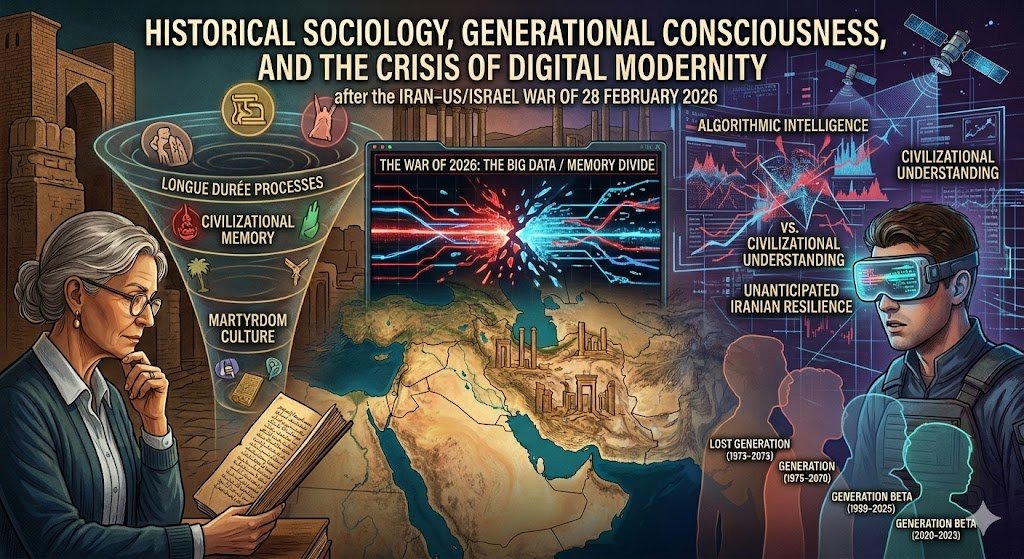
This paradox became particularly visible after the global digitalization of everyday life following the COVID-19 pandemic and intensified dramatically during the Iran–US/Israel war that erupted on 28 February 2026. The war revealed a profound contradiction within digital modernity itself. The United States and its allies possessed unmatched surveillance capabilities, AI-driven military analytics, cyber infrastructures, satellite networks, and information warfare systems. Yet they failed to adequately understand the theological depth, civilizational memory, martyrdom culture, decentralized resilience, and historical consciousness embedded within Iranian society. This failure was not merely military or diplomatic; it was epistemological. Digital power mistook data accumulation for civilizational understanding.
Historical sociology becomes indispensable precisely at this point. Conventional geopolitical analysis viewed Iran through categories such as sanctions, GDP, missile capability, oil production, internet penetration, or authoritarianism. Historical sociology instead asks deeper questions: how did the memory of the 1979 Islamic Revolution survive globalization? How did Shi‘a martyrological consciousness shape resilience? How did the Iran–Iraq War (1980–1988) produce a culture of endurance? How did sanctions unintentionally strengthen decentralized technological nationalism? Why did networked youth not necessarily become Westernized liberal subjects despite living within global digital culture? These are historical-sociological questions that conventional digital analytics failed to grasp.
The discourse of “generations” itself emerged within this broader modern attempt to classify historical consciousness. After the First World War, European and American societies increasingly began to perceive youth cohorts as historically distinct entities shaped by shared technological, military, economic, and media environments. Karl Mannheim provided one of the earliest sophisticated theories in his essay “The Problem of Generations” (1928), arguing that generations are not simply age groups but cohorts formed through shared exposure to decisive historical events during formative years.
The so-called “Lost Generation” after the First World War referred to young Europeans traumatized by mechanized warfare, trench death, and the collapse of nineteenth-century liberal optimism. Writers such as Ernest Hemingway and T. S. Eliot reflected this fragmented consciousness. The Second World War then produced another generation shaped by total war, fascism, nuclear anxiety, and reconstruction.
The post-1945 “Baby Boomers” emerged during industrial prosperity, welfare-state expansion, television culture, suburbanization, and Cold War stability in the Atlantic world. This generation inherited mass education, consumer capitalism, and the ideological competition between capitalism and socialism. The 1960s transformed many among them into protest generations through anti-war movements, civil rights struggles, feminism, counterculture, and new spiritualities.
Generation X, broadly associated with births after the late 1960s and 1970s, matured during deindustrialization, neoliberal restructuring, divorce culture, television saturation, and the decline of Cold War certainties. Their consciousness was marked less by collective utopianism and more by irony, skepticism, and fragmentation.
The so-called Millennials, generally associated with those born after approximately 1981–1991 depending on regional classification, were the first generation to come of age during globalization, the internet revolution, mobile communication, and post-Cold War unipolarity. Their formative events included 9/11, the Iraq War, financial crises, social media expansion, and precarious labor markets. Generation Z, born roughly after the late 1990s or early 2000s, became the first generation fully socialized within algorithmic life, smartphones, streaming culture, platform capitalism, and digital surveillance architectures.
The labels “Generation Alpha” and now “Generation Beta” increasingly reveal the corporate-technological colonization of human temporality itself. Childhood is now branded like software versions. Human generations are named according to market segmentation logic, predictive analytics, and digital consumer mapping. Earlier generations were historically remembered through wars, revolutions, religious awakenings, or civilizational transformations. Contemporary generations are increasingly classified through technological ecosystems and platform exposure.
This transformation corresponds closely with what Manuel Castells called the “network society,” where flows of information, capital, images, and power increasingly transcend territorial boundaries. Yet the rhetoric of the “global village,” first popularized by Marshall McLuhan, concealed enormous asymmetries of technological power and cultural interpretation.
The Iran–US/Israel conflict after February 2026 exposed these contradictions dramatically. Despite unprecedented digital infrastructures, Western strategic systems repeatedly underestimated historical memory, religious symbolism, decentralized networks, and civilizational resilience. The war demonstrated that algorithmic intelligence cannot easily replace historical understanding. Big data can predict consumption patterns more easily than sacrificial consciousness. Artificial intelligence can model logistics more effectively than martyrdom traditions. Digital surveillance can map networks but cannot fully comprehend metaphysical commitments.
The overgeneralization of generational categories therefore demands serious criticism. First, these labels are overwhelmingly Atlantic-centric. They often universalize experiences of middle-class Euro-American youth while ignoring the diversity of Asian, African, Latin American, and Middle Eastern historical experiences. A child born in rural India in 2001, a refugee born in Syria in 2001, and an upper-middle-class child born in the United States in 2001 may technically belong to “Generation Z,” yet their civilizational experiences differ radically.
Second, generational branding increasingly functions as market sociology rather than historical sociology. Technology corporations, advertisers, management theorists, and digital platforms use generational labels to predict consumption, political behavior, and attention economies. Human beings are transformed into demographic data clusters.
Third, digital discourse exaggerates novelty. Every generation imagines itself unprecedented. Yet many supposedly “new” anxieties—alienation, technological fear, moral panic, fragmentation, loneliness, war trauma, youth rebellion—have appeared repeatedly throughout modern history since at least the nineteenth century. Historical sociology restores continuity where digital culture produces amnesia.
Fourth, digital-age generational discourse ignores civilizational time. Traditional societies often organized memory through sacred calendars, dynastic cycles, epics, rituals, ecological rhythms, or cosmological ages. Contemporary digital capitalism instead organizes memory through platform updates, device generations, and trending cycles. Time itself becomes commodified and accelerated.
Finally, the events after 28 February 2026 revealed the limits of techno-managerial understandings of society. The United States possessed immense computational capability, yet failed to fully anticipate the depth of Iranian resilience because civilizational memory cannot be reduced to digital metrics alone. Historical sociology therefore becomes more important precisely in the age of artificial intelligence. The future will not be understood merely through predictive analytics, but through historically grounded interpretations of civilizations, religions, memories, wars, symbols, and collective emotions.
The greatest danger of the contemporary digital order is not simply surveillance; it is the replacement of historical consciousness with real-time informational immediacy. Human beings increasingly know “updates” but not history, “feeds” but not civilizations, “algorithms” but not traditions. Historical sociology remains one of the few intellectual traditions capable of resisting this flattening of time. It reminds us that societies are not software systems alone; they are accumulations of memory, suffering, theology, ecology, warfare, imagination, and hope across centuries.