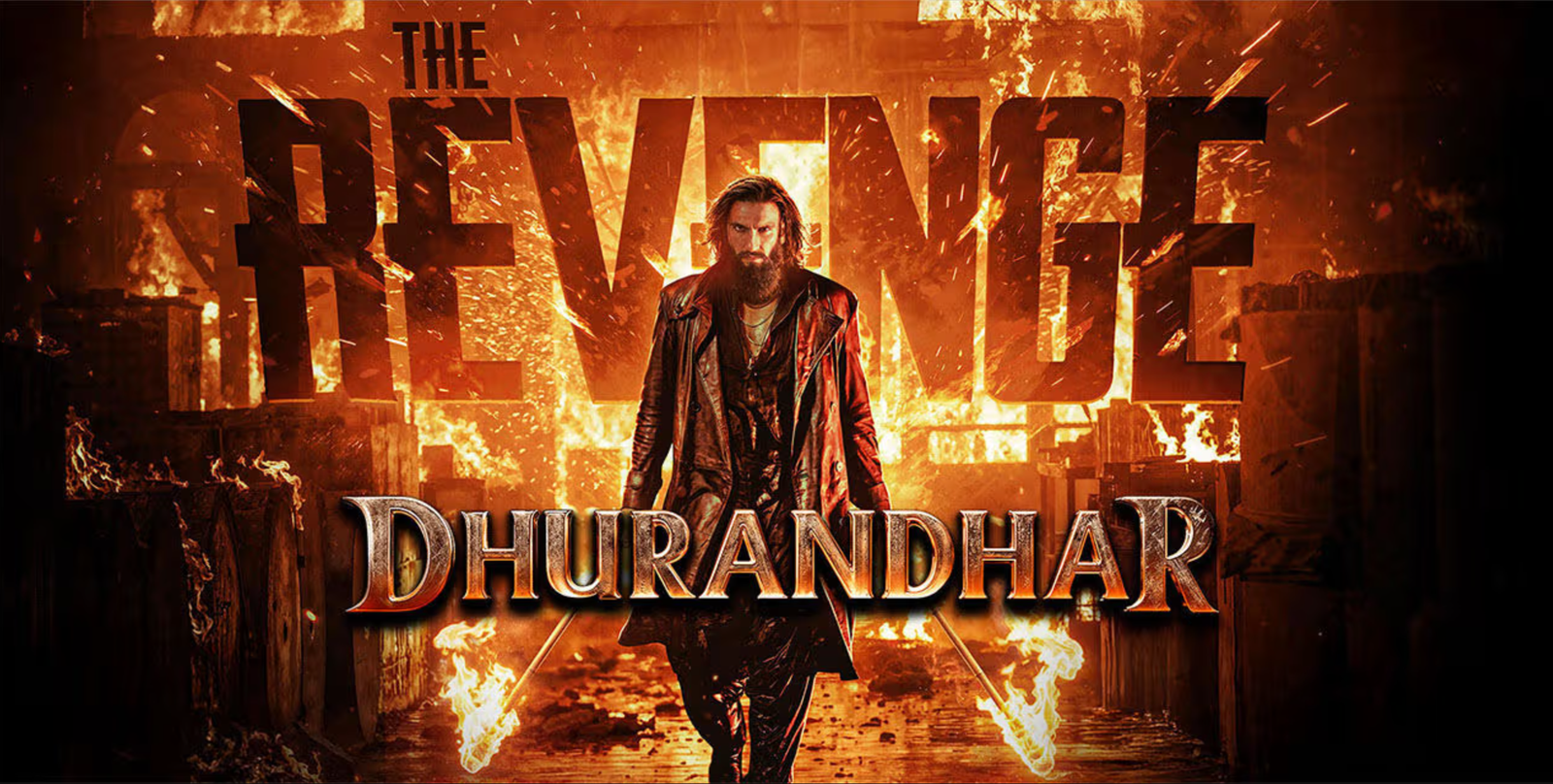
The period 2025–2026 marks a decisive cinematic moment in India because the screen is no longer merely entertaining the nation; it is reorganising the moral imagination of war. On one side stands the renewed epic universe of the Ramayana, with Nitesh Tiwari’s large-scale adaptation scheduled for Diwali 2026 and framed around Rama, Sita, Ravana, Lakshman, and Hanuman as figures of sacred memory. On the other side stands Dhurandhar, Aditya Dhar’s geopolitical spy-war universe, which Netflix describes as an action thriller inspired by real geopolitical events and whose 2025 film and 2026 sequel have become major post-pandemic popular events. Between these two poles lies the Mahabharata, not necessarily as one particular film but as the permanent Indian grammar of morally ambiguous war: war as duty, deception, statecraft, kinship collapse, cosmic burden and historical necessity.
The deeper point is that Indian cinema after Corona is not simply returning to mythological spectacle. It is returning to the sacred under the conditions of technological violence. Ramayana represents the older sacred war, where the conflict is ultimately intelligible as the restoration of cosmic order. The Mahabharata represents the tragic sacred war, where dharma does not appear in pure light but through dilemma, ambiguity, strategy and terrible loss. Dhurandhar represents the postmodern cinematic war, where the battlefield is no longer Kurukshetra or Lanka but intelligence networks, borderless surveillance, memory war, revenge, covert operations, digital circulation, streaming platforms and geopolitical effect.
This is why the movement from Ramayana to Dhurandhar via Mahabharata is not accidental. It is the passage from sacred clarity to sacred ambiguity to sacred opacity. In the Ramayana, war is still ritually framed. In the Mahabharata, war becomes philosophically unbearable. In Dhurandhar, war becomes cinematic, technological, covert, fragmented and affectively national. Yet the sacred does not disappear. It returns in another form: not as temple alone, not as scripture alone, but as mass emotional energy after a pandemic that had already forced humanity to confront death, isolation, state power, biological vulnerability and invisible enemies.
The post-Corona spectator is therefore not the old secular spectator of the Nehruvian or liberal-modern cinema hall. He or she has passed through fear, lockdown, mortality, vaccine-politics, digital dependency and civilizational anxiety. This spectator does not receive war merely as action. War now appears as revelation. The audience wants scale because ordinary life has become small. It wants sacred memory because modernity has become unstable. It wants masculine, martial, protective figures because the state, the family and the body were all experienced as vulnerable during Corona. It wants the epic because the news itself has become epic.
In this sense, Dhurandhar is not the opposite of Ramayana. It is its postmodern shadow. Rama fights openly; the modern operative fights invisibly. Rama’s war is witnessed by gods, sages, vanaras and rakshasas; the covert-war hero is witnessed by cameras, algorithms, leaks, streaming charts and hostile publics across borders. Ravana is a metaphysical adversary; the modern enemy is dispersed across terrorism, espionage, betrayal, cartels, states, non-state actors and media narratives. Yet both worlds ask the same question: when violence becomes unavoidable, how can it be morally located?
The Mahabharata is the indispensable bridge because it teaches India that sacred war is never merely pure war. Krishna’s presence does not abolish strategy; it sanctifies responsibility under conditions where innocence has already been destroyed. This is the grammar through which contemporary Indian war cinema must be read. The new cinematic warrior is not merely a nationalist hero. He is a post-Kurukshetra figure: morally burdened, wounded, technologically armed, politically used, yet still carrying an obscure hunger for dharma.
Therefore the return of the sacred after Corona is not a simple revival of religiosity. It is the return of civilizational metaphysics through the cinematic imagination of war. Indian cinema is discovering that modern war cannot be understood only through realism, journalism, geopolitics or entertainment. It requires epic categories. It requires Rama, Ravana, Krishna, Arjuna, Bhishma, Karna and Ashwatthama as symbolic presences, even when the visible story is about spies, borders, terror networks or revenge. The sacred has returned not by rejecting technology, but by entering the technological battlefield itself.