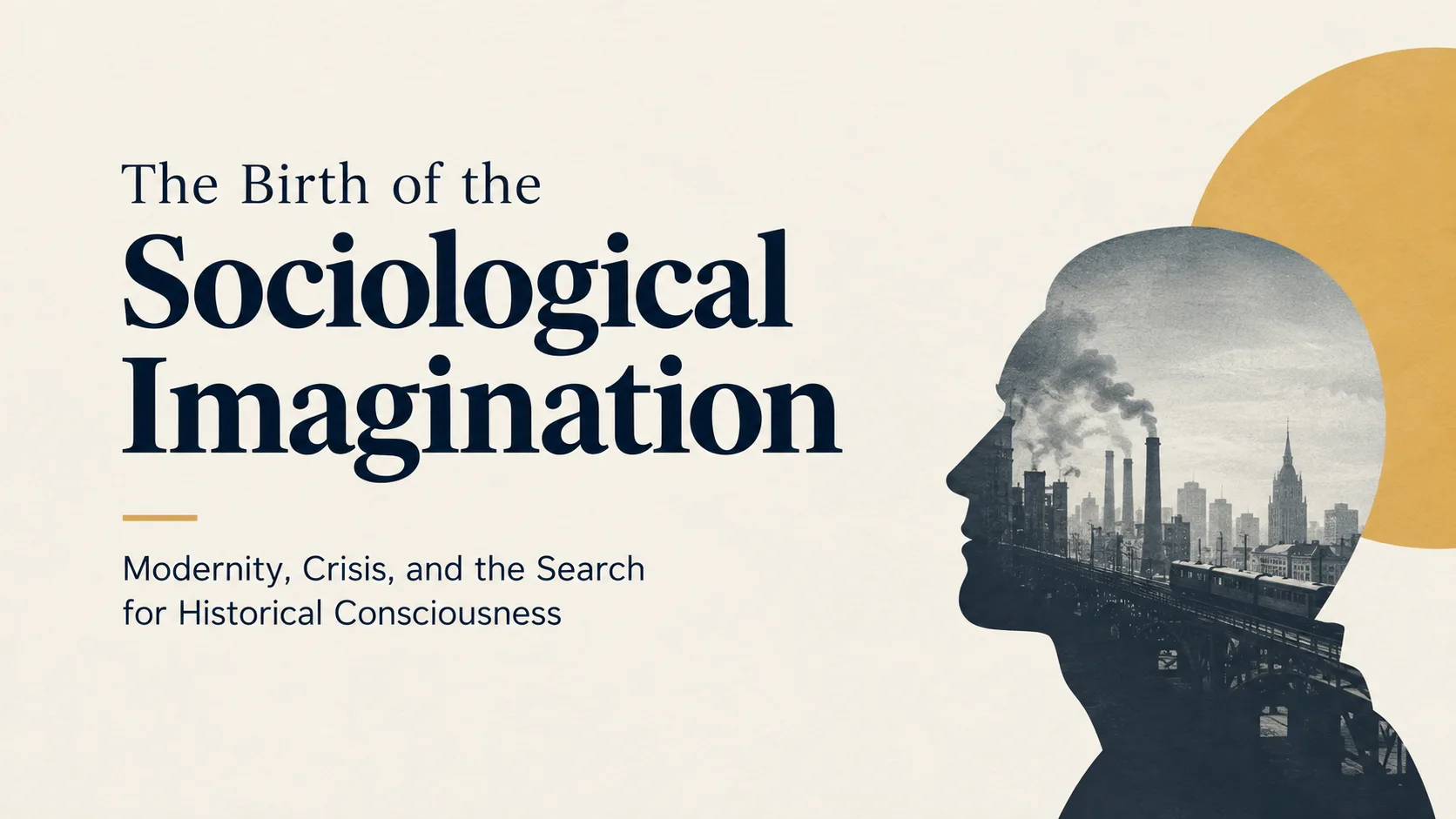
Modernity, Crisis, and the Search for Historical Consciousness
The sociological imagination emerged historically not as a peaceful academic doctrine but as an intellectual rebellion born from the deep civilizational crises of modernity. Sociology itself was the child of rupture. The collapse of medieval cosmology, the Protestant Reformation, the Scientific Revolution, the rise of industrial capitalism, the French Revolution, colonial expansion, urbanization, and technological rationalization shattered the older sacred order of Europe and gradually produced a new social world characterized by mobility, alienation, bureaucracy, and uncertainty. Human beings who had once lived within relatively stable frameworks of kinship, religion, guilds, locality, and inherited cosmology suddenly found themselves thrown into rapidly changing industrial societies governed increasingly by markets, machines, nation-states, and abstract systems of power. Sociology was born as the intellectual attempt to understand this unprecedented transformation of civilization.
Auguste Comte, who first coined the term sociology, understood this rupture with remarkable clarity. Comte believed that European civilization had entered a prolonged state of moral and intellectual anarchy after the destruction of medieval theological unity during the Reformation and the Enlightenment. His “positive philosophy” was not simply an epistemological project but an attempt to restore social order and moral cohesion within industrial civilization. Comte therefore envisioned sociology as the “queen of sciences” because only sociology could synthesize knowledge about humanity as a collective civilizational organism. In Comte’s imagination, sociology was simultaneously science, secular theology, and moral philosophy. Society could not survive merely through technological progress or economic expansion; it required a shared moral imagination. Thus from its very birth sociology contained an implicit civilizational anxiety regarding the fragmentation of modernity. This deeper concern would later reappear in Durkheim’s theory of anomie, Weber’s account of disenchantment, Simmel’s reflections on metropolitan alienation, and eventually in Mills’ formulation of the sociological imagination itself.
The nineteenth century witnessed the acceleration of industrial capitalism across Europe and North America. Railways, steam power, mechanized factories, colonial trade networks, urban expansion, and financial capitalism transformed not only economies but consciousness itself. Traditional village life declined while anonymous urban existence expanded. Human relationships increasingly became mediated through money, bureaucracy, and contractual systems rather than kinship or sacred obligations. Karl Marx interpreted this transformation through the concept of alienation. Workers became estranged from their labor, from the products they created, from nature, and ultimately from their own humanity. Marx’s historical materialism was itself a form of sociological imagination because it connected individual suffering with wider structures of capitalist production and class power. Poverty was not personal failure but structural exploitation; religion was not merely belief but also a social response to historical suffering; consciousness itself was shaped by material conditions. Marx therefore transformed personal misery into historical analysis.
Émile Durkheim similarly attempted to understand the moral consequences of industrial modernity. In The Division of Labour in Society and later in Suicide, Durkheim demonstrated that even the most intimate human acts could not be understood outside broader social structures. Suicide, which appeared to be the most personal of decisions, was shown statistically to vary according to social integration and moral regulation. Durkheim thereby revealed one of the foundational principles of the sociological imagination: personal troubles often reflect public issues embedded within collective life. Modern societies, according to Durkheim, suffered increasingly from anomie—a condition of moral disorientation produced by rapid social change and weakened collective norms. Industrial civilization generated material abundance but simultaneously eroded older moral communities. Durkheim feared that excessive individualism would produce spiritual exhaustion and social fragmentation.
Max Weber deepened this analysis by examining the relationship between rationalization, bureaucracy, religion, and power. Weber’s sociology was profoundly tragic because he believed that modernity increasingly trapped humanity within what he famously called the “iron cage” of rationalization. Bureaucratic administration, capitalist accounting, legal formalism, and scientific calculation gradually displaced charismatic and traditional forms of life. Weber did not reject rationality itself; rather he feared that instrumental rationality would colonize every sphere of existence. Human beings would become technically efficient yet spiritually impoverished. In this sense Weber anticipated many themes later central to Mills’ sociological imagination. Individuals increasingly experienced helplessness because vast bureaucratic systems controlled economic life, politics, education, military organization, and even knowledge production itself.
Georg Simmel offered perhaps the most psychologically refined account of modernity among the classical sociologists. In essays such as “The Metropolis and Mental Life,” Simmel argued that urban modernity transformed consciousness through overstimulation, monetary abstraction, and fragmented social interaction. The metropolitan individual developed a “blasé attitude” as a defensive mechanism against sensory overload and emotional exhaustion. Money became the universal mediator of social relations, reducing qualitative human experience into quantitative calculation. Simmel’s sociology represented an extraordinary early attempt to understand how structural transformations affect subjective consciousness. Here again one finds the embryonic form of the sociological imagination: the ability to connect inner psychological experience with broader historical processes.
Yet by the mid-twentieth century sociology itself entered crisis. After the Second World War, especially in the United States, sociology became increasingly institutionalized within universities, military research programs, governmental agencies, and corporate-funded research organizations. Talcott Parsons constructed vast theoretical systems attempting to explain social order through functional integration, while large-scale quantitative surveys dominated empirical research. Although these developments expanded sociology institutionally, they also produced intellectual rigidity. Sociology risked becoming either excessively abstract or narrowly technical. It was precisely against this background that C. Wright Mills intervened.
Mills belonged to a generation shaped by the Great Depression, fascism, world war, atomic anxiety, Cold War militarization, and the rise of corporate bureaucracies. Unlike Parsons, Mills distrusted grand theoretical systems detached from lived reality. Unlike positivistic survey researchers, he rejected the reduction of human beings to statistical variables. Mills believed that sociology had lost its moral and historical imagination. In The Sociological Imagination (1959), he therefore called for the restoration of a sociology capable of connecting biography with history and personal troubles with public issues. His intervention was simultaneously methodological, political, and existential.
Mills argued that ordinary individuals often feel trapped because they cannot understand the larger historical structures shaping their lives. A farmer losing land, a worker facing unemployment, a student experiencing anxiety, or a family confronting instability may interpret these conditions as purely personal failures. Yet sociology reveals that these experiences are often consequences of structural transformations such as industrial decline, militarization, economic crises, urbanization, bureaucratic rationalization, or changing gender systems. The sociological imagination therefore liberates individuals from the illusion that their suffering exists in isolation. It situates private experience within historical processes.
The distinction Mills drew between “personal troubles” and “public issues” became one of the foundational insights of modern sociology. Troubles occur within the immediate milieu of individual life, whereas issues involve the organization of social institutions and historical structures. Unemployment affecting one person may appear personal, but unemployment affecting millions becomes a structural issue rooted in economic organization. Divorce within one household may seem private, but rising instability in family structures reflects broader transformations in economy, gender roles, urbanization, and cultural values. Anxiety among isolated individuals becomes intelligible only when connected to militarized societies, technological acceleration, or consumer capitalism.
For Mills, the sociological imagination also required historical consciousness. Human beings live within biographies, but biographies unfold within historical epochs. One cannot understand a medieval monk, an industrial worker, a digital-age programmer, or an artificial intelligence engineer outside the historical structures shaping their possibilities. History is not external to personal life; it enters directly into consciousness, aspiration, fear, and identity. Thus sociology without history becomes superficial, while history without sociology becomes descriptive chronicle. Mills sought their synthesis.
Yet Mills’ project was deeper than methodology. Beneath his sociology lay a democratic moral vision. He feared that modern societies were increasingly dominated by what he called the “power elite”—a fusion of corporate, military, and political institutions controlling public life without democratic accountability. Bureaucratic systems reduced citizens into passive spectators rather than active historical agents. Mass media manufactured consent while consumer culture distracted individuals from structural critique. Under such conditions the sociological imagination became essential for democratic freedom itself. Without historical understanding, citizens could not recognize the structures dominating their lives.
Mills’ critique was also directed inward toward sociology as a profession. He attacked what he called “grand theory,” particularly the abstract system-building associated with Talcott Parsons, because it removed sociology from historical reality. At the same time he criticized “abstracted empiricism,” the obsession with technical survey research detached from substantive human concerns. Sociology, according to Mills, should neither dissolve into metaphysical abstraction nor fragment into bureaucratic data collection. It must remain connected to living human problems. The sociologist therefore required what Mills called “intellectual craftsmanship”—the cultivation of historical sensitivity, philosophical reflection, comparative imagination, and moral responsibility.
The sociological imagination thus emerged at the intersection of biography, history, and civilization. It inherited insights from Marx, Durkheim, Weber, and Simmel while simultaneously responding to the bureaucratic and technological transformations of postwar modernity. Mills transformed sociology into a form of public consciousness capable of exposing invisible structures of power beneath everyday life. In doing so he revived the original civilizational ambition of sociology itself: to understand the destiny of humanity within rapidly changing historical worlds.
Today the relevance of Mills appears even greater than during his own lifetime. Digital capitalism, artificial intelligence, surveillance technologies, ecological crisis, pandemics, financial instability, and global communication networks have intensified the relationship between personal life and planetary structures. Anxiety, loneliness, unemployment, identity crises, and political polarization can no longer be understood merely psychologically. They are embedded within algorithmic systems, technological infrastructures, global capitalism, and ecological transformations. The sociological imagination therefore remains indispensable because it alone provides the intellectual bridge between intimate human experience and historical civilization.
In this sense the sociological imagination is not merely a sociological method. It is a mode of historical awakening. It teaches human beings to perceive themselves not as isolated individuals drifting meaninglessly through private anxieties, but as participants within larger civilizational dramas unfolding across time. Without such imagination, society fragments into disconnected experiences. With it, humanity regains the capacity to understand history, power, suffering, and freedom as interconnected dimensions of collective existence.
Reference Footnotes
- Auguste Comte regarded sociology as the culminating science capable of restoring moral and intellectual order after the theological and metaphysical crises produced by the French Revolution and industrial modernity. See Auguste Comte, The Positive Philosophy of Auguste Comte, trans. Harriet Martineau (London: George Bell & Sons, 1896), Vol. I, pp. 25–42.
- Comte’s theory of the “Law of Three Stages” was not merely epistemological but civilizational, linking theological, metaphysical, and positive forms of consciousness to transformations in European society and scientific organization. See Mary Pickering, Auguste Comte: An Intellectual Biography, Vol. I (Cambridge: Cambridge University Press, 1993), pp. 198–241.
- Karl Marx’s concept of alienation emerged from the transformation of labor under industrial capitalism and the commodification of social life. See Karl Marx, Economic and Philosophic Manuscripts of 1844, trans. Martin Milligan (Moscow: Progress Publishers, 1959), pp. 67–83.
- Marx’s historical materialism linked private suffering with structural contradictions embedded in capitalist production and class relations. See Karl Marx and Friedrich Engels, The German Ideology (New York: International Publishers, 1970), pp. 42–65.
- Émile Durkheim’s concept of anomie explained the moral disorientation produced by rapid industrial and social change. See Émile Durkheim, The Division of Labour in Society, trans. George Simpson (New York: Free Press, 1964), pp. 241–276.
- Durkheim’s Suicide demonstrated that even apparently personal acts are shaped by collective social structures such as religion, family integration, and moral regulation. See Émile Durkheim, Suicide: A Study in Sociology, trans. John Spaulding and George Simpson (New York: Free Press, 1951), pp. 145–276.
- Max Weber’s concept of rationalization described the expansion of bureaucratic and calculative systems in modern civilization. See Max Weber, Economy and Society, eds. Guenther Roth and Claus Wittich (Berkeley: University of California Press, 1978), Vol. I, pp. 956–1005.
- Weber’s metaphor of the “iron cage” reflected his anxiety regarding the spiritual consequences of modern bureaucratic capitalism. See Max Weber, The Protestant Ethic and the Spirit of Capitalism, trans. Talcott Parsons (London: Routledge, 1930), pp. 181–183.
- Georg Simmel argued that metropolitan life transformed consciousness through overstimulation, abstraction, and monetary exchange. See Georg Simmel, “The Metropolis and Mental Life,” in The Sociology of Georg Simmel, trans. Kurt Wolff (New York: Free Press, 1950), pp. 409–424.
- Simmel’s philosophy of money examined how monetary abstraction reshaped qualitative human relationships into quantitative exchange relations. See Georg Simmel, The Philosophy of Money, trans. Tom Bottomore and David Frisby (London: Routledge, 1990), pp. 211–356.
- Talcott Parsons attempted to construct a universal theory of social systems emphasizing equilibrium, norms, and functional integration. See Talcott Parsons, The Social System (Glencoe: Free Press, 1951), pp. 3–45.
- C. Wright Mills criticized both “grand theory” and “abstracted empiricism” for disconnecting sociology from historical reality and lived experience. See C. Wright Mills, The Sociological Imagination (New York: Oxford University Press, 1959), pp. 25–75.
- Mills’ distinction between “personal troubles” and “public issues” remains central to sociological methodology. See Mills, The Sociological Imagination, pp. 8–17.
- Mills believed sociology should connect biography and history in order to cultivate democratic public consciousness. See John Brewer, “The Sociological Imagination Revisited,” British Journal of Sociology 55, no. 3 (2004): 317–333.
- Mills’ critique of bureaucratic modernity paralleled earlier concerns of Weber regarding rationalization and administrative domination. See Irving Louis Horowitz, C. Wright Mills: An American Utopian (New York: Free Press, 1983), pp. 89–132.
- The emergence of mass society and Cold War bureaucracy deeply shaped Mills’ intellectual orientation. See Daniel Geary, Radical Ambition: C. Wright Mills, the Left, and American Social Thought (Berkeley: University of California Press, 2009), pp. 101–164.
- Steve Fuller’s The New Sociological Imagination attempted to reinterpret Mills for the age of biotechnology, artificial intelligence, and posthuman speculation. See Steve Fuller, The New Sociological Imagination (London: Sage Publications, 2006), pp. 1–29.
- Fuller argued that sociology must resist surrendering explanatory authority to biology and neuroscience. See Fuller, The New Sociological Imagination, pp. 87–118.
- Fuller’s project of “social epistemology” emphasized that knowledge production is institutionally organized and socially structured. See Steve Fuller, Social Epistemology (Bloomington: Indiana University Press, 1988), pp. 3–26.
- Ulrich Beck’s “risk society” thesis expanded sociological analysis toward planetary ecological and technological crises. See Ulrich Beck, Risk Society: Towards a New Modernity (London: Sage Publications, 1992), pp. 19–50.
- Anthony Giddens argued that late modernity intensifies reflexivity, uncertainty, and global interconnectedness. See Anthony Giddens, The Consequences of Modernity (Stanford: Stanford University Press, 1990), pp. 1–30.
- Immanuel Wallerstein’s world-systems theory connected individual biographies to long-duration structures of global capitalism. See Immanuel Wallerstein, World-Systems Analysis (Durham: Duke University Press, 2004), pp. 23–41.
- Zygmunt Bauman’s concept of “liquid modernity” described the instability and fragmentation of contemporary life under global capitalism. See Zygmunt Bauman, Liquid Modernity (Cambridge: Polity Press, 2000), pp. 1–15.
- Manuel Castells argued that digital communication networks fundamentally transform social organization and identity formation. See Manuel Castells, The Rise of the Network Society (Oxford: Blackwell, 1996), pp. 376–428.
- Contemporary sociological debates increasingly emphasize the relationship between artificial intelligence, surveillance capitalism, and human subjectivity. See Shoshana Zuboff, The Age of Surveillance Capitalism (New York: Public Affairs, 2019), pp. 8–25.
Global Bibliography
- Bauman, Zygmunt. Liquid Modernity. Cambridge: Polity Press, 2000.
- Beck, Ulrich. Risk Society: Towards a New Modernity. London: Sage Publications, 1992.
- Brewer, John D. “The Sociological Imagination Revisited.” British Journal of Sociology 55, no. 3 (2004): 317–333.
- Castells, Manuel. The Rise of the Network Society. Oxford: Blackwell, 1996.
- Comte, Auguste. The Positive Philosophy of Auguste Comte. Translated by Harriet Martineau. London: George Bell & Sons, 1896.
- Durkheim, Émile. The Division of Labour in Society. Translated by George Simpson. New York: Free Press, 1964.
- Durkheim, Émile. Suicide: A Study in Sociology. Translated by John Spaulding and George Simpson. New York: Free Press, 1951.
- Fuller, Steve. The New Sociological Imagination. London: Sage Publications, 2006.
- Fuller, Steve. Social Epistemology. Bloomington: Indiana University Press, 1988.
- Geary, Daniel. Radical Ambition: C. Wright Mills, the Left, and American Social Thought. Berkeley: University of California Press, 2009.
- Giddens, Anthony. The Consequences of Modernity. Stanford: Stanford University Press, 1990.
- Horowitz, Irving Louis. C. Wright Mills: An American Utopian. New York: Free Press, 1983.
- Marx, Karl. Economic and Philosophic Manuscripts of 1844. Translated by Martin Milligan. Moscow: Progress Publishers, 1959.
- Marx, Karl, and Friedrich Engels. The German Ideology. New York: International Publishers, 1970.
- Mills, C. Wright. The Sociological Imagination. New York: Oxford University Press, 1959.
- Parsons, Talcott. The Social System. Glencoe: Free Press, 1951.
- Pickering, Mary. Auguste Comte: An Intellectual Biography. 3 Vols. Cambridge: Cambridge University Press, 1993–2009.
- Simmel, Georg. The Philosophy of Money. Translated by Tom Bottomore and David Frisby. London: Routledge, 1990.
- Simmel, Georg. “The Metropolis and Mental Life.” In The Sociology of Georg Simmel, translated by Kurt Wolff, 409–424. New York: Free Press, 1950.
- Wallerstein, Immanuel. World-Systems Analysis. Durham: Duke University Press, 2004.
- Weber, Max. Economy and Society. Edited by Guenther Roth and Claus Wittich. Berkeley: University of California Press, 1978.
- Weber, Max. The Protestant Ethic and the Spirit of Capitalism. Translated by Talcott Parsons. London: Routledge, 1930.
- Zuboff, Shoshana. The Age of Surveillance Capitalism. New York: Public Affairs, 2019.