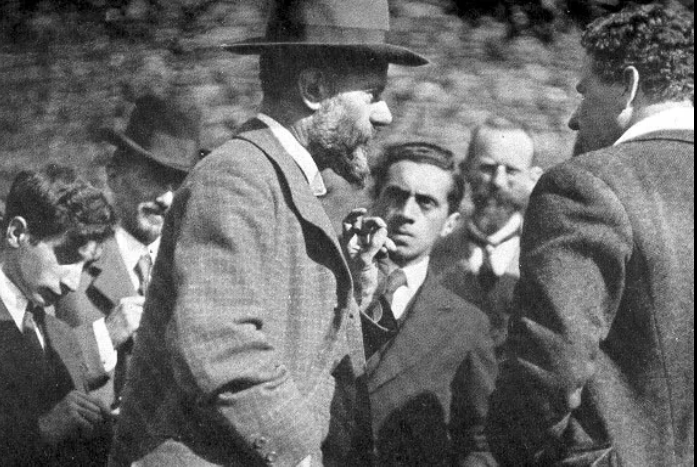
Max Weber as Politician, War Intellectual and Postwar Negotiator: A Critical Historiographical Reassessment
The image of Max Weber as detached academic sage sitting above politics has become increasingly untenable after the publication of modern Weber scholarship, especially the works of Wolfgang Mommsen and the editors of the Max Weber Gesamtausgabe. Contemporary research demonstrates that Weber was deeply embedded in German nationalist politics, wartime debates, constitutional struggles, and postwar negotiations. He was not merely sociologist of power; he was participant within the political crises of imperial and post-imperial Germany.[1]
The turning point in Weber studies came with Wolfgang Mommsen’s monumental Max Weber and German Politics, 1890–1920, originally published in German in 1959 and later translated into English.[2] Mommsen shattered the Cold War image of Weber as a purely liberal defender of neutral social science. Instead, Weber emerged as liberal nationalist, imperial thinker, constitutional reformer, and political intellectual deeply engaged with German power politics. Mommsen demonstrated that Weber’s political interventions were not marginal appendices to his sociology; they formed part of the same intellectual project.
Weber’s political inheritance itself came from family background. His father was associated with the National Liberal milieu of Bismarckian Germany and participated actively in Prussian and imperial politics.[3] Weber grew up within political culture where questions of German unification, empire, liberalism, nationalism, and statecraft were daily realities. His Freiburg inaugural lecture of 1895 already revealed intense nationalist concern regarding Germany’s future position in world politics. In that address Weber criticized Junker conservatism while simultaneously supporting overseas imperial expansion as necessary for German political maturity.[4]
This early political Weber complicates later attempts to portray him simply as neutral sociologist. Weber consistently believed that great powers required political energy, national leadership, military preparedness, and international influence. He admired political realism and distrusted sentimental pacifism. Unlike Leo Tolstoy, John Ruskin, or George Bernard Shaw, Weber never embraced moral pacifism.[5]
With the outbreak of the First World War in 1914, Weber entered political life even more directly. Initially he supported the German war effort enthusiastically and volunteered for administrative military service, organizing army hospitals in Heidelberg.[6] Modern scholars emphasize that Weber’s early wartime nationalism was genuine, though later modified critically. The Stanford Encyclopedia of Philosophy notes that Weber became “a fervent nationalist supporter of the War” before later criticizing aspects of German strategy and expansionism.
Yet Weber’s wartime role was more than emotional patriotism. He became a public commentator on strategy, parliamentarianism, German leadership, annexation policy, and constitutional reform.[7] His wartime journalism and political essays reveal thinkers intensely preoccupied with Germany’s geopolitical survival and institutional weakness.
This is where contemporary criticism becomes important. Weber’s sociology of capitalism and rationalization remained strikingly silent regarding the foundational role of military technology, war finance, imperial conquest, naval power, and colonial corruption in the making of European modernity.[8] By Weber’s own time, the role of war in European state formation had already been recognized widely within public and intellectual spheres.
From the Scottish Enlightenment onward, European thinkers repeatedly linked commerce, empire, military organization, and political power.[9] Recent scholarship by Anna Plassart has demonstrated how debates surrounding the French Revolution, Napoleon, commerce, republicanism, and imperial warfare deeply shaped European political modernity.[10] Weber could not plausibly have been unaware of these traditions.
Nor could Weber have been ignorant of the military foundations of German unification itself. The wars against Denmark, Austria, and France under Otto von Bismarck and Helmuth von Moltke the Elder demonstrated decisively that military organization, railway logistics, artillery coordination, conscription systems, and bureaucratic planning formed the backbone of modern German state power.[11]
Yet Weber’s sociology rarely made military technology and organized violence foundational categories of capitalist modernity. This silence has become increasingly visible after works by Charles Tilly, Michael Mann, and John Brewer demonstrated the centrality of military-fiscal states, coercion, taxation, and war-making in European modernization.[12]
Tilly’s famous argument that “war made the state and the state made war” directly challenges Weberian overemphasis upon religious ethics and bureaucratic legality alone.[13] European capitalism did not emerge merely through Protestant ascetic discipline. It also emerged through military extraction, colonial monopolies, naval supremacy, plantation systems, and imperial finance.
The omission becomes even more striking in relation to colonial corruption and imperial predation. By Weber’s time the scandals surrounding Robert Clive and Warren Hastings had long entered European historical consciousness.[14] Parliamentary debates, impeachment trials, and public controversies exposed how empire, corruption, violence, speculation, and commercial conquest structured British imperial expansion.
The impeachment of Hastings especially became a major European political spectacle involving questions of legality, morality, colonial administration, and imperial abuse.[15] Weber, trained as jurist and deeply engaged with political life, certainly knew these histories. Yet his sociology of capitalism rarely integrated colonial corruption into its explanatory framework.
This selective emphasis produced major historiographical consequences. Weber located the “spirit” of capitalism mainly within Protestant inner-worldly asceticism, disciplined vocation, and rational calculation.[16] But historians such as Fernand Braudel, Andre Gunder Frank, Sven Beckert, and W. E. B. Du Bois later demonstrated that capitalism also depended fundamentally upon slavery, colonial extraction, military conquest, and global violence.[17]
Weber’s wartime political role intensified after 1917. He became a strong advocate of constitutional reform and parliamentary government while simultaneously opposing humiliating peace conditions.[18] His famous essays “Parliament and Government in a Reconstructed Germany” argued that Germany’s political weakness resulted partly from excessive bureaucratic domination and insufficient parliamentary leadership.[19]
At the same time, Weber remained nationalist. He criticized reckless annexationism and unrestricted submarine warfare, yet he also feared Germany’s geopolitical collapse.[20] His politics therefore combined liberal constitutionalism with nationalist realism.
After Germany’s defeat Weber entered postwar political struggles directly. He co-founded the German Democratic Party, campaigned publicly, advised constitutional discussions, and participated in debates surrounding the Weimar settlement.[21] He also joined the German delegation connected with Versailles negotiations in 1919 and strongly opposed what he regarded as dishonorable peace terms.
Peter Thomas notes that Weber demanded rejection of the “peace of shame” and remained deeply concerned with restoring German strategic power after Versailles. Weber therefore cannot be separated from the nationalist crisis of postwar Germany.
This political Weber complicates the mythology of “value-neutral” scholarship.[22] Weber’s methodological writings indeed emphasized distinction between scientific analysis and ultimate value commitments, yet Weber himself consistently intervened within political struggles. His sociology emerged from crises of German nationalism, empire, war, bureaucracy, and modernity—not from detached neutrality.
The contemporary reassessment therefore moves in two directions simultaneously.[23] On one side, scholars continue recognizing Weber’s brilliance regarding rationalization, legitimacy, bureaucracy, authority, and political responsibility. On the other side, historians increasingly expose his silences regarding colonial violence, military technology, imperial corruption, and global extraction.
The most important recent scholarship therefore treats Weber neither as saint of objective sociology nor as mere ideologue of empire.[24] Instead Weber appears as contradictory intellectual figure: liberal yet nationalist, critical yet imperial, anti-annexationist yet committed to German power, analyst of domination yet insufficiently attentive to colonial violence as constitutive of capitalism itself.
In the final analysis, Weber’s political life reveals that sociology itself emerged historically within the crises of empire, nationalism, industrial warfare, and constitutional transformation.[25] Weber was not a philosopher in an Antarctic cave removed from history. He was a participant-observer within one of Europe’s greatest civilizational catastrophes.
His sociology therefore remains indispensable precisely because it bears the marks of those contradictions so visibly.
Reference Footnotes
[1] Wolfgang Mommsen, Max Weber and German Politics, 1890–1920 (Chicago: University of Chicago Press, 1984), pp. 1–42.
[2] Mommsen, Max Weber and German Politics, pp. 251–319.
[3] Max Weber biography in Encyclopaedia Britannica.
[4] Mommsen, Max Weber and German Politics, pp. 35–58.
[5] Wilhelm Hennis, Max Weber’s Central Question (Newbury: Threshold Press, 1988), pp. 41–77.
[6] Stanford Encyclopedia of Philosophy – Max Weber.
[7] Max Weber, Political Writings (Cambridge: Cambridge University Press, 1994), pp. 129–214.
[8] Charles Tilly, Coercion, Capital, and European States (Oxford: Blackwell, 1990), pp. 67–140.
[9] John Brewer, The Sinews of Power (Cambridge, MA: Harvard University Press, 1989), pp. 15–113.
[10] Anna Plassart, The Scottish Enlightenment and the French Revolution (Cambridge: Cambridge University Press, 2015), pp. 1–58.
[11] Michael Mann, The Sources of Social Power, Vol. II (Cambridge: Cambridge University Press, 1993), pp. 1–214.
[12] John Brewer, The Sinews of Power, pp. 15–113; Tilly, Coercion, Capital, and European States, pp. 67–140.
[13] Tilly, Coercion, Capital, and European States, pp. 67–95.
[14] P. J. Marshall, The Impeachment of Warren Hastings (Oxford: Oxford University Press, 1965), pp. 1–39.
[15] Edmund Burke, Speeches on the Impeachment of Warren Hastings (London: Longman, 1850), pp. 1–75.
[16] Weber, The Protestant Ethic and the Spirit of Capitalism, pp. 39–183.
[17] Fernand Braudel, Civilization and Capitalism, Vol. II, pp. 227–563; Sven Beckert, Empire of Cotton, pp. 1–39.
[18] Max Weber and German politics.
[19] Weber, Parliament and Government in a Reconstructed Germany, pp. 1–45.
[20] Max Weber’s Lessons for Democracies Under Siege.
[21] Britannica – Max Weber biography.
[22] Stanislav Andreski, Social Sciences as Sorcery (London: Deutsch, 1972), pp. 1–27.
[23] Stephen Kalberg, Max Weber’s Sociology of Civilizations: A Reconstruction (London: Routledge, 2021), pp. 103–147.
[24] Jürgen Habermas, The Theory of Communicative Action, Vol. I (Boston: Beacon Press, 1984), pp. 143–271.
[25] Norbert Elias, The Germans (New York: Columbia University Press, 1996), pp. 3–47.
Bibliography
- Stanislav Andreski. Social Sciences as Sorcery. London: Deutsch, 1972.
- Sven Beckert. Empire of Cotton. New York: Knopf, 2014.
- John Brewer. The Sinews of Power. Cambridge, MA: Harvard University Press, 1989.
- Fernand Braudel. Civilization and Capitalism. 3 vols. New York: Harper & Row, 1981–1984.
- Edmund Burke. Speeches on the Impeachment of Warren Hastings. London: Longman, 1850.
- Émile Durkheim and Ernest Denis. Who Wanted War? The Origin of the War According to Diplomatic Documents. Paris: Armand Colin, 1915.
- Norbert Elias. The Germans. New York: Columbia University Press, 1996.
- Andre Gunder Frank. ReOrient. Berkeley: University of California Press, 1998.
- Jürgen Habermas. The Theory of Communicative Action. Vol. I. Boston: Beacon Press, 1984.
- Wilhelm Hennis. Max Weber’s Central Question. Newbury: Threshold Press, 1988.
- Stephen Kalberg. Max Weber’s Sociology of Civilizations: A Reconstruction. London: Routledge, 2021.
- Michael Mann. The Sources of Social Power. Vol. II. Cambridge: Cambridge University Press, 1993.
- P. J. Marshall. The Impeachment of Warren Hastings. Oxford: Oxford University Press, 1965.
- Wolfgang Mommsen. Max Weber and German Politics, 1890–1920. Chicago: University of Chicago Press, 1984.
- Anna Plassart. The Scottish Enlightenment and the French Revolution. Cambridge: Cambridge University Press, 2015.
- Charles Tilly. Coercion, Capital, and European States. Oxford: Blackwell, 1990.
- Max Weber. Political Writings. Cambridge: Cambridge University Press, 1994.
- Max Weber. Economy and Society. Cambridge, MA: Harvard University Press, 2019.
- Max Weber. The Protestant Ethic and the Spirit of Capitalism. London: Allen & Unwin, 1930.
- Max Weber. The Vocation Lectures. Indianapolis: Hackett Publishing, 2004.