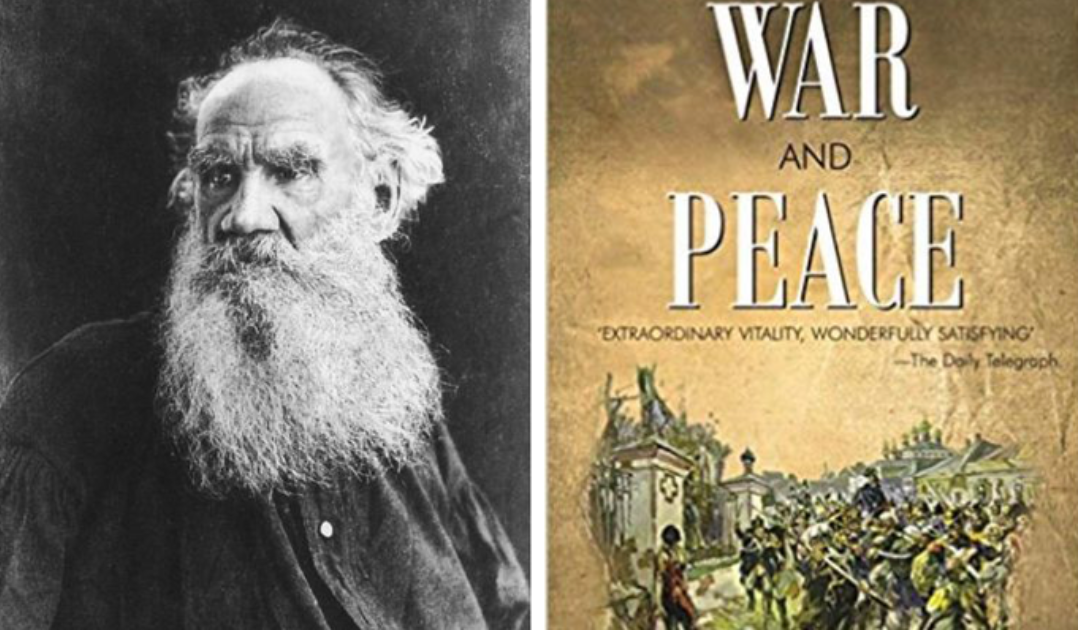
Leo Tolstoy and the Russian Theology of War and Peace
The place of Leo Tolstoy in the historical sociology of war and peace cannot be understood merely through literary criticism. Tolstoy must instead be located within the long durée of Russian Orthodox civilization, the theology of suffering inherited from Byzantine Christianity, the messianic self-understanding of Holy Russia, and the deep tension within Russian consciousness between imperial power and spiritual humility. In this sense, War and Peace was not simply a novel about the Napoleonic invasion of Russia; it was a civilizational scripture about the destiny of Russia as a sacred community confronting Western rationalism, militarism, and imperial modernity. Tolstoy therefore occupies a paradoxical place in Russian civilization. He was simultaneously the greatest literary interpreter of Orthodox Russia and one of the fiercest critics of the institutional Russian Orthodox Church. This paradox later became foundational for the contradictory trajectories of modern Russian political theology—from pacifist Christian anarchism to Eurasian imperial revivalism.
The Russian Orthodox theology of war emerged historically from the Byzantine doctrine of symphonia, the sacred partnership between Church and Empire. After the fall of Constantinople in 1453, Moscow increasingly imagined itself as the “Third Rome,” the last guardian of authentic Christianity against both Islamic conquest and Western Catholic-Protestant fragmentation. Russian literature from the nineteenth century onward internalized this theology deeply. The great Russian novelists were not merely storytellers but theologians of civilization. Fyodor Dostoevsky, Nikolai Gogol, Ivan Turgenev, and Tolstoy all transformed literary prose into a battlefield over the spiritual destiny of Russia and Europe.
Tolstoy’s War and Peace must therefore be interpreted as a civilizational text situated between Orthodox providentialism and modern sociology of history. Tolstoy rejected the Western heroic theory of history associated with Carlyle and Napoleonic modernity. Instead, he proposed that history is shaped by innumerable collective actions emerging organically from the people. His critique of the “great man theory” anticipated later sociological critiques of methodological individualism. Paul Vitányi has correctly argued that Tolstoy developed an implicit mathematical sociology of war in War and Peace, where historical outcomes emerge from collective probabilities rather than individual command.
The Orthodox substratum of War and Peace is decisive. Contemporary scholarship increasingly recognizes the novel as a deeply theological text structured around Orthodox liturgical temporality and sacred symbolism. Recent studies have emphasized that the narrative rhythm of War and Peace follows the movement from suffering to resurrection characteristic of Orthodox cosmology. Tolstoy’s Russia is not merely a nation-state; it is a sacred organism held together through suffering, sacrifice, humility, and collective memory. The peasants, not the aristocracy, embody the moral soul of the nation. Kutuzov triumphs not because of military genius but because he surrenders himself to the spiritual rhythm of history. Napoleon fails because he represents the hubris of Western rational control.
Yet Tolstoy gradually moved away from institutional Orthodoxy. After the 1870s, especially in works such as The Kingdom of God Is Within You and Church and State, he condemned both militarism and the Russian Orthodox Church’s support for imperial violence. Tolstoy reinterpreted Christianity through the Sermon on the Mount and developed a doctrine of radical nonviolence. He regarded state violence as fundamentally incompatible with Christ’s teachings. In this respect Tolstoy became one of the most important global theologians of pacifism, influencing Mahatma Gandhi, Christian anarchists, and later nonviolent movements across the world.
This contradiction inside Tolstoy—between civilizational nationalism and universal pacifism—became one of the defining tensions of Russian modernity itself. Russian civilization repeatedly oscillated between two poles. One pole emphasized humility, suffering, compassion, and spiritual universality. The other emphasized imperial destiny, sacred geography, civilizational mission, and military sacrifice. Russian literature became the great arena where this contradiction unfolded.
The writings of Dostoevsky radicalized the second tendency. Whereas Tolstoy increasingly moved toward Christian universalism, Dostoevsky transformed Orthodoxy into a philosophy of civilizational destiny. His later political writings, especially A Writer’s Diary, articulated a messianic vision of Russia as the redeemer civilization destined to rescue humanity from Western materialism and nihilism. Contemporary analyses have noted how later Russian strategic thinkers selectively appropriated Dostoevsky’s apocalyptic nationalism while ignoring his existential humanism.
The genealogy from Dostoevsky to contemporary Russian strategic thought passes through Slavophilism, Eurasianism, and post-Soviet Orthodox revivalism. Thinkers such as Nikolai Danilevsky and Konstantin Leontiev argued that civilizations possess unique spiritual forms irreducible to universal Western modernity. Danilevsky’s Russia and Europe (1869) became foundational for later civilizational theories. He rejected the universalist pretensions of European liberalism and argued that Russia belonged to a separate Slavic-Orthodox civilization.
This line of thought re-emerged powerfully after the collapse of the Soviet Union through the works of Aleksandr Dugin. Dugin synthesized Orthodox traditionalism, Eurasian geopolitics, Heideggerian philosophy, and anti-liberal civilizational theory into what he called the “Fourth Political Theory.” His work represents an attempt to construct a post-liberal Russian civilizational ideology capable of confronting Atlanticist modernity led by the United States and NATO.
Dugin’s strategic theology transforms Russia into a metaphysical civilization rather than a mere nation-state. Liberalism is treated not simply as a political ideology but as a civilizational disease that destroys spiritual identity, sacred hierarchy, and collective belonging. Contemporary analyses of Russian civilizational narratives show that Putin’s Russia increasingly mobilizes precisely this language of historical continuity, sacred destiny, anti-Western traditionalism, and Orthodox moral order.
The Russian Orthodox Church under Patriarch Kirill has also increasingly articulated the Ukraine conflict within a sacred civilizational framework. The language of “Holy Rus,” spiritual unity, defense against decadent Western liberalism, and protection of traditional Christian values now forms part of contemporary Russian political theology. In this sense, Russian Orthodoxy has partially returned to the Byzantine doctrine of the sacred empire. War becomes framed not merely as geopolitical conflict but as metaphysical defense of civilization itself.
However, the Tolstoyan critique remains equally alive within Russian intellectual traditions. Contemporary Russian philosophy continues to contain strong pacifist and dialogical strands represented by thinkers such as Nikolai Berdyaev, Vladimir Solovyov, and later humanistic traditions. Recent studies on Russian philosophy of war emphasize that Russian thought has always contained competing interpretations of war—providential, revolutionary, existential, and dialogical.
This duality explains why Tolstoy remains central today. Contemporary Russia simultaneously inherits Tolstoy’s civilizational nationalism and rejects his radical pacifism. Putinist strategy appropriates the historical memory of patriotic sacrifice, especially the defeat of Napoleon and Hitler, while suppressing Tolstoy’s critique of state violence and ecclesiastical militarism. The contemporary Russian state therefore selectively mobilizes the Orthodox-symbolic universe of War and Peace while excluding its Christian-anarchist conclusions.
From the perspective of historical sociology, this development reflects the crisis of global liberal modernity itself. After the end of the Cold War, many Western theorists assumed that liberal democracy represented the final stage of ideological evolution. Yet Russian strategic thought under Putin increasingly presents itself as the defender of multipolar civilization against homogenizing Atlantic liberalism. Dugin’s Eurasianism, Orthodox revivalism, and civilizational geopolitics must therefore be interpreted as responses to the crisis of post-Cold War unipolarity.
The Ukraine war intensified this ideological conflict dramatically. Contemporary debates increasingly interpret Russian literature itself through the lens of imperial memory and civilizational warfare. Russian classics are no longer viewed merely as literary achievements but as repositories of civilizational narratives shaping geopolitical imagination. Tolstoy, Dostoevsky, and other Russian masters thus continue to function as strategic intellectual resources within global struggles over identity, sovereignty, and civilization.
The deeper sociological issue here concerns the return of sacred history in the age of digital modernity. Russian strategic theology today combines medieval Orthodox symbolism with contemporary information warfare, cyber-politics, and geopolitical realism. Telegram channels, digital propaganda systems, and online civilizational narratives now function as instruments of theological geopolitics. Recent research on narrative evolution during the Russia–Ukraine war demonstrates how competing sacred-historical narratives circulate through digital networks to shape collective consciousness.
Tolstoy therefore stands at the center of a vast civilizational contradiction. He remains both the greatest literary theologian of Russian sacred destiny and the greatest Christian critic of war, empire, and institutional religion. His writings reveal the unresolved tension between universal ethics and civilizational sovereignty that continues to haunt Russia today. In this sense, the struggle between Tolstoy and Dugin inside Russian consciousness is not merely intellectual. It is a struggle over the soul of Russia itself.
Select Bibliography
- Donna Tussing Orwin, Tolstoy’s Art and Thought, 1847–1880 (Princeton University Press, 1993).
- Donna Tussing Orwin (ed.), The Cambridge Companion to Tolstoy (Cambridge University Press, 2002).
- Isaiah Berlin, The Hedgehog and the Fox (1953).
- Nicholas Riasanovsky, Russian Identities: A Historical Survey (Oxford University Press, 2005).
- Nikolai Berdyaev, The Russian Idea (1946).
- Vladimir Solovyov, War, Progress and the End of History (1900).
- Alexander Dugin, The Fourth Political Theory (2009).
- Marlène Laruelle, Russian Nationalism: Imaginaries, Doctrines, and Political Battlefields (Routledge, 2018).
- Andrei Tsygankov, Russia’s Foreign Policy: Change and Continuity in National Identity (Rowman & Littlefield, 2022).
- Richard Pipes, Russia Under the Old Regime (Penguin, 1995).
- Georges Florovsky, Ways of Russian Theology (Belmont, 1979).
- John Meyendorff, Byzantine Theology (Fordham University Press, 1974).
- Fyodor Dostoevsky, A Writer’s Diary (1873–1881).
- Nikolai Danilevsky, Russia and Europe (1869).
- Lev Gumilev, Ethnogenesis and the Biosphere (1989).
- Mark Galeotti, Putin’s Wars (Osprey, 2022).
- Timothy Snyder, The Road to Unfreedom (Penguin, 2018).
- Marlene Laruelle (ed.), Russian Nationalism and the National Reassertion of Russia (Routledge, 2009).