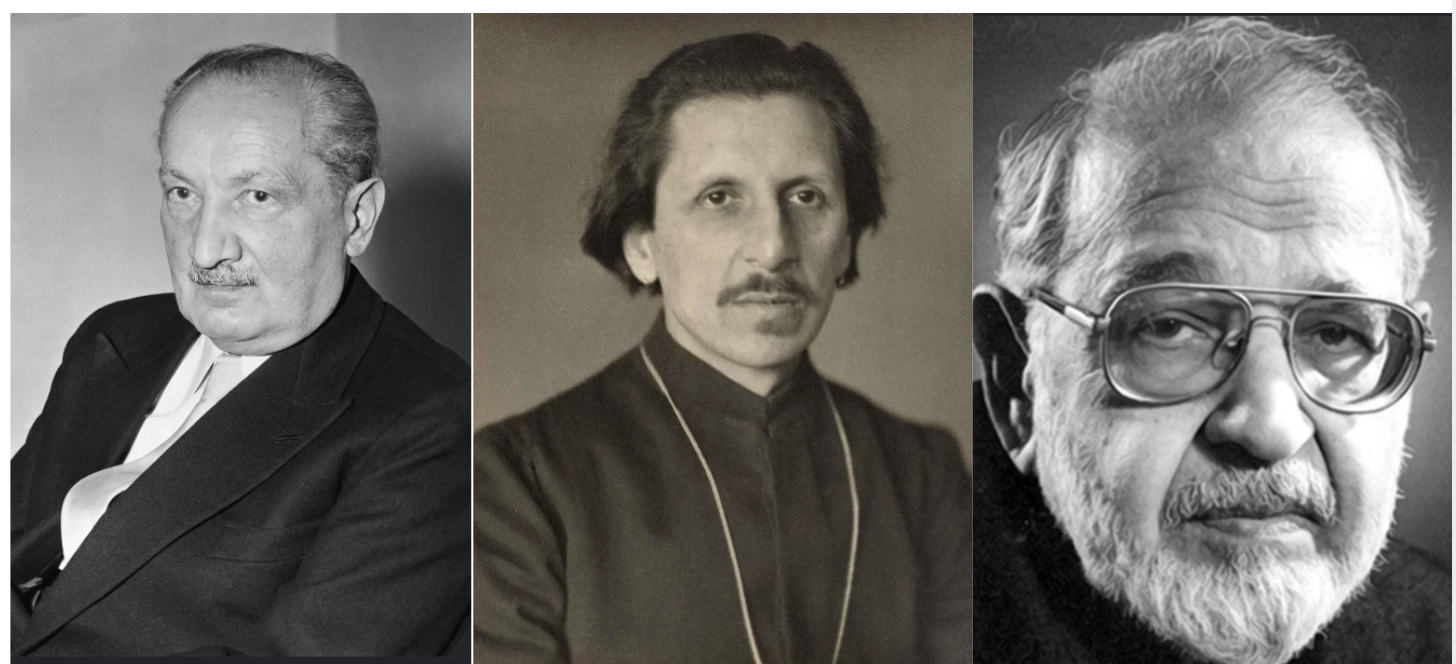
Time, Eternity and Being: A Historical Sociology of Civilizational Temporalities from Coomaraswamy, Heidegger and Agyeya to Hawking and the Digital Age
The question of time is never merely philosophical. It is civilizational. Every civilization produces its own experience of temporality, eternity, and being. What modern sociology after Émile Durkheim and Max Weber often reduced to “collective consciousness” or “rationalization” was, in a deeper historical perspective, a struggle between rival ontologies of time itself. The medieval Christian monastery, the Hindu temple-city, the Islamic mosque-university complex, the Confucian imperial bureaucracy, the Buddhist monastery, the Russian Orthodox liturgical cosmos, and the African ancestral community were not simply social institutions. They were temporal architectures. They disciplined memory, mortality, continuity, and transcendence in radically different ways.
The contemporary planetary crisis of ecological degradation, digital acceleration, artificial intelligence, loneliness, and civilizational fragmentation is therefore not only a crisis of economics or politics. It is fundamentally a crisis of temporality. Humanity no longer knows how to inhabit time. The industrial revolution transformed time into measurable productivity; digital capitalism fragmented it into algorithmic immediacy; contemporary consumerism dissolved continuity into perpetual distraction. In this context, three seminal twentieth-century works—Ananda K. Coomaraswamy’s Time and Eternity (1947), Martin Heidegger’s Being and Time (1927), and S. H. Vatsyayan ‘Agyeya’s Kāl kā Ḍamarū Nāda—appear not merely as literary or philosophical interventions but as civilizational attempts to recover lost modes of being.
I. Coomaraswamy and the Metaphysics of Sacred Time
Ananda K. Coomaraswamy wrote Time and Eternity at the end of the Second World War, when European civilization had entered what many perceived as metaphysical exhaustion. The book was not a conventional study of comparative religion. It was an attack on the desacralization of time in modern industrial civilization. Coomaraswamy argued that all traditional civilizations distinguished between temporal succession and eternal presence. Eternity, in the classical metaphysical traditions, was not endless duration but transcendence of duration itself. Drawing upon the Upanishads, Plotinus, Meister Eckhart, Dante, Islamic metaphysics, and Thomist theology, Coomaraswamy insisted that modern civilization had confused permanence with chronology.[1]
The distinction between “time” and “eternity” had deep roots in both Indic and Western traditions. In the Katha Upanishad, the distinction between the transient and the eternal is central to the dialogue between Nachiketa and Yama.[2] Similarly, in Augustine’s Confessions, temporality is treated as psychological fragmentation before divine eternity.[3] Coomaraswamy synthesized these traditions to argue that traditional civilizations perceived history symbolically, not merely chronologically.
Modernity, however, transformed time into an economic abstraction. The sociological implications were enormous. Lewis Mumford later argued that the clock, rather than the steam engine, was the decisive machine of industrial civilization because it standardized social life around mechanical temporality.[4] E. P. Thompson similarly demonstrated how industrial capitalism imposed “time discipline” upon laboring populations in eighteenth- and nineteenth-century Europe.[5] Yet Coomaraswamy went beyond sociology into metaphysics. He argued that industrial society represented not merely economic transformation but ontological degradation.
For Coomaraswamy, sacred civilizations organized life around ritual time. Festivals, pilgrimages, liturgical calendars, agricultural cycles, and cosmic symbolism connected human beings to eternity. Industrial modernity destroyed these rhythms and replaced them with secular acceleration. The sacred calendar gave way to the railway timetable. The consequence was existential homelessness.
His critique anticipated later works such as Mircea Eliade’s The Myth of the Eternal Return (1949), where archaic societies were described as continually re-entering sacred primordial time through ritual repetition.[6] Eliade explicitly acknowledged Coomaraswamy’s influence on comparative religious studies.[7]
II. Heidegger and the Ontology of Temporality
Martin Heidegger approached temporality from a radically different direction. Being and Time (Sein und Zeit, 1927) emerged from the crisis of European philosophy after Nietzsche, Husserl, and the First World War. Heidegger argued that Western metaphysics since Plato had forgotten the question of Being itself.[8]
For Heidegger, temporality was not an external sequence of moments but the fundamental structure of existence. Human beings (Dasein) are temporal because they are finite. Mortality gives existence urgency and meaning. Authentic existence emerges through confrontation with death.[9]
This was not merely existential psychology. Heidegger believed industrial modernity had reduced beings into resources available for technological manipulation. Later, in “The Question Concerning Technology” (1954), he argued that modern technology enframed reality as “standing reserve” (Bestand).[10] Time itself became calculative efficiency.
The sociological implications were profound. Modern bureaucratic and industrial society produced what Heidegger regarded as inauthentic existence. Human beings became absorbed in impersonal everydayness (das Man). Clock-time replaced existential temporality. In this sense Heidegger converged with Coomaraswamy despite their philosophical differences. Both regarded industrial civilization as spiritually catastrophic.
Yet their solutions diverged sharply. Coomaraswamy returned toward perennial metaphysical traditions; Heidegger rejected classical metaphysics itself. Coomaraswamy’s eternity remained transcendental; Heidegger’s temporality remained finite and existential.
The contrast reflects deeper civilizational differences between Indic and European traditions. Indic metaphysics often treated temporality as derivative from cosmic eternity. Heidegger, shaped by post-Christian European nihilism, treated finitude as constitutive of existence itself.
III. Agyeya and the Indian Poetics of Time
Sachchidananda Hirananda Vatsyayan ‘Agyeya’ entered this debate through literary modernism rather than systematic philosophy. In Kāl kā Ḍamarū Nāda, time appears not merely as chronology or existential anxiety but as cosmic vibration. The metaphor of Shiva’s ḍamarū is crucial. In Indic cosmology, creation itself emerges through rhythm and sound.
Agyeya’s intervention differed from both Coomaraswamy and Heidegger. Unlike Coomaraswamy, he did not reject modern subjectivity. Unlike Heidegger, he did not reduce temporality to existential finitude. Instead, he attempted to reconcile modern consciousness with Indic cosmological imagination.
The result was a uniquely postcolonial temporality. India after colonialism experienced multiple historical layers simultaneously: Vedic memory, Mughal legacy, colonial bureaucracy, industrial capitalism, Gandhian nationalism, socialist developmentalism, and digital globalization. Agyeya’s work reflects this layered temporality.
The Indian experience of time historically differed from the linear eschatology of Abrahamic civilizations. Hindu cosmology imagined cyclical yugas, kalpas, and cosmic dissolution. The Mahabharata repeatedly presents time (kāla) as devourer of worlds.[11] Shiva’s dance symbolizes cosmic creation and destruction. Buddhist philosophy added radical impermanence (anicca), while Tantric traditions emphasized rhythmic pulsation (spanda).
Agyeya transformed these cosmological inheritances into literary modernity. His temporality is fragmented yet cosmic, personal yet civilizational.
IV. Islamic Conceptions of Time and Eternity
The Islamic world produced one of the richest metaphysical reflections on temporality. Ibn Arabi argued that creation is renewed at every instant through divine manifestation.[12] Time is not autonomous but dependent upon God’s perpetual creativity.
Similarly, Al-Ghazali rejected Aristotelian eternity of the world and defended divine omnipotence over temporality.[13] Later, Mulla Sadra developed the doctrine of “substantial motion” (al-harakat al-jawhariyya), according to which existence itself is dynamic becoming.[14]
Islamic civilization therefore combined linear prophetic history with mystical transcendence. The Qur’an repeatedly contrasts fleeting worldly duration with divine eternity. Yet Islamic ritual life—daily prayers, Ramadan, pilgrimage—creates cyclical sacred temporality within historical linearity.
This synthesis differs both from Hindu cyclical cosmology and Christian salvation history. It produced distinctive Islamic sociological forms, from dynastic cycles analyzed by Ibn Khaldun to Sufi experiences of timeless presence.[15]
V. China, Japan and Civilizational Rhythms
Chinese civilization historically conceived temporality through harmony and continuity rather than transcendental eternity. Confucianism emphasized ancestral continuity, ritual repetition, and dynastic order. Daoism introduced fluid cosmological becoming.
Laozi described reality as flowing transformation.[16] Time was seasonal rhythm rather than apocalyptic history. This orientation profoundly shaped Chinese statecraft and social organization.
Japanese civilization transformed Buddhist impermanence into aesthetics. Zen traditions emphasized immediacy. Concepts such as mono no aware treated transient beauty as metaphysical revelation. Unlike Western metaphysics, Japanese thought often found eternity within impermanence itself.
VI. Russia, Orthodoxy and Apocalyptic Time
Russian civilization developed a profoundly apocalyptic temporality. Fyodor Dostoevsky and Leo Tolstoy both treated historical time as moral-spiritual struggle.
Russian Orthodoxy preserved liturgical temporality against secular modernity much longer than Western Europe. Thinkers such as Nikolai Berdyaev argued that technological civilization enslaved humanity within objectified time.[17]
This apocalyptic-historical consciousness continues to influence contemporary Russian civilizational narratives.
VII. Scientific Time: From Newton to Hawking
Modern science transformed humanity’s understanding of time more radically than any previous intellectual revolution. Isaac Newton conceived time as absolute mathematical duration.[18] Albert Einstein shattered this conception through relativity.[19]
Finally, Stephen Hawking popularized cosmological temporality in A Brief History of Time (1988). Hawking narrated the universe historically—from Big Bang singularity to black holes and cosmic entropy.[20]
Yet scientific cosmology remained largely silent regarding existential meaning. Physics could describe duration but not explain why mortality generates anxiety, why ritual generates solidarity, or why civilizations imagine eternity differently.
This is where the humanities and sociology regain importance.
VIII. Digital Civilization and the Crisis of Temporality
Contemporary digital civilization has intensified temporal fragmentation. Social media compresses attention into perpetual immediacy. Artificial intelligence accelerates informational time beyond human contemplative rhythms. Hartmut Rosa describes this condition as “social acceleration.”[21]
The ecological crisis itself reflects distorted temporality. Industrial civilization consumed planetary resources as though future generations were irrelevant. Capitalism colonized the future.
Traditional civilizations, despite their contradictions, preserved long-duration thinking through ritual calendars, ancestral memory, pilgrimage, and sacred cosmologies.
The twenty-first century therefore witnesses a struggle between competing temporal regimes: technological acceleration versus civilizational continuity, algorithmic immediacy versus sacred duration.
Conclusion
Coomaraswamy, Heidegger, and Agyeya represent three monumental attempts to rescue humanity from temporal impoverishment. Coomaraswamy sought recovery of eternal metaphysics; Heidegger sought retrieval of authentic being through finitude; Agyeya sought poetic reconciliation between modern consciousness and cosmic rhythm.
Together they reveal that civilizations are fundamentally temporal orders. A civilization survives not merely through military power or economic productivity but through its ability to organize memory, mortality, continuity, and transcendence.
The future of planetary civilization may therefore depend less upon technological innovation than upon humanity’s rediscovery of meaningful temporality itself.
Footnotes
[1] Ananda K. Coomaraswamy, Time and Eternity (New Delhi: Munshiram Manoharlal, 1990 [1947]), pp. 15–19.
[2] Katha Upanishad, I.2.10–18.
[3] Augustine, Confessions, trans. Henry Chadwick (Oxford: Oxford University Press, 1991), Book XI, pp. 230–245.
[4] Lewis Mumford, Technics and Civilization (New York: Harcourt Brace, 1934), pp. 14–18.
[5] E. P. Thompson, “Time, Work-Discipline and Industrial Capitalism,” Past & Present, Vol. 38 (1967), pp. 56–97.
[6] Mircea Eliade, The Myth of the Eternal Return (Princeton: Princeton University Press, 1954), pp. 34–49.
[7] Mircea Eliade, Images and Symbols (New York: Sheed & Ward, 1961), p. 27.
[8] Martin Heidegger, Being and Time, trans. John Macquarrie and Edward Robinson (Oxford: Blackwell, 1962), pp. 19–35.
[9] Heidegger, Being and Time, pp. 279–311.
[10] Martin Heidegger, “The Question Concerning Technology,” in The Question Concerning Technology and Other Essays (New York: Harper & Row, 1977), pp. 3–35.
[11] Mahabharata, Udyoga Parva 71.10–12.
[12] Ibn Arabi, The Bezels of Wisdom, trans. R. W. J. Austin (New York: Paulist Press, 1980), pp. 89–102.
[13] Al-Ghazali, The Incoherence of the Philosophers, trans. Michael Marmura (Provo: BYU Press, 2000), pp. 16–28.
[14] Mulla Sadra, The Transcendent Philosophy of the Four Journeys of the Intellect, Vol. I (Tehran edition, 1981), pp. 204–219.
[15] Ibn Khaldun, The Muqaddimah, trans. Franz Rosenthal (Princeton: Princeton University Press, 1967), Vol. I, pp. 289–315.
[16] Tao Te Ching, trans. D. C. Lau (London: Penguin, 1963), Chapters 14–25.
[17] Nikolai Berdyaev, The Meaning of History (London: Geoffrey Bles, 1936), pp. 120–148.
[18] Isaac Newton, Philosophiæ Naturalis Principia Mathematica (London, 1687), Scholium to the Definitions.
[19] Albert Einstein, Relativity: The Special and General Theory (New York: Crown, 1961), pp. 39–55.
[20] Stephen Hawking, A Brief History of Time (New York: Bantam Books, 1988), pp. 1–17.
[21] Hartmut Rosa, Social Acceleration: A New Theory of Modernity (New York: Columbia University Press, 2013), pp. 3–29.
Select Bibliography
- Augustine. Confessions. Oxford: Oxford University Press, 1991.
- Berdyaev, Nikolai. The Meaning of History. London: Geoffrey Bles, 1936.
- Coomaraswamy, Ananda K. Time and Eternity. New Delhi: Munshiram Manoharlal, 1990 [1947].
- Eliade, Mircea. The Myth of the Eternal Return. Princeton: Princeton University Press, 1954.
- Heidegger, Martin. Being and Time. Oxford: Blackwell, 1962.
- Hawking, Stephen. A Brief History of Time. New York: Bantam, 1988.
- Ibn Arabi. The Bezels of Wisdom. New York: Paulist Press, 1980.
- Ibn Khaldun. The Muqaddimah. Princeton: Princeton University Press, 1967.
- Mumford, Lewis. Technics and Civilization. New York: Harcourt Brace, 1934.
- Rosa, Hartmut. Social Acceleration. New York: Columbia University Press, 2013.
- Thompson, E. P. “Time, Work-Discipline and Industrial Capitalism.” Past & Present 38 (1967): 56–97.