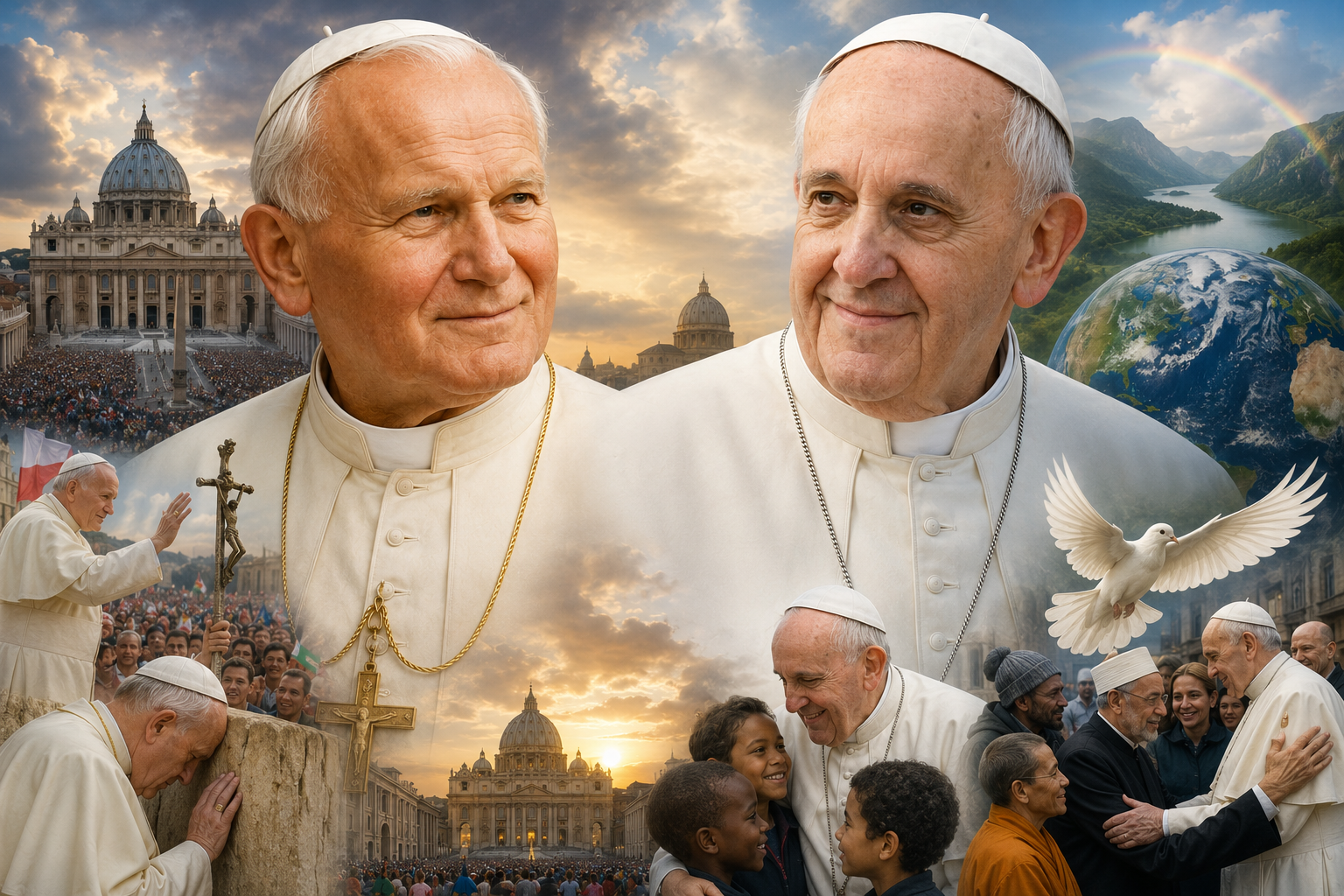
The Two Popes and the Remaking of the Post-War World: Pope John Paul II and Pope Francis as Theologians, Civilizational Actors and Charismatic Architects of Late Modernity
The sociology of civilizations after the Second World War cannot be adequately understood through the categories of secular modernization theory alone. Nor can the world historical transformations of the late twentieth and early twenty-first centuries be interpreted only through the categories of capitalism, nationalism, technological modernization, or military power. The Catholic Church, which many nineteenth-century sociologists expected to decline irreversibly under the pressure of industrial modernity, instead emerged after 1945 as one of the decisive transnational civilizational actors in the reconstruction of global moral discourse. Within this transformation, two pontificates stand out as epoch-making interventions into the political theology of modern civilization: the pontificates of Pope John Paul II and Pope Francis.
If Martin Luther, Huldrych Zwingli, and John Calvin transformed Europe during the crisis of medieval Christendom and contributed decisively to the emergence of Protestant modernity, then John Paul II and Francis transformed the moral architecture of late modernity and digital planetary civilization after the catastrophes of fascism, communism, decolonization, ecological degradation, global capitalism, and network society. Their importance lies not merely in theology narrowly understood, but in their capacity to intervene simultaneously in religion, culture, politics, economics, media, diplomacy, and civilizational ethics. They became not only popes but global charismatic figures in the Weberian sense, capable of reshaping moral legitimacy across nations and civilizations.
The tragedy of much classical sociology is that it often reduced Catholicism to hierarchy, ritualism, or anti-modern traditionalism, while elevating Protestantism as the ethical motor of capitalism and modern rationality. Max Weber’s The Protestant Ethic and the Spirit of Capitalism (1904–05) became so dominant that the Catholic contribution to modern civilizational ethics remained comparatively under-examined. Yet the twentieth century gradually revealed another trajectory: the Catholic Church could produce not only resistance to modernity but alternative visions of modernity itself. From Rerum Novarum (1891) to Quadragesimo Anno (1931), from Vatican II to Centesimus Annus (1991) and Laudato Si’ (2015), Catholic social thought emerged as one of the few global traditions capable of criticizing both unrestrained capitalism and totalitarian collectivism simultaneously.
The lives of John Paul II and Francis must therefore be situated not merely within ecclesiastical history but within the sociology of civilizations, historical sociology, and global political theology.
I. Pope John Paul II: The Philosopher-Actor Who Dissolved the Moral Legitimacy of the Cold War
Karol Wojtyła was born in Wadowice, Poland, in 1920, a civilizational frontier zone repeatedly devastated by Nazism and Soviet communism. His life embodied the trauma of twentieth-century Europe itself. He lived through German occupation, Stalinism, ideological terror, and the destruction of traditional Catholic Poland. Unlike many Western theologians formed in liberal democratic environments, Wojtyła emerged from a crucible where the state sought to colonize the human soul. This experience shaped his lifelong philosophical concern with personhood, freedom, dignity, and spiritual sovereignty.
His intellectual formation was unusually broad. He absorbed Thomism, phenomenology, existentialism, and dramatic literature simultaneously. His early philosophical works, especially The Acting Person (1969), attempted to synthesize phenomenology and Catholic anthropology, arguing that human beings cannot be reduced either to economic categories or mechanistic political systems. Unlike secular Marxist anthropology, which often reduced consciousness to material conditions, Wojtyła insisted that the human person possessed irreducible transcendental dignity grounded in divine creation.
This philosophical anthropology later became a civilizational weapon against Soviet communism. The Cold War was not merely a military confrontation between NATO and the Warsaw Pact. It was also a struggle between rival understandings of the human person. John Paul II understood that Marxist states could survive economic crisis for long periods, but they could not survive permanent erosion of moral legitimacy. His strategy therefore was not military conquest but civilizational delegitimation.
When he became pope in 1978, the first non-Italian pope in 455 years, the symbolic geography of Europe changed instantly. A Slavic pope from communist Poland shattered the cultural monopoly of Soviet ideological authority in Eastern Europe. His 1979 pilgrimage to Poland became one of the decisive moments of twentieth-century history. Millions gathered publicly in a society where collective public religious expression had been structurally constrained by communist surveillance. During the Warsaw Victory Square sermon, his invocation “Do not be afraid” became more than a spiritual exhortation; it became a sociological event.
The alliance—sometimes explicit, sometimes tacit—between John Paul II, Ronald Reagan, and Margaret Thatcher must be interpreted carefully. It was not simply a conservative coalition. Rather, it represented three different traditions converging temporarily against Soviet communism: Catholic personalism, Anglo-American market liberalism, and anti-communist geopolitics. Yet the pope was never reducible to Reaganite capitalism. This distinction is crucial. While Reagan celebrated market freedom as civilizational destiny, John Paul II consistently warned that consumerism could become another form of spiritual totalitarianism.
The Polish Solidarity movement under Lech Wałęsa emerged partly through this moral atmosphere. Historians such as Timothy Garton Ash and George Weigel have argued that John Paul II’s moral intervention fundamentally weakened communist legitimacy in Eastern Europe. Mikhail Gorbachev himself later acknowledged the pope’s historic role in transforming Europe.
Yet the pope’s significance exceeded Eastern Europe. The Iranian Revolution of 1979 also revealed the return of religion as a revolutionary force in modern politics. Although John Paul II and Ruhollah Khomeini represented radically different theological traditions, both demonstrated that secular modernization theory had underestimated religious civilization. The post-war secular assumption that religion would disappear under industrialization collapsed dramatically between 1978 and 1979. Catholic Poland and Shi‘a Iran together announced the “return of the sacred” into geopolitical modernity.
Similarly, the emergence of Deng Xiaoping’s China after 1978 represented another challenge to rigid ideological modernity. Deng preserved communist political structure while integrating market mechanisms. John Paul II recognized earlier than many Western liberals that the future world would not converge into one homogeneous civilization. Rather, multiple modernities would emerge simultaneously. In this sense, he anticipated later theories of civilizational plurality associated with scholars like Shmuel Noah Eisenstadt.
John Paul II’s encyclicals became crucial texts in Catholic social thought. Laborem Exercens (1981) defended the dignity of labor against both capitalist commodification and communist collectivism. Sollicitudo Rei Socialis (1987) criticized global inequality and dependency structures. Most importantly, Centesimus Annus (1991), written after the collapse of Soviet communism, offered one of the most sophisticated Catholic evaluations of capitalism in modern history. John Paul II accepted markets conditionally but warned repeatedly that a civilization organized solely around consumption would destroy human solidarity and transcendence.
In contrast to simplistic readings, John Paul II was neither a neoliberal triumphalist nor a socialist theologian. He sought a moral economy grounded in human dignity, subsidiarity, community, and spiritual freedom. His sociology of civilization therefore cannot be reduced either to capitalism or anti-capitalism. Rather, it represented a Catholic critique of reductionism itself.
His role in media modernity was equally significant. He understood television before many theologians did. He transformed the papacy into a global performative institution mediated through mass communication. His travels—over 100 international journeys—created a planetary Catholic visibility unprecedented in Church history. In Weberian terms, charisma became technologically amplified through global media systems.
Yet his pontificate was not without contradiction. Critics argued that his positions on contraception, gender, liberation theology, and clerical centralization limited Catholic adaptability in late modernity. Feminist theologians and Latin American liberation theologians often viewed him as too conservative institutionally. Nevertheless, even critics acknowledged his enormous moral authority against dictatorship, authoritarianism, and dehumanization.
II. Pope Francis: The Pope of Ecological Civilization and Moral Critique of Global Capitalism
If John Paul II represented the anti-totalitarian Catholic conscience of the Cold War world, Pope Francis represented the moral conscience of late capitalism and ecological crisis.
Born in Buenos Aires in 1936 to an Italian immigrant family, Jorge Mario Bergoglio emerged from the social realities of Latin America rather than the philosophical crises of Eastern Europe. This geographical difference mattered profoundly. Latin America experienced not Soviet totalitarianism but military dictatorship, debt dependency, structural inequality, urban poverty, and extractive capitalism. Francis therefore developed a theology grounded less in phenomenological philosophy and more in pastoral proximity to suffering populations.
He was deeply influenced by the Latin American “theology of the people,” distinct from but related to liberation theology. While liberation theology often used Marxist social analysis, Francis emphasized popular religiosity, community ethics, and the dignity of the poor without fully embracing Marxist frameworks. His pastoral style reflected this orientation. He preferred symbolic simplicity over imperial ecclesiastical grandeur.
When he became pope in 2013, the symbolic meaning was immense. He was the first Jesuit pope, the first pope from the Americas, and the first pope from the Global South. This represented a tectonic civilizational shift within Catholicism itself. Christianity’s demographic center had moved decisively away from Europe toward Latin America, Africa, and Asia.
Francis’s critique of capitalism was sharper and more direct than that of most earlier popes. His apostolic exhortation Evangelii Gaudium (2013) condemned “an economy of exclusion” and criticized the “idolatry of money.” Unlike technocratic economists who interpreted inequality statistically, Francis treated exclusion as a moral and spiritual pathology.
His most important intervention came with the encyclical Laudato Si’ (2015), one of the most consequential religious documents of the twenty-first century. This text fundamentally altered global religious discourse on ecology. Francis argued that ecological destruction, consumerism, technological excess, inequality, and spiritual alienation were interconnected dimensions of a single civilizational crisis. He rejected the separation between environmental ethics and social ethics.
In sociological terms, Laudato Si’ marked a transition from industrial modernity to ecological civilization discourse. Francis challenged both capitalist developmentalism and socialist productivism. He argued that the planet itself had become a victim of instrumental rationality. Here the influence of thinkers such as Romano Guardini and implicitly even critiques associated with Heideggerian technological modernity became visible.
Francis’s thought also represented a critique of what may be called digital hypermodernity. He warned repeatedly that technological acceleration without moral depth produces loneliness, fragmentation, and disposability. Unlike Cold War ideology, which divided humanity geopolitically, late capitalism creates civilizational atomization through consumption and networked spectacle.
Theologically, Francis emphasized mercy over doctrinal rigidity. Sociologically, this shifted Catholicism toward pastoral inclusiveness. He spoke repeatedly about migrants, refugees, indigenous peoples, and climate victims as the abandoned populations of global capitalism. In this sense, he transformed the papacy from a Eurocentric moral institution into a planetary ethical voice.
His interventions resonated far beyond Catholicism. Environmental activists, secular humanists, Muslim intellectuals, Hindu ecological thinkers, and Buddhist environmental networks all engaged Laudato Si’. Francis thereby expanded Catholic social thought into a genuinely global ecological discourse.
At the same time, Francis generated intense opposition within conservative Catholic circles. Critics accused him of weakening doctrinal clarity and excessively criticizing markets. Yet this opposition itself revealed the deep sociological conflict inside contemporary Christianity between neoliberal civil religion and communitarian Catholic ethics.
III. Protestant Ethic and Catholic Ethic Revisited
The comparative sociology of Protestantism and Catholicism requires major revision in light of these two pontificates. Weber’s Protestant ethic thesis highlighted ascetic discipline, rationalization, deferred gratification, and vocation as foundations for capitalist modernity. Yet late capitalism has evolved far beyond Protestant asceticism into consumerist hedonism, financial abstraction, and digital commodification. In this context, Catholic social thought re-emerged as a counter-discourse emphasizing dignity, solidarity, ecological balance, and moral economy. John Paul II and Francis together articulated a post-Weberian Catholic ethic. John Paul II defended spiritual freedom against ideological totalitarianism. Francis defended ecological and social humanity against market absolutism. Both opposed reduction of human beings to economic units.
Thus the sociology of civilizations must move beyond simplistic binaries between Protestant modernity and Catholic traditionalism. The Catholic Church after Vatican II became one of the few institutions simultaneously global, transnational, moral, ritual, and civilizational. It speaks to billions across radically different societies while preserving continuity with ancient theological traditions. Unlike purely secular institutions, the papacy combines charisma, ritual legitimacy, historical memory, symbolic continuity, and media visibility. This combination gives popes unusual global influence even in secular societies.
IV. The Two Popes in Historical Sociology
From the perspective of historical sociology, John Paul II and Francis may be interpreted as two sequential responses to crises of modern civilization. John Paul II responded to ideological totalitarianism, state absolutism, and the crisis of spiritual freedom under Cold War modernity. Francis responded to ecological collapse, technological excess, inequality, and market absolutism under late capitalism.
The first confronted the prison state; the second confronted the consumerist planetary machine.
The first helped dissolve Soviet legitimacy; the second challenged the moral legitimacy of predatory global capitalism. The first emerged from Eastern Europe; the second from Latin America. The first spoke the language of freedom; the second the language of mercy and ecology. Yet both shared one foundational conviction: civilization without transcendence becomes destructive. In this sense, the sociology of these two popes intersects directly with the sociology of civilizations. They remind scholars that religion did not disappear after modernity. Rather, religion mutated, globalized, mediated itself technologically, and re-entered world history in new forms.
The twenty-first century world—marked simultaneously by AI, digital capitalism, ecological anxiety, migration crises, resurgent religions, civilizational conflicts, and planetary interdependence—cannot be understood through secular modernization theories alone. The Catholic interventions of John Paul II and Francis demonstrate that theological traditions remain active producers of historical change. Indeed, one may argue that the papacy after 1945 became a unique institution: simultaneously medieval in continuity, modern in diplomacy, postmodern in media performance, and planetary in moral aspiration.