The Kantian Closure and the Exile of the Noumenal
The late eighteenth century marks a decisive epistemic reconfiguration in European thought. In the Critique of Pure Reason, Immanuel Kant establishes a strict boundary between phenomena (the world as experienced) and noumena (the thing-in-itself), arguing that the latter is fundamentally inaccessible to human cognition (Kant, 1781/1787, A254/B310–A260/B316). This move, while presented as a critical delimitation of metaphysics, effectively produces what may be termed an epistemological enclosure: ontology is displaced, and knowledge becomes a function of the structures of human cognition rather than a participation in being.
Subsequent European intellectual traditions—whether the positivism of Auguste Comte, the historicism of G. W. F. Hegel, or the sociology of Max Weber—operate within this horizon. Even when they appear to reintroduce metaphysical concerns, they do so through mediations of history, society, or rationalization. The noumenal is no longer a lived or actionable domain; it becomes either unknowable or sociologically reducible.
This epistemological closure is inseparable from the rise of modern European power. As scholars such as Michael Adas have shown, the authority of the West in the nineteenth century rested on a fusion of epistemic confidence and technological superiority (Adas, Machines as the Measure of Men, 1989, pp. 3–15). The “knowing subject” became the sovereign of both nature and history.
The Iranian Revolution as Noumenal Insurrection
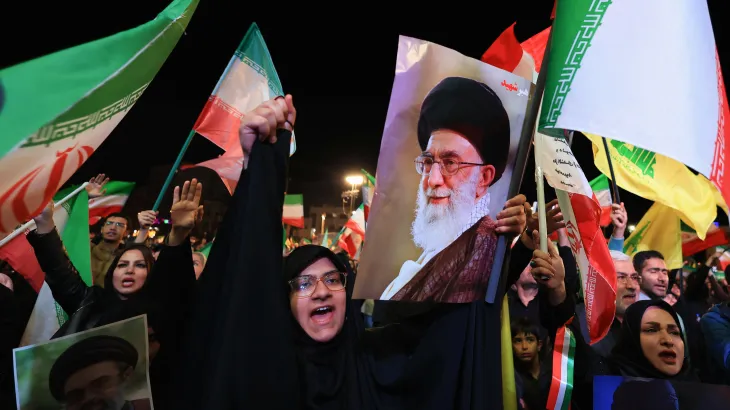
Against this longue durée, the Islamic Revolution of Iran emerges not merely as a political upheaval but as a noumenal insurrection—a reassertion of metaphysical sovereignty in a world structured by epistemological rationality.
The leadership of Ruhollah Khomeini articulated a vision in which political authority derived not from popular sovereignty in the modern sense, but from a metaphysical order grounded in divine law. In Hukumat-e Islami (Islamic Government), Khomeini insists that governance must be rooted in the guardianship of the jurist, which is justified not empirically but ontologically—through the continuity of divine authority (Khomeini, 1970/1981, pp. 27–35).
This constitutes a direct challenge to the Kantian settlement. If Kant denies access to the noumenal, Khomeini’s project presupposes not only access but political enactment of the noumenal. The Iranian Revolution thus collapses the modern distinction between metaphysics and politics. It reopens the question that Kant had sought to close: can the ultimate ground of being be a legitimate basis for social order?
Michel Foucault, one of the few Western thinkers to grasp the depth of this rupture, described the revolution as a form of “political spirituality” (Foucault, “What Are the Iranians Dreaming About?”, Corriere della Sera, 1979; reprinted in Afary and Anderson, Foucault and the Iranian Revolution, 2005, pp. 209–218). For Foucault, the Iranian uprising revealed a mode of subjectivity irreducible to Western categories of revolution, ideology, or class struggle.
War, Technology, and the Return of the Noumenal (1979–2026)
The period from 1979 to 2026 can be read as a prolonged dialectic between the epistemological order of Western modernity and the noumenal reassertion embodied by Iran. This dialectic unfolds through a series of conflicts in which war technology and metaphysical claims are inseparably intertwined.
Scholars of war such as Martin van Creveld have emphasized that modern warfare is not merely a technical phenomenon but a transformation of social and symbolic orders (The Transformation of War, 1991, pp. 192–210). Similarly, John Keegan argues that war expresses cultural and metaphysical assumptions about reality (A History of Warfare, 1993, pp. 3–12). In this sense, the conflicts involving Iran—whether the Iran–Iraq War (1980–1988), the shadow wars of the 2000s, or the escalating confrontation culminating in the ongoing Iran–U.S. war since February 28, 2026—are not simply geopolitical struggles. They are ontological confrontations.
The Western deployment of advanced military technologies—precision strikes, cyber warfare, surveillance systems—represents the apex of the epistemological paradigm: control through knowledge, prediction, and calculation. Iran’s resistance, by contrast, draws upon a different register, one that mobilizes martyrdom, sacrifice, and transcendence. As Hamid Dabashi notes, the Iranian revolutionary ethos cannot be understood without reference to a “theology of liberation” that reconfigures death and suffering as sites of meaning (Theology of Discontent, 1993, pp. 413–425).
Thus, the battlefield becomes a site where two epistemes collide: one grounded in the calculative rationality of modern science, the other in a lived ontology that refuses reduction to empirical categories.
Beyond Binary: Dialectics of Noumenal and Phenomenal Orders
It would be a mistake, however, to interpret this confrontation as a simple opposition between “West” and “Islam,” or between rationality and faith. The more precise formulation is a dialectical tension between two regimes of reality. On one side, the Kantian-epistemological order continues to evolve, incorporating new forms of knowledge and power. On the other, the Iranian Revolution inaugurates a counter-tradition that insists on the primacy of the noumenal. Yet these are not isolated spheres. They interact, overlap, and transform one another.
For instance, Iran itself employs modern technologies and participates in global systems of knowledge, while the West increasingly confronts crises—ecological, political, existential—that expose the limits of its epistemological framework. As Charles Taylor has argued, the “immanent frame” of modernity is never fully closed; it is haunted by the possibility of transcendence (A Secular Age, 2007, pp. 539–593).
The Iranian Revolution, in this sense, functions as a global event that destabilizes the immanent frame. It demonstrates that the exclusion of the noumenal is not a universal necessity but a historically contingent choice.
The 2026 War and the Reopening of Ontology
The ongoing Iran–U.S. war since February 28, 2026 intensifies this dialectic to a new level. What is at stake is no longer regional influence or strategic dominance, but the very structure of global reality.
From the perspective of Western strategic thought, the conflict is framed in terms of deterrence, escalation, and technological superiority. From the Iranian perspective, it is articulated in terms of resistance, justice, and divine mandate. These are not merely different narratives; they are incommensurable ontologies.
This situation forces a reconsideration of the Kantian closure. If the noumenal can re-enter history as a political force—if it can shape institutions, mobilize populations, and sustain resistance against technologically superior adversaries—then the strict separation between phenomena and noumena becomes untenable.
In this sense, the Iranian Revolution and its unfolding consequences constitute a paradigmatic intervention in global thought. They compel scholars to rethink the foundations of modern knowledge and to acknowledge the persistence—and perhaps the necessity—of the noumenal dimension.
Toward a Post-Kantian Global Sociology
The implications of this analysis extend beyond the specific case of Iran. They point toward the need for a post-Kantian sociology, one that does not reduce reality to observable phenomena but remains open to the ontological claims embedded in different civilizations.
Such an approach would resonate with the work of scholars like Seyyed Hossein Nasr, who argues for the recovery of metaphysical knowledge as a basis for understanding modern crises (Knowledge and the Sacred, 1981, pp. 1–20), and Talal Asad, who critiques the secular assumptions underlying Western social theory (Formations of the Secular, 2003, pp. 13–37).
It would also require a re-engagement with non-Western intellectual traditions, not as objects of study but as sources of theoretical insight. The Iranian Revolution, in this sense, is not an anomaly but a signal event—an indication that the global intellectual order is undergoing a profound transformation.
Conclusion
To read the Islamic Revolution of Iran as a noumenal event is to recognize that the history of modernity is not a linear progression from superstition to rationality but a contested field in which different conceptions of reality struggle for dominance. The Kantian closure of ontology in favor of epistemology was a powerful and historically effective move, but it was never final. The events from 1979 to 2026, culminating in the current Iran–US war, demonstrate that the noumenal can return—not as an abstract philosophical concept, but as a lived, political, and civilizational force. This return does not simply negate modernity; it transforms it, opening new possibilities for thought and action. In this sense, the Iranian Revolution stands as one of the most significant intellectual and historical events of the modern era—a challenge to the very foundations of the Western mind and an invitation to rethink the relationship between knowledge, being, and power in a rapidly changing world.