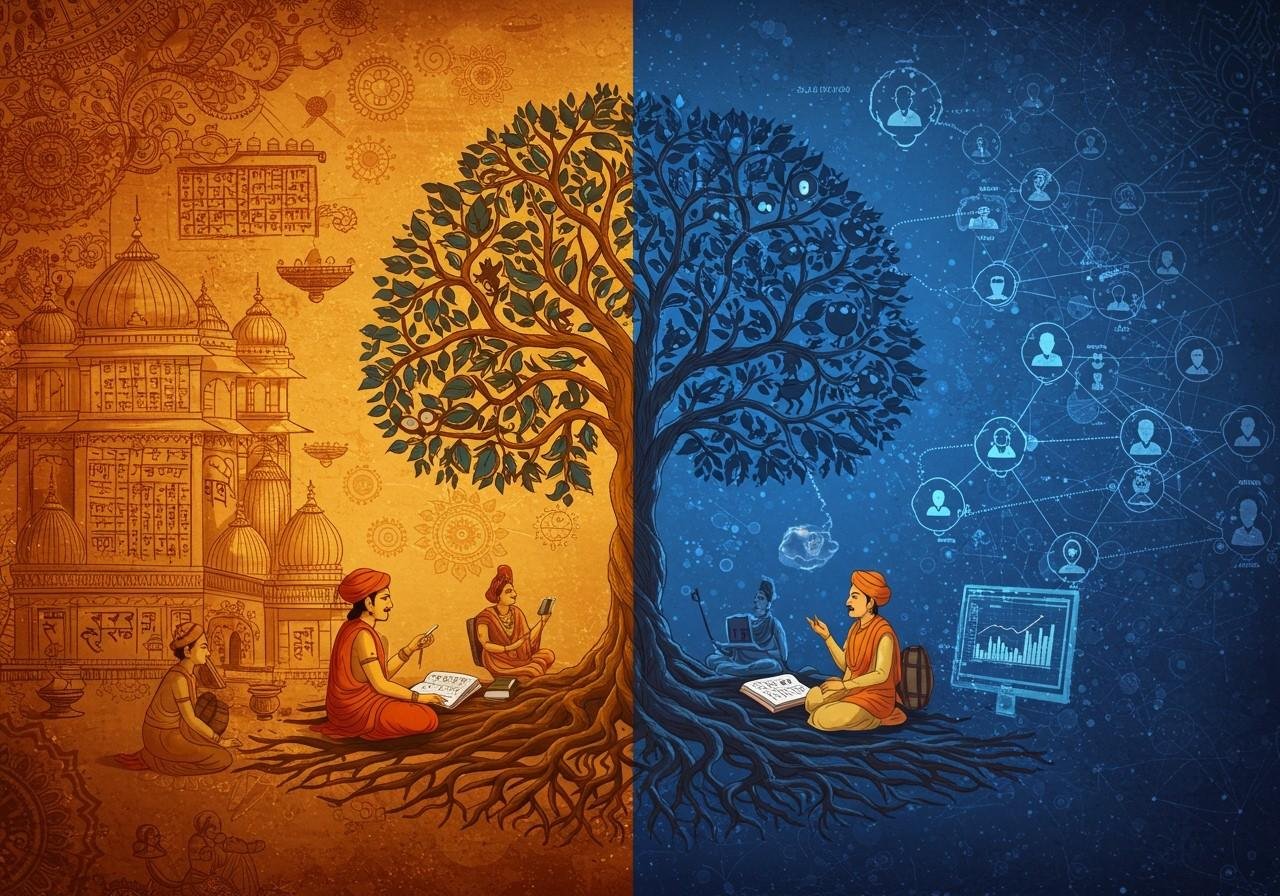
In India, both Indology and Sociology developed as “Twin-Sisters”, during the eighteenth century as “Ideas” as well as well-articulated “disciples” of scholarship. In the world of Ideas, “Indology” was mesmerising as the “Voyages” were for people like Christopher Columbus and Vasco Da Gama. Both were journeys of the robust mind of the newly awakened European spirit, primarily in the Catholic world of Spain, Portugal, Holland, France and Italy. When William Jones used “Indology”, during the rule of the East India Company (1757-1858), Indology was a well developed “Idea”. In the same way, when Auguste Comte used the terms Social Physics and Sociology in the 1830s, these ideas were fairly developed in Lutheran Germany, Zwinglian Scandinicia and Calvinist groups in French speaking European Communities. Therefore, my aim in this book is not to write a chronological history of these ideas and disciplines, rather I shall try to highlight the contemporary relevance of the “Twin-Sisters” to understand India, in the language of European modernity.
Broadly speaking, there are two approaches to the study of Indian society—(a) the Indological and (b) the sociological. The Indological approach claims that Indian society can be understood only through the concepts, theories and frameworks of Indian civilisation. Indologists claim that the uniqueness of Indian civilization cannot be fitted into the general framework of European sociology. They rely primarily on the book-view and give more importance to the culture of Indian society than to the empirical social structure. The sociological approach, on the other hand, gives more importance to the empirical structure in the field than to the cultural framework of Indian civilisation. It claims that sociology is a universal science of society, and its concepts, theories and assumptions can be fruitfully utilised beyond Europe for comparative analysis. Both approaches have their advantages and limitations. Many sociologists today try to combine both the approaches to get a holistic picture of the structures, processes and functions of different institutions in particular and Indian society in general.
Indology literally means a systematic study of Indian culture. Indologists have claimed that the uniqueness of the India civilisation cannot be fitted into the framework of European sociology. They rely primarily on the hook-view and assert that Indian society can be understood only through the concepts, theories and frameworks of the Indian civilisation. This approach gives more importance to the culture of the Indian society than to the empirical structure. Indology is both an independent discipline in itself as well as a particular approach in Indian sociology. In both versions, Indological studies consist of investigations of language, ideas, beliefs, customs, taboos, codes, institutions, tools, techniques, work of art, rituals, ceremonies and other related components of culture.
Indology is dependent on interdisciplinary work. Although it largely draws from the methods of philology and history, its origins and needs demonstrate the incorporation of art history, archaeology, philosophy, folklore, anthropology, and even economics and law. Some of the difficulties of Indology stem from the problems of interdisciplinary work as such. It is very difficult for academic institutions to coalesce and coordinate the coalitions of faculty needed to work for the goal of any inter-disciplinary enterprise. At the heart of this problem is the very design of the modern Indian university, which emphasises the collectivity of scholars around a singular discipline. Indology is much older than sociology as an independent discipline in India.
The first important centre of Indology was started by Sir William Jones at Calcutta in 1784. Therefore, when the first department of sociology was started at Bombay University in 1919, the science called Indology was already well established in India. As a result, the founding fathers of Indian Sociology were influenced in no small measure by ‘Indological literature’. We can discern this clearly in the writings of B. K. Sarkar, G. S. Ghurye, Radhakamal Mukherjee, K. M. Kapadia, P. H. Prabhu and Iravati Karve. Indological approach in Indian Sociology is influenced by the science of Indology but is not coterminous with Indology as a discipline. All sociologists, who have used the Indological approach, are also influenced by other sociological perspectives. For example, in the writings of G. S. Ghurye, there is a synthesis of the Indological approach and the diffusionist approach, propagated by W.H.R. Rivers. In the same way, in the writings of Radhakamal Mukherjee, there is a synthesis of the Indological perspective with empirical sociology of the American variety.
Secondly, Indology as a discipline contains a variety of approaches and methods. There are many schools within Indology as a science. Different Indian sociologists were influenced by different schools of Indology. For example, B. K. Sarkar was influenced by the Indological studies of the Asiatic society founded by Sir William Jones. G. S. Ghurye was influenced more by the writings of the Indologists of the Bhandarkar Institute in Pune than by the British school of Indology, founded by Sir William Jones and the German scholar Max Muller. Similarly, Radhakamal Mukherjee was influenced by the Indological writings of Anand K. Coomarswamy and some authors of the Asiatic Society in Calcutta.
Mainstream Indology, however, has been the creation of the Western scholars. The primary sources of Indological studies are classical texts, manuscripts, archaeological artefacts, philological data and symbolic expressions. The aim of Indological studies is to gain a deeper understanding of Indian culture. Within Indological studies, there are two types of broader writings—one is called Indology or Indic studies and the other is called Oriental studies. There are both commonalities and differences between Indology and Oriental studies.
Indology is supposed to be the sympathetic and positive account of the non-European societies of the East, including Indian society and culture. An oriental study is supposed to be the unsympathetic and negative account of Indian society and culture. Orientalism emerged as the ideological need of the British Empire, whereas Indology is said to be the westerners’ labour of love for Indian wisdom. Max Muller, James Mill and William Archer were the important figures of Orientalist writing about India. The Indological writings were influenced by William Jones, Wilkins, Colebrooke and Wilson in British India; Rene Guenon, Louis Renou and Bougie in France; William Dwight Whitney, Maurice Bloomfield, Franklin Edgerton, W. Norman Brown, Anand K. Coomarswamy, Joseph Campbell and Mircea Elliade in USA. The German Indologists and Orientalists include Max Weber, Karl Marx, Max Muller and Count Keyserling. Indological studies have developed mostly an empathic understanding of Indian Culture.
However, there is a general tendency among Indologists to exaggerate either the virtues or the weaknesses of Indian culture. Orientalists tended to see primarily negative elements in Indian tradition and mostly rationalised missionary activities as well as the British rule in India. Indologists, on the other hand, have over-emphasised Indian spiritualism and under-emphasised the material culture and practical wisdom of the common people in India. As a result, they have simultaneously underlined the virtues of European education, institutions, science and technology.
The French, the German and the American schools of Indology, however, are considered more systematic and meticulous about the complexities of the Indian cultural traditions than the British school of Indology. The Indological approach, within Indian sociology, is comparatively more developed, sophisticated and nuanced than the mainstream Indological writings of the British school. Within the wider framework of sociology, it has broadened our understanding of Indian family, marriage, kinship, religion, art, culture, language, mythology and civilisation (Bhate, 2002; Lokeshwarananda, 1992). Recently, under the influence of Louis Dumont and Mckini Marriott, ‘culturological’ writings on India have fruitfully utilised the depth of the Indological approach. N. Madan has recently pleaded for the synthesis of Coomarswamy and Levi-Strauss in the creative understanding of Indian society and culture. D. P. Mukerji had earlier pleaded for a synthesis of Indian tradition (provided by Indologists) within the Marxian analytical framework of dialectics. All major sociologists, before independence, were influenced by the Indological approach in one way or the other (Madan, 1995; Singh, 2004; Mukherjee, 1979).
INDOLOGY IN INDIA
Indological studies began in India with the establishment of the Asiatic Society, Calcutta in 1784 by Sir William Jones, for the purpose of inquiring into the history and antiquities, arts, science and literature of Asia in general, and India in particular. India was, for William Jones, larger than the Indian subcontinent. It held within its sweep those parts of Asia with which it had religious, cultural and linguistic ties. The society brought out two periodicals—The Journal of the Asiatic Society and The Asiatic Research, besides Bibliotheca Indica, a series of annotated editions of the Oriental classics. The Asiatic Society is still very active, bringing out regular publications about Indian society and culture. Charles Wilkins, H. T. Colebrooke, H. H. Wilson, W. H. Mill, George Tumour, James Prinsep and others have become famous names in the Indological circles (Mukherjee, 1991; Kaul, 1995). The Oriental Institute in Baroda was the second important Indological centre to come up in India. It was founded in the year 1893 by the Maharaja of Baroda. Anantakrishna Shastri was the nucleus of this institute. He had collected about 10,000 important manuscripts from all over India. Gaekwad’s Oriental series was started in 1915. The work of collecting rare manuscripts, research and publication of critical editions were gradually institutionalised. C.D. Dalai and Binoytosh Bhattacharya were general editors of this series. The principal objective of the Oriental Institute has been to develop a well-equipped library of rare and unpublished manuscripts and reference books on Oriental and Indological studies for advanced students and research scholars. The institute has published rare original works on subjects such as philosophy, literature, Buddhism, Jainism, technical sciences, Hindu law, encyclopaedic works, Persian, Arabic and Portuguese treatises, and compositions in old Gujarati language (Vyas, 1992). The Bhandarkar Oriental Research Institute was founded in 1917 in Pune to commemorate the life and works of Sir R.G. Bhandarkar. Bhandarkar was one of the pioneers of Indology in our country.
Bhandarkar was a man with many talents. He was a historian, a philologist, an educationist and a philosopher. He had published authoritative works on Sanskrit grammar and on the history of languages, derived from Sanskrit. He also wrote several works on the history, religion and linguistics of India. The Bhandarkar Oriental Research Institute works through its five main departments: (i) Mahabharata Research Unit, (ii) Manuscripts, (iii) Publication, (iv) Postgraduate Research and (v) Prakrit Dictionary. VS. Sukthankar, S.K. Belvalkar, P.K. Gode, P.N. Kane, P.L. Vaidya, Abhyankar, V.P. Limaye, P.V. Bapat, R.N. Dandekar, A.M. Ghatage and M.A. Mehendale were the moving spirits of the Bhandarkar Institute. In the field of Indological Research, it is as important as, if not more than, the Asiatic Society (Laddu, 1992).
The Vishveshvaranand Vishwa Bandhu Institute of Sanskrit and Indological Studies, Hoshiarpur, was earlier known as the Vishveshvaranand Vedic Research Institute. In 1903, two Sanyasis—Swami Vishveshvaranand and Swami Nityanand—launched at Simla a project of preparing word indices to the four principal Vedic Samhitas and, ultimately, a lexicon of the basic texts. With the passing away of Swami Nityanand in 1914, Swami Vishveshvaranand carried forward the project all alone till 1918 at Simla and, thereafter, till 1923 at Indore. In 1923, he shifted to Lahore, where he met Acharya Vishva Bandhu, to whom he entrusted the project. After 1929, Vishva Bandhu extended the scope of the proposed lexicon to the preparation of a Vedic Dictionary in the form of a critical record of eminent as well as modern interpretations of Vedic words with complete textual citations, and philological and proto-linguistic cognitions. This project was completed in 1965 and published as Vedic Word Concordance (1935-65). Then, a Comparative and Critical Dictionary of Vedic Interpretation was brought out in 1972. Other projects of this institute were concerned with the preparation of critical editions of the Vedic texts with commentaries, and linguistic studies of the dialects of the north-western region. This is one of the indigenous institutes of Indology, which has taken independent lines in the interpretation of the Indian cultural and spiritual traditions (Chaubey, 1992).
The Banaras Hindu University (BHU) was founded in 1916 by Pandit Madan Mohan Malviya. Indological studies were carried out by the Sanskrit department of BHU. Ramavatar Sharma, Nil Kamal Bhattacharya, S.K. Belvalkar, A.B. Dhruva, Subodh Chandra Mukherjee and P.L. Vaidya started a rich tradition of Indological studies (Mishra, 1992). The Oriental Research Institute was founded in 1891 in Mysore by Chamaraja Woodeyar of the Mysore State. M. Hiriyanna, A. Mahadeva Sastri, S.G. Narasimhachar, R. Shamasatri and Sudarshanacharrya built the reputation of this institute by their pioneering works. R. Shamasatri’s discovery and critical edition of Kautilya’s Arthashastra is comparable to P.V. Kane’s History of the Dharmasastras. M. Hiriyanna wrote authoritative commentaries on the Indian philosophical systems (Rajagopalachar, 1992).
The Theosophical Society was founded in Madras in 1882. Helena Petrovna Blavatsky and Henry Steel Olcott had founded the Theosophical Movement in New York in 1875. It utilised ideas and symbols from Egyptian, Hindu and Buddhist religions as legitimisation for its criticism of contemporary life in Europe and America. On 2nd May 1878, the New York group changed its name to the Theosophical Society of the Arya Samaj of India. The society also recognised Swami Dayananda Saraswati as its lawful Director and Chief. By 1881, Dayananda and the Theosophists had parted ways and, therefore, the Theosophical Society was restructured. A wide range of individuals like A.O. Hume, Gopal Krishna Gokhle and Major General Morgan of the British army joined this movement. In December 1882, they shifted to Adyar, just south of Madras city. They built several Sanskrit schools in Triplicane, Mylapore, Black Town and Madras city. They established a big Oriental library at Adyar in 1886. In 1893, Annie Besant came to India to work for the Theosophical Society. She founded the Central Hindu College at Varanasi in 1898. In 1907, she became the president of the Theosophical Society and shifted to Adyar. In 1914, she joined the Indian National Congress and, three years later, was elected as its president. She wrote several books on the Indian tradition and inspired a new kind of Indological studies on the one hand, and gave a new dimension to the freedom movement on the other (Jones, 1999). The above centres of Indology are the most important ones.
It is, however, not the whole story. Any discussion of Indological studies will be incomplete without a discussion of German scholar F. Max Muller. He was commissioned by the East India Company to translate and edit the Sacred Books of the East series. Together, with the British historian James Mill and the officials of the British Raj (Charles Metcalfe and Henry Maine) and the people from the Asiatic Society (William Jones, Wilkins, Wilson and Colebrooke), Max Muller shaped the British school of Indology and Orientalism. Max Muller’s Indology was more in the category of Orientalism. He was biassed from the very beginning so were the British historians like James Mill and V. Smith. In comparison, the people from the Asiatic Society were less critical and more sympathetic. Unfortunately, the latter were selective in their coverage of the elements of Indian civilisation (Thapar, 1999; Muller, 1991; Kaul, 1995; Bhate, 2002).
However, the British school of Indology is comparatively outdated now. Among the European scholars, the French and the Germans were more systematic Indologists, and some of them are still read (for example, Rene Guenon, Louis Rene, Fritzof Schuon, Count Keyserling, Bougie, Marcel Mauss and Marco Pains). The American school of Indology was initially rooted in the German school; William Dwight Whitney and Maurice Bloomfield imported continental Indological practice through their studies in Germany. They had received the bulk of their training in classical languages and cultures such as Greek and Latin, and travelled to Germany primarily to learn Sanskrit. By 1912, Indological studies were systematised at Harvard, Yale, John Hopkins and Pennsylvania universities. Soon, the Boston Museum of Fine Arts became the centre of Indological studies in the USA. Bloomfield’s students like Franklin Edgerton, W. Norman Brown and Ananda Kentish Coomaraswamy of the Boston Museum were instrumental in transcending the limitations of continental Indology. W. Norman Brown published a seminal document in 1938. The essential argument of the monograph was that India’s civilisation is too complex and important to be shouldered by one faculty member. For instance, the Sanskritic and Indic Studies departments needed to hire several academics specialising in language, literature, history, archaeology and art, along with economics, geography and other social sciences. He also pleaded for a multi-faceted syllabus, offering a concentration on the regional study of Indian civilisation.
W. Norman Brown and Anand K. Coomarswamy have influenced the sociological and Indological studies of the Lucknow School of Sociology in general, and Radhakamal Mukerjee and A. K. Saran in particular. From William Jones to Anand Coomarswamy, Indological studies have influenced generations of intellectuals, including the sociologists. They have articulated the book-view of Indian society and culture. It is a fact that the contemporary understanding of Indian kinship, culture, religion and language is conditioned by either Indology or Orientalism. G.S. Ghurye, B.K. Sarkar, Radhakamal Mukherjee, K.M. Kapadia, P.H. Prabhu, Louis Dumont, David Pocock, McKim Marriott, R. Indane and TN. Madan have used Indological approaches in addition to their sociological insights.
SALIENT FEATURES AND DYNAMICS OF INDOLOGY
Indology has flourished in diverse directions, under the leadership of erudite scholars, both western and Indian, including philological, literary, religious, philosophical and socio-cultural studies. It has also entered the computer age, along with other branches of knowledge, and has occupied a website for itself. The general apathy in the Indian mind towards Indology is mainly due to its low job potential as well as a strong impact of westernisation. Therefore, those who pursue the study of Indology today do so either because they are committed to the perpetuation of their national tradition, or because they have no better choice. As a result, the considerably low standard of the research output, lack of motivation, adherence to outdated research methodologies, and absence of insight into genuine problems in different areas of Indology are characteristic of the post-independence predicament.
Interdisciplinary as well as multi-disciplinary approaches are now more popular than the outdated methodology, consisting of a mere philosophical approach. While, on the one hand, a good grounding in the grammar of at least, one of the classical languages is a must for every student of Indology, on the other, he is expected to closely study recent contributions in sociological and anthropological theories, and to find out whether they can offer any model(s), applicable to the area of his study.
Computers have brought in a revolution not only by minimising hard manual labour and the time span required for higher studies, but also by opening up new approaches to the tradition as well as linguistic and philological problems. Students and researchers in Sanskrit have become aware of the fact that Sanskrit is not merely a cultural language of India, but that it was “found as the paramount linguistic medium by which ruling elites expressed their power from Purushapura (Peshawar) in Gandhara in the north-west of the subcontinent to as far east as Panduranga in Annam (South Vietnam) and Pram banan in Central Java” (Sheldon, The Sanskrit Cosmopolis 300-1300: Trans-Culturation, Venularization, and Question of Identity in Indology and Status of Sanskrit, Ho Uben, Jan E.M. and Leiden, E.J. (ed.), 1996, p. 198)
It has been stressed in a recent study that “for Indians as well as Europeans, Europeanisation of the Earth continues to be inescapable and irreversible. For this very reason, ancient Indian thought in its unassimilable, non-actualisable, yet intensely meaningful distance and otherness is not obsolete” (Halbfass, 1988). The same author has also observed that the dialogue between the East and the West is still being dominated by Europe and that Indians are yet to participate in it (Halbfass, 1991). The discourse on Indology at the critical level accepts that the categories of disciplines that emerged in the 19th century or earlier in the western historical situation, as a result of developments in the domains of science, economics and other social theories, the vast reservoir of primary material and the knowledge base of the indigenous systems were neither accepted nor taken cognisance of. The cultural ‘other’ was understood in terms of categories of the self. In this case, self was the West in the age of Enlightenment or colonial expansion. The institutions and the discourses, especially in English and other European languages (whether in the West or in the East), continue to follow these categories of disciplines and subdisciplines. The methodologies of research analysis and critical assessment are thus linear and one-dimensional (Mate, 2002).
Going through certain German texts on India from Hegel to Gunter Grass, one may come to recognise how partial, distorted and prejudiced the European understanding of India has been, in the past as well as in the present. Europe has almost always claimed central and privileged hermeneutic positions for itself. But Europe today is no more a geographic entity; it is the name of a continent of knowledge that embraces all continents, and there are scholars in India or Japan, who are as Eurocentric as Europeans themselves, even as there are several scholars in Europe who are becoming conscious of the dangers of privileging their worldview and imposing it on other modes of perception and other kinds of knowledge. While Greek and mediaeval Euro-centrism may just have been specific instances of ethnocentrism, simply co-existing with other culturally bound approaches to people from the other continents, but modern Euro-centrism expresses itself in the form of universals; universalised claims and principles, like the claims and methods of the modern science and technology, and the claims of utter objectivity, theoretical mastery and comprehensive representation of reality in the natural and physical as well as the historical, social and cultural spheres.
Husserl and Heidegger have called this process The Europeanization of the Earth, the former positively and the latter sceptically (Sceptically, because these universals are often unwarranted universalisation of certain culture-specific forms of thought and attitude; a parochialization in the garb of globalisation that ultimately amounts to intellectual colonisation—a prequel to the economic globalisation, championed by the United States today and perhaps a greater threat in physical and cultural terms).
Critical insiders of western thought, like Michel Foucault, have made visible the implications of power and domination inherent in the European representational and calculating reason. And Said’s critique of Orientalism and its imaginative geography reveals how the western approach to the non-western world is inseparable from claims of mastery, superiority and domination. Edward Said’s (Orientalism, 1978) own justifiable critique of this discursive strategy, centred on the European treatment of Islam, is blind to Islam’s own treatment of other cultures and traditions, especially its creation of its own Orient, evident in the essentialisation and the ‘othering’ of the Indian culture in the writings of a traditional Islamic scholar like Al-Biruni. In the typical Hegelian approach, the Orient provides the pre-history of the Occident; India is part of this prehistory. In relation to the European present, it is a matter of the past, not an actual living challenge and alternative. Perhaps, neither is there a single undivided phenomenon called Euro-centrism nor an undivided and undifferentiated discourse called Orientalism; one may have to speak of several Euro-centrisms and several Orientalisms. It is only fair to admit the existence of a parallel ideology that has, sometimes, been termed Ludo-centric (Satchidanandan, 2002; Ghose, 2002; Sardar, 1998; Sardar, 2002; Smith, 2003; Teltscher, 1995).
At the close of the 18th century, the first Europeans interested in India and in Sanskrit [Sir William Jones (1746-1794), H.T. Colebrooke (1756-1837), C.E. Wilkins (1759-1836) and others] set to work. And on 15th January 1784, the Bengal Asiatic Society first met in Calcutta. Charles Wilkins wrote the first direct and complete translation of the Bhagavad-Gita, published in London in 1785, and two years later completed the translation of the Hitopadesa. Sakuntala was translated by Jones in 1789 and the Gita Govinda in 1792. Europe came into contact with Indian thought and poetry through these works. Goethe, Schiller, Novalis, Schopenhauer, La Fontaine, Victor Hugo and many others enthusiastically embarked on the study of Sakuntala and the Bhagavad-Gita and began to sing their praises.
However, the England of the 18th and 19th centuries was particularly interested in rejecting Sanskrit culture and everything it implied because it could not admit that, under the pretext of carrying out a ‘civilising mission’, it was occupying and exploiting a nation far more civilised. Europe had discovered something which injured its pride: its civilisation was not the only one, but there were others, particularly the India’s, which had a literature and a profundity of thought equal or even superior to the British. This situation gave rise to two responses from the humanists and the members of the clergy, brought up on a diet of Greek and Judaic culture.
The first tendency is that of the ignorant, who claim, against all logic, that there cannot be any civilisation, any religion or any literature equal or superior to the European ones, and consequently that all that is Indian has been borrowed from Europe. So, it happened that a certain Father Bouchet wrote to the Bishop of Avranches in France that the Vedas have been copied from the Law of Moses (Jarocha, 2002).
While, the other tendency was that of the Indophiles, who hated India with all their heart; the most important representative of the Indophiles was Baron Thomas Babington Macaulay (1800-1859), who wrote a note on public education that disappointed the young people, who were interested in studying the culture of India.
It will, however, be wrong to assert that the initial mistakes of Indology were confined to people such as these. The problem was that although European scholars were enthusiastic about Indian literature, the Sanskrit language and the depth of Hindu religious thought, all worthy of study and praise, these elements do not constitute all of Indian culture. The pundits dedicated themselves exclusively to spirituality. However, the pundits were not all of India, but only one of its aspects. Doubtlessly, the most valuable, the worthiest of being studied, out of respect and interest, but they were still only a part of India, only one facet of the enormous and thrilling personality of this great country. What about the rest of the Indians?
They had to live with the problem of the British occupation, of a foreign invasion that did not allow the country to develop itself because its economy was totally subservient to the British interests. They were religious, but did not know Sanskrit. The average Indian could not explain to Europeans the Charaka Samhita, the Sulbasutras, or the many other texts that are extraordinary proofs of the talent and culture developed by the Indian civilisation (Jarocha, 2002). The European scholars, for their part, had no interest in showing up these aspects of India because, deep down, they were all more or less Euro-centric or racist or, in the best of cases, they had that superiority complex, of which many Europeans are unaware and that goes beyond their natural kindness and their desire to understand. This partial or incomplete approach is at the very root of Indology and is its principal mistake. We are still noticing its consequences today. The only thing the westerners know about India is its spirituality, its inclination towards metaphysics, meditation and Yoga. All of this is, no doubt, important, but is obviously one sided. Ordinary people in the West know nothing about Ashoka, the Guptas or the Mauryas nor do they know about medical science in ancient India, which was so advanced or about Indian contributions to astronomy and mathematics. And while other nations are regarded as highly civilised and capable of participating in all aspects of culture, India is relegated to Yoga, meditation and metaphysics. For those westerners, who are dedicated to the adoration of the dollar and today run the world, India is a backward country. And this is what they transmit to those lower down the ladder. This state of affairs is due to the origins of Indology, to the early days when India began to be studied by foreigners (Jarocha, 2002).
Today, processes of globalisation and rationalisation appear together with powerful counter-currents, especially numerous trends of traditionalism and regionalisation (Staal, 1993). India’s modern economy cannot be regarded as merely an instance of ‘Westernisation’. In the 20th century, India occupied a unique position in the economic history of nations. The number of pioneering and trend-setting industrial achievements made by India is perhaps unmatched by many other nations in the world today. The country has preserved and revered the traditions of over 6000 years old civilisations, and is simultaneously one of the most advanced, rapidly changing and modern nations.
There is a necessity to clearly separate the diachronic and the synchronic perspectives, which is at the basis of this distinction between India and Europe. Whether we like it or not, distant countries have become globalised. But the present day globalisation is entirely unprecedented in the known history of mankind, although we do have well-documented cases of incipient, and later stagnating, globalisations. Some excellent examples are provided by South Asia’s past: Ashoka’s military, and later religious conquest of a large part of the then known world, and the Sanskritisation of Central, East and Southeast Asia in what Pollock has termed as the ‘Sanskrit Cosmopolis, 300-1300’ (Pollock, 1996).
Globalisation is, in any case, neither a Western phenomenon nor is it an instance of Westernisation. ‘Rational actions’ or ‘actions based on reason’ have been opposed by the Indologists both to ‘actions based on the passions’ (Plato) and to ‘actions based on tradition and authority’ (Hume). Rationality may be thought of as being mainly limited to mathematical and logical reasoning (Hume). In the South Asian Sanskritic traditions, rationality or ‘reasoning’ (tarka) was usually seen as one of the means of gaining knowledge (pramanas), together with direct perception (Pratyaksa) and traditional lore (agama).
Science is, of course, not an exclusively European phenomenon, as has been rightly emphasised and substantiated by Stall in some recent publications (Stall, 1993, 1995). A science, that is, any science, whether in the present or in the past, provides a sufficient grasp on the problems in its field; technologies can be designed to solve these problems and to produce useful and desirable results. This spreading of science and technology inevitably involves not only the acceptance of a successful science and technology by persons and communities, but also the rejection of some body of knowledge, at least, the rejection of some body of less successful knowledge, at least, for the limited area in which the new science and technology are accepted. The rejected body of knowledge may go under many names: magic, superstition or unsuccessful and stagnated science. The borderline between science, religion and magic is extremely problematic (Tambiah, 1990). But to the extent that a successful science or technology is rational, a conscious choice to accept it—a North American Indian, who accepts European weapons; a Papua New Guinean accepting Western medicine, etc.; it should also be considered rational, even if numerous non-rational factors play a role in the decision.
In the 1960s, Thomas A. Kuhn had argued that even within science, non-rational factors play a major role in the choice between competing theories and paradigms. Karl Popper and Imre Lakatos accepted some of Kuhn’s points, but they argued that rationality holds a primary position in these processes of scientific choice. It can, similarly, be argued that rationality plays an important role in the decision to adopt modern scientific theories and technologies, where one formerly followed traditional beliefs and techniques. We have to conclude that rationalisation, especially in the form of the spread of modern science and technology, is neither a western phenomenon nor is it necessarily an instance of westernisation. If at all the world has indeed become increasingly rationalised and globalised, but neither really westernised nor subjugated and controlled by the West, Indology, unfortunately, has remained largely a western discourse, which excludes or opposes an Indian discourse.
Before India’s independence, western indological discourse was closely connected with Europe’s wish to rule, and to continue to rule India. At least, part of the motivating power behind the enormous efforts invested in the unearthing and exploring of the data regarding South Asia’s past was generated by the ideological wars between the Europeans and Indians, who wanted to appropriate a glorious past of origins representing symbolic power. But today, these ideological wars have shifted and to a considerable extent subsided (Bhate, 2002).
Diachronically, Indology is a western discourse which has tended to exclude the Indian discourse at many levels. Synchronically, however, we do not see a coherent Indological discourse, which excludes or opposes an Indian discourse. Rather, there are several distinct Western European Indological discourses, namely French, German, British, Dutch, Italian, Polish and others. Besides, there are the North-American and Latin-American Indological discourses, and there are those of the Indian, Nepalese, Pakistani, Chinese, Japanese and other Indological discourses, which all have both local and global aspects.
Each of these discourses, deals in its own way, with what is traditionally the subject matter of Indology, that is, the linguistic, literary, social and political past and present of ‘South Asia’ or the Indian subcontinent. It has indeed always been difficult to define Indology or South Asian studies as a unitary discipline or field, and this will probably always remain so. Some kind of unity is, nevertheless, provided by the nature and richness of data. As far as methods are concerned (philological, linguistic and archaeological), Indology is, of course, not a unitary discipline. Indology is, therefore, better characterised as a ‘field’ of studies than as a discipline, although the peculiar nature of its data does require mastery over specific constellations of skills and methods.
However, one sometimes feels that Indology, which used to be a fountainhead of creative ideas for linguistics and the then newly emerging social sciences in the 19th century, has been stuck in the muddy backwaters of outdated ideas and concepts in the religious and human sciences. Be that as it may be, one major justification for doing Indological research lies in the enormous amount of data concerning human development in South Asia extending beyond 20 centuries. In fact, the questions and problems concerning the linguistic, political, economic and social history of the sub-continent add an important historical dimension to the modern linguistic, political, economic and social sciences, and will always contribute to their further critical development.
In spite of historical and contextual differences between Western and Indian and other traditions, there are some universals of the human condition. Language, thought and objective reality, in its temporal and spatial dimensions, are three factors that any human being has to deal with. Statements on language, thought and objective reality have relevance for any human being having to deal with these universals of the human condition, in any period in the history of mankind. If such statements implicitly claim universal validity, they should survive a confrontation with statements on the same topic from different traditions. Here, we are not just interested in data concerning various fields of social and linguistic behaviour, which we can use to build our own theories. Indologists want to know how thinkers in the past collected and theorised the data available to them. These thinkers of the past are then not just providers of new data, but they also become, perhaps, first of all, partners in a dialogue. As in any sincere dialogue, the other may provide challenging new ideas and insights for our own theorising. He may also give us insight into the strong points and basic conditions of our own successes. Although the past cannot be expected to provide us with instant solutions to the problems, which accompany our technological and scientific successes (and blunders), and which nowadays present themselves in unprecedented urgency and in unexpected dimensions; it can suggest alternatives and correctives to one-sided developments.
An enormous amount of our daily working knowledge is based on “linguistic input”, that is, verbal and written testimonies from authors, who are removed from us in time and/or space and who have, or had at their disposal, perceptual sources and/or intellectual skills not available to us. The Western philosophical tradition has, nevertheless, only very sparingly dealt with problems of knowledge based on spoken or written words. The South Asian tradition, on the other hand, has dealt with this universal problem area in a systematic and profound way, and contains in this respect numerous challenges and incentives for modern (Western and non-Western) sociologists and anthropologists. The past cannot be expected to provide us with complete instant solutions to modern problems. At the most, the perspectives of the past can have an important catalysing function. Problems in the modern world are, in the final analysis, to be solved in the present time. Even if ancient texts come close to directly addressing a number of problems, which occupy us at present (e.g. because universals of the human condition are involved), there always remains a final step to be made, namely that of adapting and applying the ancient answers to the modern context.
Knowledge grows in discontinuity and dialogical confrontation with the unfamiliar. Monologically, it merely consolidates itself. In this respect, the ‘interest’ of knowledge lies in the dialogue with other worlds; it needs to know whether you know things that can destroy my universal generalisation, or disrupt my implications; we could say that any interest in ‘truth’ presupposes interaction between the pluralities of knowledge bearers. The acceptance of imperfections, in our own perceptions and statements, implies recognition of the value of different perceptions. The philologists tried to understand the Vedas in the case of the Sanskrit tradition, Homer’s works in the Greek-Latin tradition, the Bible in the Hebrew tradition, and the Koran in the Arabic tradition. These systematic attempts gave rise to a philological tradition, in which it was important to be precise and careful with the precise text and interpretation of the works as the basis of one’s (religious and/or ethnic) community.
Now, in the course of time, both the West and South Asian regime have developed perspectivist approaches, in which it was not enough to be precise and careful with the texts of one’s own community; it was equally important to be precise and careful with the views of others and the sources of alternative traditions (Roberts, 1992). It can be argued that Western scholars have so far studied the South Asian sources mainly for the sake of acquiring new data for the Western tradition of philology and other branches of learning. Although Wilhelm Halbfass and a few others did make some relevant contributions, too little attention has been paid to the philological skills, techniques and conceptual tools with the perspectivist attitude of philosophy as its pinnacle that have evolved and developed in South Asia. Nevertheless, it is these philological skills, techniques and conceptual tools that have conserved, transmitted and, to a considerable extent, also created the data, which have been so happily accepted by the Western scholars.
Till the first half of the 20th century, the academic teachers and students of the Sanskrit language could be excused for limiting themselves to the study of grammar and books, in view of the available methods of language learning, and the absence of or difficulty of access to recorded speech. Now, with the advent of the 21st century, these excuses are no longer valid, and Sanskrit courses at universities should comprise a component of ‘spoken Sanskrit’ in addition to the study of grammar and classical texts, at least, during one year, both for didactic reasons (better and fuller mastery over the language), and in order to facilitate and stimulate the communication between two rare species on this planet—traditional Sastrins and students of ancient Sanskrit sources.
Indology emerged as a discipline in India in 1784, whereas sociology emerged in France in 1836. The first department of sociology was established at Bombay University in 1919, under the chairmanship of Sir Patrick Geddes, but the teaching of sociology as one of the courses at undergraduate level had started earlier at Calcutta University in 1908. It is, however, important to note that both Indology and sociology as disciplines are the products of the European Enlightenment and they share more common ground than most people are ready to concede. Both are humanist disciplines and claim to be objective and scientific. From G.S. Ghurye to M.N. Srinivas, the mainstream of Indian sociology has been the product of European theory and Indological data. All of the important sociologists before M.N. Srinivas (with the exception of A.R. Desai) were as much Indologists as they were sociologists or social anthropologists. Even Srinivas had, at times, used Indological data to supplement his field work. The defining features of sociology, however, have been the field-view and the comparative method. Sociologists and social anthropologists tone down the uniqueness of Indian culture and underline the structural similarity of Indian society with other societies.
In the development of a sociological approach to Indian society and culture, the role of four university departments of sociology has been an important factor. These are departments of Sociology at Bombay, Calcutta, Lucknow and Delhi universities. Some people refer to these departments as the four schools of Indian Sociology. Although all the faculty members of these departments never shared one theoretical framework or one methodological preference, but there was much commonality regarding the nature of sociological enterprise as well as the priority areas of research. Within the same department, theoretical preferences have been changing over time and all such changes were linked with socio-political and institutional developments at home and abroad. Most creative sociologists of India have tried to synthesise out of these four schools. It was only the sociology department at Delhi University that consciously tried to separate the Sociology of India from Indological studies. Later on, however, J.P.S. Uberoi and Veena Das were attracted to some of the aspects of the Lucknow school of sociology. G.S. Ghurye, B.K. Sarkar and Radhakamal Mukherjee had produced a very creative synthesis of Indology and sociology in their writings. Here it is noteworthy that even Karl Marx, Max Weber and Marcel Mauss were great Indologists of their times. The Indological works of Marx, Weber and Mauss were written under the influence of earlier Indologists and Orientalists of Europe, and these writings are analytically separable from their sociological writings about European society. Therefore, Indology and sociology are not only related in India but are also related in the European Scholarship.