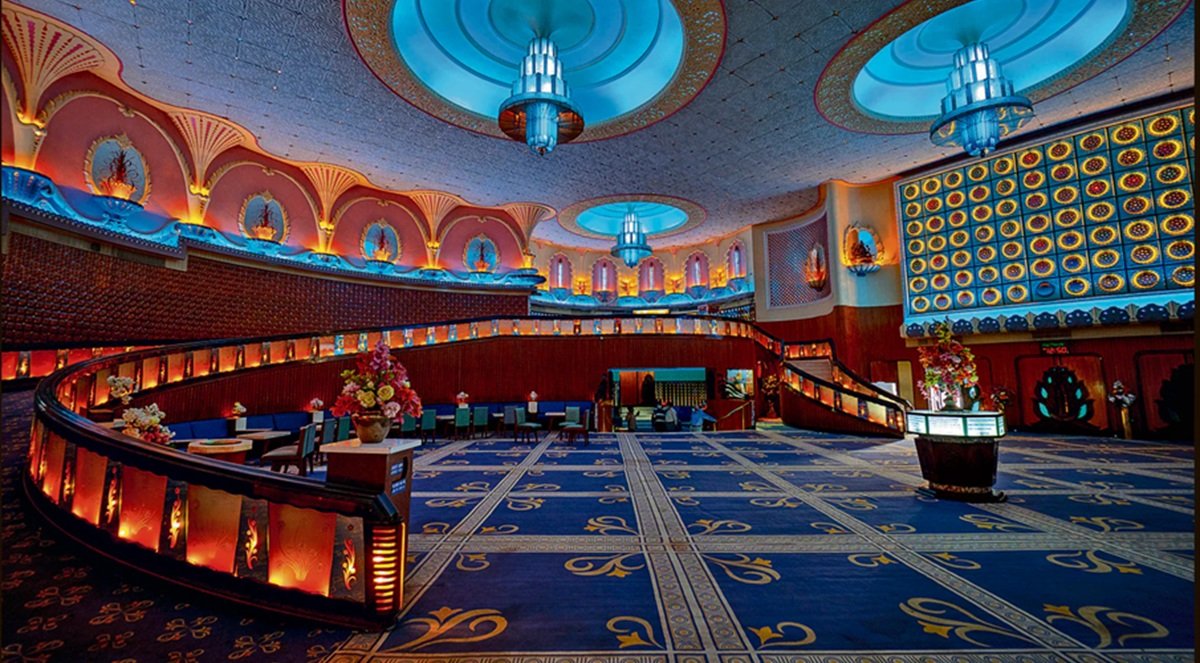
The status of cinema halls in India gradually (from 1913 till today) came at par with Hindu temples. Temples and cinemas are typical Indian ‘public spheres’ or public spaces which are always crowded with people. The entrance and exit gates of a temple or cinema hall are usually the same, especially in single-screen cinema halls. Crowds can always be seen at the entry and exit doors of both temples and cinema halls. The rush to get in, the long queues at the ticket windows as well as the quarrels of buying and selling of black tickets; all these activities can be easily witnessed. Some temples too, like cinema halls, have the graded ticket system or rates for the darshan (sight) of God. Thus, the Sociology of Cinema can learn a lot from the Sociology of Religion. As per Indian metaphysics, the temple (Cinemagriha or Cinema Hall) creates special conditions and effects in which one gets an opportunity to hear or see the symbolic or figurative description of the world (Leela) of the Lord. Circumstances are in the hands of destiny and controller of this destiny (director and writer) but everybody does not behave in the same manner under these circumstances. Everybody does not make a similar sense to these conditions. Each individual constructs his own meaning on the basis of his nature, self-conduct, background, training and desire-aspiration. Literally, everyone is alone even in the crowd, especially in a crowd inside a temple or a cinema hall.
Lights are switched off in the cinema hall before a film starts. In Western religious places, worship, prayer or other rituals are performed in the light. Therefore, a kind of adverse relationship can be construed between the darkness of the cinema hall and the light at the place of worship. An uncomfortable relationship persists, outside India, between film discourse and the cultural and religious discourse. On the other hand, the Western technology of cinema and the tradition of viewing films in the dark evolved into a smooth relationship with Indian Dharma (Cosmic Order) and worship from 1913 onwards. It is not irrelevant that India’s first feature film is Raja Harishchandra (1913) and Hollywood’s first film is The Great Train Robbery (1903).
According to experts of Hindu classical texts, there is darkness in the Sanctum Sanctorum of the temple so that the inner light of self awareness gets ignited in the devotee. Like the womb of the mother or like a grave or pyre, the way to go into the sanctum (in the form of a seed or as a father) and to come out (in the form of a child) is the same. The world’s first feature film was seen by the people of France in the hall of a Paris hotel called the India Salon. Just as Krishna was born in the darkness of a prison in the dark night of Krishna Janmashtami from the womb of Devaki but he grew up in the lap of Yashoda, in the same way, cinema was born in Western European countries like France but flourished in America (Hollywood), China, Japan and India.
Gradually, Hollywood films, with their better technology, craft and missionary spirit, made European filmmaking irrelevant and unattractive to European audiences and cinema halls. According to some European critics, Hollywood films are a cultural crusade launched against European Christianity by the Jewish, settled in America. On the other hand, for the general audience of India, the darkness of the cinema hall evokes the memory of the Sanctum Sanctorum of the temples. Moreover, the narrative structure of films in India follows the elements of epic dramas such as Ramayana, Mahabharata, Shrimad Bhagwad or Jataka tales.
Like the Indian worship system, our films also often have elements of songs and music. In every hero there is a reflection of Krishna and in every heroine there is a reflection of Radha or Gopi. Every Virahini (a woman suffering because of separation from her lover) sings the songs of Meera or the Gopis. Indian cinema is an extension of the traditional life of indigenous communities. However, this has not been done systematically or with plan; this has happened naturally; it has happened at the level of subconscious. On the contrary, the universities of the country or the English media have been getting seekers, instructions, guidance and nurturing or funding from the establishment by systematic means ever since the British Raj. From the times of the British Raj, the vibrant life of indigenous communities rooted in Indian cultural traditions of Desi (Indigenous) and Margi (Classical) have been viewed with a sense of contempt by the English educated ruling elite of India. On the other hand, Indian cinema looked at traditional culture and traditional people of India with a deep sense of admiration and empathy. Thus, Indian cinema has played a greater role in the preservation and promotion of the indigenous aspects of Indian culture. It has also brought to the fore unstable aspects of the indigenous customs and has evaluated them much more than the Indian state or Indian universities.