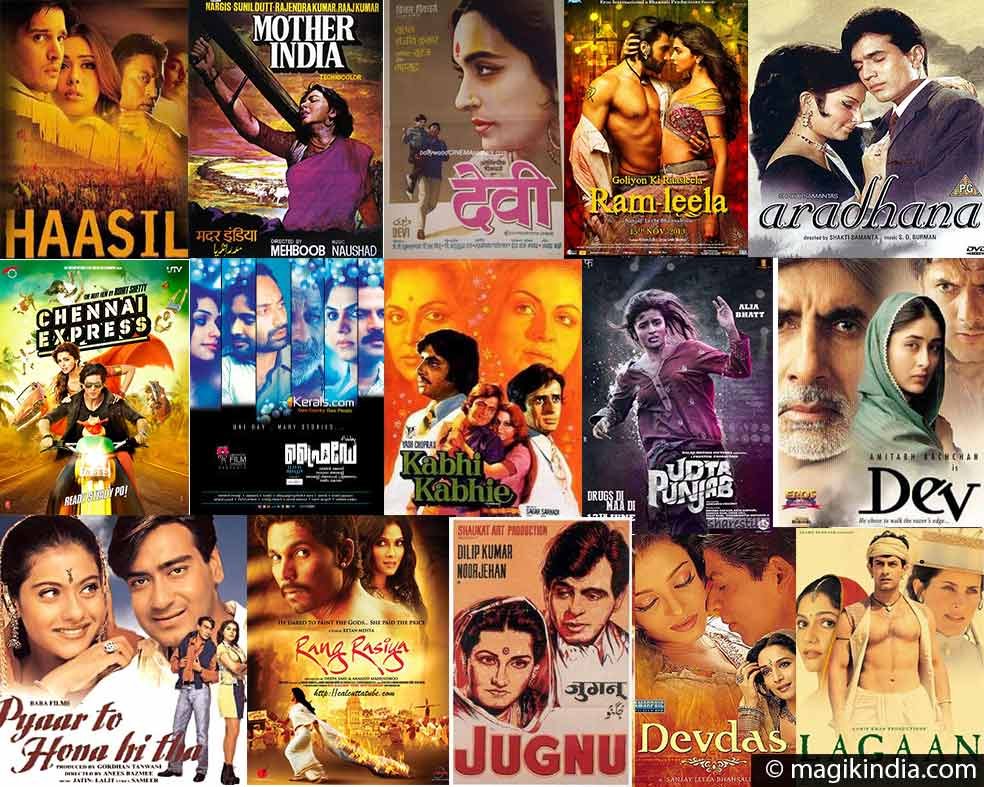
Most people get alarmed at first, when I say, “cinema is very important to understand, preserve and promote Indian culture.” For example, Mahatma Gandhi was against the cinema. The Vishwa Hindu Parishad and the RSS (Sangh Parivar) are also, by and large, against the cinema. There are other groups in India, who think that cinema pollutes Indian culture. It is a bad influence on Indian culture by displaying and promoting something negative like the bad habits, the bad manners and the bad attitudes of man on the celluloid. But in my opinion, cinema has played a very important role in the preservation, promotion and dissemination of Indian culture.
Cinema is a form of technology. Printing is also a form of technology. Indian society and Indian culture have always been oral in nature. Therefore, when print technology came in, it had a destabilising influence on Indian society at the beginning. But, when cinema came in, it gave an opportunity to express one’s views about Indian culture, even if they were not educated or not literate. The print technology is not friendly to illiterate and uneducated people.
However, there arises a contradiction here. As I have claimed earlier that up to the 18th century, India was one of the most literate, one of the most educated societies of the world, so why am I raising the question of illiteracy now? The reason is very simple. Our educational system, like the economic system, was destroyed by the British in India. It was done by them through two major attempts.
The first attempt was when Lord Cornwallis introduced ‘The Permanent Settlement’ in India. The British in the very beginning came to India as the East India Company for doing trade. But Lord Cornwallis, after colonising India, introduced the Permanent Settlement, which altered, changed and modified the legal ownership of land, rivers, mountains and forests. Before Lord Cornwallis’s Permanent Settlement, the land, the river, the mountain and the forest belonged to the local community and the state was entitled for a nominal tax. Indian education was not dependent upon the state up to 18th century because till 18th century, most of the villages in India earmarked or donated thirty percent of the local lands to the village temple. The village temple utilised these resources and was responsible for education, health services, religious services, guidance about agriculture, vocational training and mediation of nature, culture and divinity and the settlement of disputes in the villages. Therefore, by introducing permanent settlement, Lord Cornwallis claimed that the land, rivers, mountains, and forests belonged to the state; the control over these natural resources were given to some Indians, who were ready to cooperate with the East India Company and with the British Raj. As a result, a new class emerged in India. This new class was that of the ‘Zamindars’ and the ‘Contractors’. The zamindars and contractors were given the legal right to collect taxes on land, rivers, mountains and forests. Consequently, people’s legal rights to give 30% of the land to the temples were taken away. Hence, the self-financing scheme of the Indian temple was destroyed. In India, the temple was not only the custodian of education and health but also of arts and sciences. As a result, the spread and growth of education, health, R&D in agriculture and sciences like Ayurveda and Astrology (Jyotish Shastra), the Vastu Shastra and science and technology were adversely affected in India. Therefore, when Lord Cornwallis’s permanent settlement became a permanent feature of India, its education system was destroyed. Illiteracy and uneducated people became the defining feature of Indian society after the 18th century.
The second attempt was launched when two institutions, namely the Asiatic Society of Bengal under the leadership of William Jones and second was a project called The Sacred Books of the East under the editorship of Max Muller were founded in India. William Jones and Max Muller are regarded as Indologists. They tried to codify the Indian texts. They tried to translate the Indian text into English. However, translation was not something new to India. Many works of translation took place even during the medieval period. Indian sciences, Indian technologies and Indian philosophies were translated into Arabic and Persian, which then were routed to Europe through Arab and Persia. The historians have commented about the significant role the Muslims played in the Renaissance of Europe.
When Europe was under the spell of Christianity and the Catholic Church, the knowledge about the pagan Rome, pagan Greece and pagan Egypt was suppressed. There was not much knowledge about the science and technology of India and China then. When the Renaissance began, the Europeans tried to translate the Arabic and Persian texts, which were already the translations of Sanskrit text, Pali text, Prakrit text and Chinese text. Therefore, there is a historical genealogy of modern science which is rooted in the East. But the West was not content with the existing knowledge, so they innovated on this foundation. As a result, printing technology was discovered by the Europeans, primarily by the Germans. Therefore, the first printed book in the world is the bible.
As I have mentioned above, after the British Empire was established in India, they tried to print Indian text into English, under the leadership of William Jones and Max Muller. But at that time, very few Indians were educated and fewer Indians knew the English language. As a result, the society got internally divided between the masses and the elite. The elite were those who could speak, write and read English and the majority was the masses, who did not understand English. Masses used to conduct their life in Indian languages. Fortunately or unfortunately, English emerged as the language of learning, not only during British rule but also when we became an independent country in 1947. Almost all major educational institutions of India conduct their educational and research activities in the English language. If one does not know the English language, one cannot understand what is going on in the world of academia in India.
In contrast to the above mentioned development in the Universities in India, the cinema developed Hindi as the all-India language. It is a fact that cinema emerged in India in 1913, even though sun-screening of European cinema took place earlier. The first Indian who made a film in India was Dadasaheb Phalke. He made a film called Raja Harishchandra in 1913. During this time, the Indian freedom movement was going on and one of the most important leaders of the Indian freedom movement in 1913 was Bal Gangadhar Tilak. Dadasaheb Phalke was influenced by the views of Bal Gangadhar Tilak. He was a nationalist entrepreneur. He wanted to make an Indian film on an Indian theme. The film that he had in mind was ‘The Life of Jesus Christ’, which he had seen earlier and was influenced by it. Thus, it is a fact that cinema is a Western technology, a Western medium. Cinema, in India, is not an Indian invention. It is an adaptation of the western technology in Indian style and in the Indian context. But unlike the university system, the cinema in India, very soon discovered an all India language, that is, Hindi or Hindustani.
Cinema, in India, is the largest industry in the world. In India, films are made in more than 14 languages. To sum up, India produces a minimum 1000 films every year, whereas America or Hollywood produces only 250 films, at the maximum. India is the largest democracy and the second-most populous country in the world. Indian films are, by and large, very Indian in content, in packaging and in technology. Thus, Cinema gave Indians a common language, even though they take inspiration from the West.
Inferring from above, we can say that Indians, primarily the Indian masses, were ‘gunga’ (dumb) before 1931, as from 1913 to 1931 was a silent-era in Indian cinema. The first talkie film was ‘Alam Ara’ that was made in 1931 by Ardeshar Irani, a Parsi. From 1931 to 2011, Indian Cinema has produced and articulated Indian viewpoints and captured Indian culture in its changing dimensions. This contribution of Indian cinema is yet to be understood and appreciated by Indians as well as foreigners. Indian cinema is not studied systematically till now in India. It is only in Jawaharlal Nehru University that a course has been developed to understand Cinema and Culture in India.
As I have mentioned earlier, India became an oral society after the 18th century because the Indian education system was destroyed and destabilised. There were English schools, but only the elite could afford the expense of reading in the convent school. As a result, the Gurukuls and the Madrasas were adversely affected. When cinema came in, a large number of creative Indians flocked to make films. The early masters of Indian cinema, who made Indian classics, were either illiterate or semi-educated. For example, Mehboob Khan, a Gujrati filmmaker, who made Mother India (1957), was illiterate. He learned to sign only when he became very rich and he had to open a bank account and had to sign the cheque. Similarly, V. Shantaram, a filmmaker from Maharashtra was also illiterate, and so was his guru, Baburao Painter. Raj Kapoor, a filmmaker from Punjab, who made many good films like Shree 420 (1955), Barsat (1949), Awaara (1951), Bobby (1973), Satyam Shivam Sundaram (1978)and Prem Rog (1982), was a 9th class pass. As a result, cinema became so popular among masses in India.
There were five major centres of Indian cinema. One was Calcutta or Kolkata, second was Lahore, in Pakistan, third was Madras or Chennai, fourth was Mumbai or Bombay and fifth was, initially Kolhapur and later, Pune. Interestingly, these five centres were the capitals of different zones of India, ruled by the East India Company. Bombay was initially a Portuguese town, which was given to the British, as a matrimonial gift. Calcutta and Madras were developed by the British. Lahore was an Indian town in undivided Punjab. Kolhapur and Pune were Indian towns. Indian Cinema was adversely affected after the partitions of Bengal and Punjab into India and Pakistan. The Bengali cinema declined, when East Bengal became separate from West Bengal. It became uneconomical to make films in Bengali language because half of the audience went to East Pakistan, now known as Bangladesh. Similarly, when Punjab was divided, Lahore became part of Pakistan; so many filmmakers from Lahore and Kolkata shifted to Bombay.
Therefore, after 1947, Bombay became a more important centre for Indian cinema than the others. After the death of Dadasaheb Phalke, Kolhapur declined as a film centre and Pune became important. Later on, Pune people also shifted to Bombay. Basically, from now onwards, only two important centres of cinema remained in India—Bombay and Madras. Madras used to produce films not only in Hindi but also in Tamil, Telugu, Malayalam and Kannada. At that time, most of the major filmmakers of Hindi cinema came from non-Hindi speaking areas. Surprisingly, before the 1970s, no major filmmaker or film artist from Hindi heartland played an important role in Hindi cinema. The first Hindi speaking person in Bollywood was Amitabh Bachchan. Therefore, it is important to understand and highlight the fact that Hindi as a mother tongue of India is a creation of the Hindi film industry rather than the state of India.
Hindi was made the national language of India by the State of India, under the influence of Mahatma Gandhi. Jawaharlal Nehru made English the additional official language of India—initially, only for 10 years. That 10 year period expired in 1957, yet the official language of the Indian state remains English even today. It is shameful, but it is a fact. The three-language formula was adopted by the Indian government, assuming that Hindi will be accepted by the non-Hindi speaking states as the third language. But there arose an anti-Hindi movement in Tamil Nadu. This was because the Congress party in Tamil Nadu was challenged by DMK (Dravida Munnetra Kazhagam), under the leadership of C.N. Annadurai and M. Karunanidhi. Both Annadurai and Karunanidhi were film personalities. They were the scriptwriters. They were great fans of Tamil Cinema. Tamil Cinema played a very crucial role in the popularity and development of DMK and AIADMK in Tamil Nadu politics. Thus, we see that Tamil Cinema destroyed the social base of the congress party.
Hindi, as a mother tongue of India, is a creation of the Hindi film industry rather than the state of India. One of the main reasons for this to happen was S.S. Vasan, the owner of Gemini studio; S.S. Vasan, one of the founding fathers of Hindi cinema, considered it more prestigious to make a Hindi film than a Tamil film or Telugu film, because whenever he made a Hindi film, he used to direct it himself. But when he made a film in Tamil or Telugu, he used to hire directors for them. S.S. Vasan made Chandralekha in 1948, just one year after India’s independence. This is the first major film after partition, which became very popular at all India levels. The second most important filmmaker of Hindi cinema was Mehboob Khan, a Gujrati. The third important filmmaker of Hindi cinema was Sohrab Modi, again a Gujrati of Parsi lineage. The fourth important filmmaker of Hindi cinema was V. Shantaram, who used to make films both in Marathi and Hindi, even though he was a Marathi speaking person. The fifth most important Hindi filmmaker was Himanshu Roy, a Bengali; he was the owner of Bombay Talkies. Then, there was A.R. Kardar; he was a Muslim from Punjab of Pakistan.
In this way, we can see that people of Punjab, Bengal, Maharashtra, Gujarat and Tamil Nadu played a very important role in the making and in the development of Hindi cinema. As a result, we find that consciously an all India language and culture was developed in the Bombay film industry. One can notice that until very recently, the names of heroes and heroines of Hindi cinema did not display the caste surnames. Most of the heroes and heroines were known only by their first names. Therefore, an attempt was made to create a contemporary culture of India through the films.
Films not only preserved Indian culture of medieval times, but there was also a reform movement through cinema. The Bombay Talkies of Himanshu Roy was influenced by the Brahmo Samaj movement of Bengal. The people at Calcutta, for example, Debaki Bose and his followers like Bimal Roy were influenced by the freedom movement and the Swadeshi movement of Bengal. A.R. Kardar was a Sufi. He was followed by many people in Bombay cinema. There were Progressive Writers Association and Indian People’s Theatre Association (IPTA), which were communist groups. It tried to spread the ideology of the communist party through cinema. Then, there were Aryasamajis like B.R. Chopra.
The point I want to highlight here is that there were two currents which were going on in India. One was the political current, which influenced the Indian state. There were different political parties—the Communist Party of India, the Congress Party, Bhartiya Jansang, Swatantra Party and the Socialist Party, which tried to influence the political fortunes of India. Some of these political parties, for example, the DMK and Akali Dal had regional bases that tried to articulate the regional culture. However, the majority of the political parties in India had only political agenda and they were not very particular about the cultural agenda.
The cultural agenda was carried on by the writers of novels, stories, poems as well as by the cinema. The communists played a very important role in the print generated literature. After 1936, the Progressive Writers Association and the Janwadi Lekhak Sangh became very significant in the promotion of the communist literature in Indian society. As a result, those who did not like the communist’s ideology stopped reading literature and started watching films. It led to a great decline of literature and the great rise of Indian Cinema.
Therefore, if one desires to understand the salient features of Indian Culture from 1936 till date, one will have to watch Indian Cinema. Hence, the second current was the cultural current, influenced by Indian Cinema. India produces almost 1000 films per year. So, even if one watches one film per day, one can watch only 365 films in a year. Consequently, the film viewing in India is influenced by two channels. One is the informal channel, that is, mouth to mouth publicity. For instance, if one has watched a good film, he/she will tell their friends and neighbours to go and watch that film. And the second channel is that of the film reviews and critics. The film reviews are mostly written by the educated in India, who are either secularist or Marxist. Nevertheless, they criticise a film, which is neither secular nor Marxist. As a result, a class of parallel cinema or new cinema or progressive cinema or art films has been created, that is appreciated and eulogised by the film reviewers. These reviewers, generally, denigrate the popular cinema or the blockbusters. But only a small section of the Indian society reads a review to watch the film. The masses of the Indian society do not watch cinema on the basis of film reviews.
Film viewing is a very elaborate cultural affair for most of the Indians in the small towns as well as in the villages. Until the 1970s, the whole family used to go and watch a film in small towns and villages. It is a phenomenon that can be compared to that of going to the temple. It is also like going to a ‘Mela’ or fair. People used to get all dressed up in new clothes to go to watch a film. The film watching process was sort of a picnic excursion.
But from 1982 to 1989, there was a rupture in the film viewing culture. Since 1982, film viewing in India declined because colour television came to India and the era of television serials started. The first serial was Humlog. It was followed by Buniyad, Ramayana directed by Ramanand Sagar, Mahabharatha directed by B.R. Chopra, Chanakya, The Sword of Tipu Sultan, The Great Maratha, and so on. The screening of these television serials created a very interesting phenomenon in Indian culture. For instance, in the 1980s, when Ramayana and Mahabharatha were being telecast on Sundays, the roads used to become open and empty as nobody went on to the roads or to the market during their screening. They had unprecedented popularity.
Nonetheless religious films or films with religious messages are very popular in India even today, the reason being that the majority of Indians are very religious. One can easily observe that any city in India is divided into different areas, centred on a temple or a cinema hall.
Both temple and a cinema hall have a very striking similarity. There is a Garbhagriha (sanctum sanctorum) in the temple. The Garbhagriha is usually a dark place in the temple, where the icon of the main deity is located. It is in the innermost part of the temple, where sun rays do not fall and usually has no windows. Therefore, the darkness of the Garbhgriha of the temple is similar to the darkness of the cinema hall, when the film is being screened. In this darkness, one communes with the main characters on the screen. This is a communion that is very similar to the communion of the deity and the devotee in the temple. On the contrary, one does not switch off the lights, while watching the television.
Therefore, I have argued that Indian temples and Indian cinema are homologous. They are structurally similar. There is a temple of desire in the cinema hall. The religion in India, as I have said, is very different from the religion elsewhere. Indian religions emphasise harmony between the spiritual and the material. Indian gods are both aesthetic and erotic. For example, Lord Krishna and Lord Shiva are both erotic as well as aesthetic. This harmony and synthesis between eroticism and aestheticism is also depicted in the popular cinema of India. In this way, Indian cinema has played a very important role in the preservation, promotion and transformation of Indian culture from the late medieval period to the contemporary times.